There are proper stages to the process, like first the ideas are presented, teams refine them, research is done, large documents are drafted, and, this way, slowly, everything comes together to form a product. But something came up, snapped a finger, and changed how things work traditionally.
Yes, we are talking about large language models and how they walked in, switched on the lights, and showed everyone a faster way to build.
With the help of LLMS, teams are not starting with a blank page; instead, they get to start with already drafted documents, real insights, and prototypes that actually make sense. Discussion and research that took hours and weeks now takes as little time as your coffee takes to cool down.
And no, this isn’t magic at all. This is just a picture showing LLM product development becoming the new backbone of modern products.
If you are someone trying to understand what’s possible, how large language model development fits into real workflows, and helps organizations stay competitive. Let’s explore the world of LLM product development.
What LLMs Really Are and Why They Matter
Before we talk about how LLMs fit into workflows and it’s use cases, you need to understand what LLMs really are and what value they bring.
LLMs might sound like magic for teams, but they are really complex neural networks that are trained on an enormous pile of text, such as books, articles, documentation, forums, basically everything you can think of. This training allows them to understand patterns in language in a way a product team would understand patterns in use behavior.
To simply explain it, LLMS can read, write, analyze, and reason just the way teams do, but the differentiator is the speed they do it all; no team can match the speed of LLMs. This is why LLM product development adds great value to the organizations.
Why teams care so much about LLMs right now
They turn raw information into clean insights
They help product teams move from idea to output without delay
They simplify complex decisions with clear summaries
They give engineers, designers, and product owners a way to skip repetitive work
They can be molded into custom LLM solutions for niche challenges
They fit into existing systems without forcing you to rebuild everything
This combination of what LLM offers is the reason for its fast market growth. The large language model market size is forecast to reach USD 21.17 billion by 2030. It is being used by organizations of various industries like healthcare, finance, retail, education, and tech. Almost every industry is now leveraging LLMs for its everyday processes. No matter what the goals of the organization are, whether they want a smoother research process, quicker documentation, or faster prototyping, LLM development has become the go-to answer for all.
Industries where LLMs are already making their mark:
The healthcare teams use them to structure reports and support medical research
The retail industry uses them to write product descriptions and guide shoppers
The finance industry uses them to simplify legal documents and customer queries
The education industry uses them to create quizzes, summaries, and personalized study plans for students
After having a look at how widely this technology is being adopted in various industries, you must now have a better understanding of the bigger picture surrounding LLM development. And that we are not even talking about something futuristic, we are actually talking about a tech that is being leveraged in the present. As an organization, if you invest in LLM integration today, you will be able to gain a competitive advantage in the market.
Understanding LLM Product Development
Now that you have a clear understanding of what LLM product development really is and what value it brings, let’s have a look at what it actually looks like in day-to-day work.
In simple words, it is the practice of integrating large language models in the full product lifecycle. It is not a fancy add-on, or just a side experiment, but it is a full-fledged working part of the processes like research, planning, designing, building, and supporting digital products.
You can think of it as a tool that will entirely upgrade your workflow and processes; it won’t just polish the dashboard.
How LLMs fit into the product lifecycle
This is where things get interesting because LLMs are touching almost every stage of the product lifecycle. Let’s have a look:
LLMs don’t work on one single thing; instead, they strengthen the full chain of development. This is the reason why an LLM in product development is considered so powerful.
Two main ways companies use LLMs
1. LLMs as internal development tools
These LLMS that are used as internal development tools can be considered as those quiet helpers that are working behind the scenes. These tools can be used to make tasks that take up too much time very simple to handle. Let’s have a look at what they do:
Tools like Codex, Cursor, Replit, and other AI-driven systems are already helping teams move faster without compromising quality. This alone saves a lot of hours given to these tasks, which teams can give to other important tasks.
2. LLMs as embedded product features
This is the stage where LLMs become an actual part of the product experience. Let’s have a look at some examples:
Companies that are using the technology well aren’t just adding features; they are bringing a positive change in their value proposition. As an organization, as soon as an LLM feature becomes the reason users choose the app, they step into the generative AI product development area.
Why companies are taking this seriously
You might think that companies are using this technology just to come across as innovative, but that’s not the reality. Let’s have a look at why they are doing it:
LLM development holds the power to shift the energy of the teams from just getting things done to an attitude of creating things that actually matter.
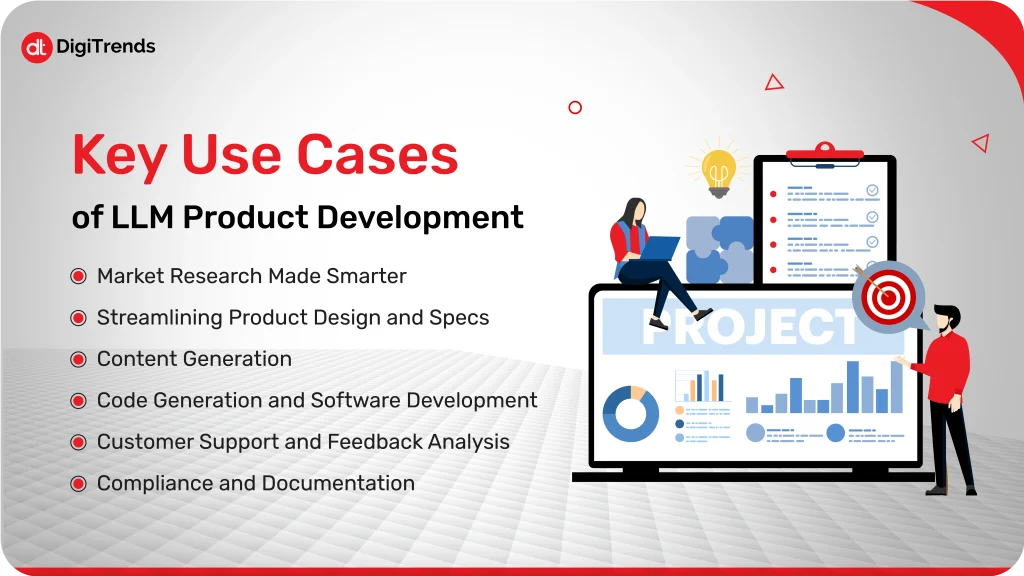
Key Use Cases of LLM Product Development
By now, you must also agree that LLM product development is not just a hype word. It has practical applications across every stage of a product’s life. Now, let’s have a look at the most impactful ways teams are using large language model development to get real results.
1. Market Research Made Smarter
We all know that every product is backed by plenty of research, as the research is the whole foundation of a product. Traditional market research is done by long surveys, interviews, and hours of summarizing the data. Let’s see how LLMs change that process for the better:
Scan thousands of documents, reviews, or forums to identify trends
Highlight gaps in competitor products
Summarize key insights for stakeholders in minutes
Suggest potential opportunities for new features
With the help of LLMs in market research, product teams can have a clear understanding of what users need, instead of trying to evaluate what might work. This makes the process faster and more efficient.
2. Streamlining Product Design and Specs
When you have the insights, it takes a lot of time to analyze them and then come to a decision on what the further actions should be, which is very time-consuming too. Let’s have a look at how LLM development helps in this process:
Creating draft product requirement documents (PRDs) from user stories or prompts
Checking specs for inconsistencies or gaps
Suggesting solutions based on historical bugs or known issues
All this helps in reducing the back-and-forth between designers, engineers, and product managers, and they can easily focus on the creation of the product instead of rewriting or going through long documents.
3. Content Generation
LLMs can also help with content generation, making the process easy for marketing teams. Let’s have a look at what it can do for marketing and content teams:
Write blogs, newsletters, or ad copy
Generate social media posts with the right tone and target audience in mind
Produce images, simple infographics, or memes using generative AI tools
Draft internal manuals or product guidelines
This is the perfect example of how LLM is not only beneficial for internal teams, but it also helps in easing the process for external users.
4. Code Generation and Software Development
The teams that get the most boost out of large language model development are developers. Let’s have a look at what it can do for developers:
This helps development teams in focusing on solving other complex problems, while LLM can handle the small repetitive tasks that take up all the time.
5. Customer Support and Feedback Analysis
All companies have to deal with problems like high ticket volume or repetitive queries. LLMs can also help solve this challenge. Let’s have a look at how:
Automating answers to common questions
Analyzing customer feedback to highlight actionable insights
Detecting patterns in complaints before they escalate
As an organization, if you are using LLMs to support your systems, you can successfully create a system that provides a faster and smarter service to your customers, and you don’t even have to overwork your teams or hire more workers for it.
6. Compliance and Documentation
LLMs can be really beneficial for highly regulated industries like healthcare and finance. Let’s have a look at how:
Automate creation of policies, audits, and certifications
Translate complex legal or technical language into plain text
Custom LLM solutions make sure that the organization can save time, reduce any chances of errors, and maintain compliance.
When LLM product development is done right, it touches every part of the development process, including launching and supporting a product. It not only brings speed to the process, but it also brings intelligence and helps in making confident decisions for all the teams.
Implementing LLM Product Development in Your Workflow
Now that you know the use cases of LLMs, you must also understand how they are implemented successfully. And no, it does not work as you must imagine it; it is not like dropping another AI tool into the workflow and waiting for it to work. Implementation of the LLM product development will require clear planning, the right setup, so you will first have to set your goals and then dive into it.
Let’s have a look at what the appropriate approach for implementation is:
1. Identify High-Impact Use Cases
Start by asking: Where will LLMs bring the most value? Look for areas that are:
Doing discovery sessions with product, design, and support teams helps you map pain points and validate where LLM integration makes the biggest difference.
2. Choose the Right LLM Setup
Not all LLMs are created equal. Decide based on your product’s needs:
Pre-trained APIs (like GPT-4 from OpenAI or Claude from Anthropic)
Fine-tuned custom models built from your own datasets
Open-source LLMs like LLaMA or Mistral
Working with an LLM development company can help you select the model that balances performance, security, and cost.
3. Start Small with Prototypes
Don’t try to overhaul your entire workflow at once. Build small prototypes to:
Test LLM outputs
Measure time saved on tasks
Collect quality feedback from the team
This iterative approach lets you refine the model’s role without disrupting ongoing work.
4. Integrate Into Existing Tools
The smoother the integration, the faster the adoption will be. Consider embedding LLMs into platforms your team already uses:
Slack or Zoom for quick summarization
Notion for documentation
IDEs like Visual Studio Code for code assistance
Seamless integration ensures teams use LLMs without needing to overhaul their current tools.
5. Build Governance and Monitoring
As LLM product development scales, guardrails become crucial:
Validate outputs regularly
Audit prompts and responses
Track usage, errors, and performance
This keeps the model reliable and ensures compliance with internal and industry standards.
6. Train Your Team
Finally, make sure your team knows how to work with LLMs effectively:
Writing clear prompts
Fine-tuning outputs for specific goals
Understanding limitations like hallucinations or outdated knowledge
Treating the LLM as a collaborator, not a replacement
A well-trained team turns large language model development from a tool into a true productivity engine.
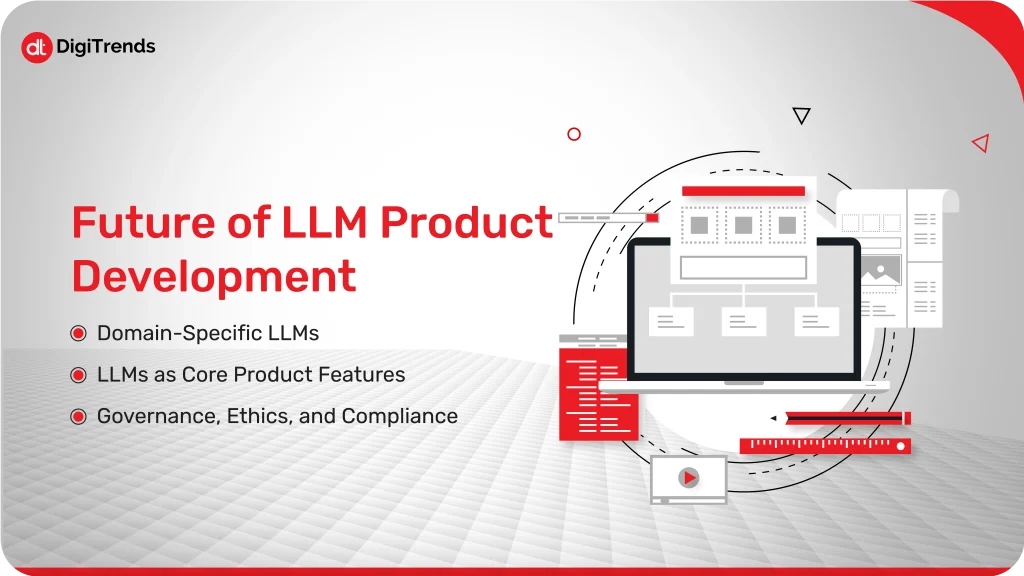
Future of LLM Product Development
The world of LLM product development is evolving fast. What’s happening today is just the beginning. As models get smarter, teams will find even more ways to integrate large language model development into their products and processes.
1. Domain-Specific LLMs
Generic LLMs are powerful, but specialized models are becoming the norm. Healthcare, legal, finance, and other industries are creating LLMs trained on domain-specific data. These models outperform general ones and provide highly accurate, actionable insights.
2. LLMs as Core Product Features
We’ll see more products built around LLM capabilities, not just using them in the background. From AI writing assistants to intelligent chatbots and advanced analytics tools, LLMs are becoming central to user experiences. Companies embedding AI features early gain a competitive edge in innovation and user engagement.
3. Governance, Ethics, and Compliance
As LLMs grow in influence, companies must prioritize ethical AI use, transparency, and compliance. Models must be monitored for bias, accuracy, and reliability. Businesses that establish clear guidelines and governance for their LLM integration will build trust with users and stakeholders alike.
The future of product development is AI-driven, and those who embrace generative AI product development now will lead the next wave of innovation.
Conclusion
LLM product development is no longer a “nice-to-have”; it’s shaping how products are built, launched, and supported. From speeding up research and code generation to automating content and enhancing customer experiences, large language models are transforming every stage of the product lifecycle.
Companies that adopt large language model development early gain a clear advantage: faster timelines, smarter insights, and more innovative features. By combining the right models, seamless LLM integration, and practical workflows, teams can focus on solving meaningful problems instead of repetitive tasks.
At DigiTrends, we can help businesses harness this potential. Whether it’s deploying custom LLM solutions, embedding AI features into products, or streamlining workflows, our goal is to make generative AI product development practical, measurable, and impactful. The future belongs to teams that move fast, experiment, and use LLMs to their fullest.
Frequently Asked Questions
LLM product development is the process of integrating large language models into the product lifecycle to improve research, design, engineering, and customer interactions. It helps teams work faster, make smarter decisions, and deliver products with more intelligence and efficiency.
Businesses can integrate LLMs by embedding them as product features, using them for internal tools like research or code generation, or fine-tuning custom LLM solutions to meet specific business needs. Choosing the right model and workflow is key to successful integration.
LLMs are used for market research, content creation, code generation, customer support automation, and compliance documentation. They streamline repetitive tasks, enhance insights, and improve overall productivity across the product lifecycle.
Custom LLM solutions are fine-tuned on specific datasets or business requirements, making them more accurate and relevant than generic models. They address niche problems, improve decision-making, and deliver outputs tailored to the company’s products or industry.
Challenges include ensuring data privacy, monitoring model accuracy, avoiding bias, setting governance protocols, and training teams to use LLMs effectively. Planning and oversight are essential for reliable and ethical deployment.
Submit Your Message
Author :Muhammad Ishaque
I’m a dedicated SEO specialist who propels brands to new heights of online visibility and growth through digital strategies and analytical insights.
Recent Blogs
February 17th, 2026
Customer Experience Automation in 2026: How AI is Transforming CX Strategy
Explore how customer experience automation is used to fulfill modern customer demands, how AI helps in transforming CX strategy, key CX automation tools, real-world examples, and more.










 02 December 2025
  4 months ago
  172 Views