



Top 11 Healthcare App Developers in the USA: A 2026 Guide
Have a look at the top 11 healthcare app developers in the USA in 2026 and what makes them stand out.
Continue Reading
We build AI-powered software solutions designed to transform your vision into powerful, results-driven applications.

Providing Avant-Garde Mobile App Solutions.
Powerful apps made for the Apple ecosystem
Scalable apps built for android
Single codebase apps that work across platforms
Efficient apps built using React Native
High-performance apps made using Flutter
Providing Bespoke Mobile Game Development Services.
Delivering Innovative And Avant- Garde AR Solutions.
Our VR Development Services Allow Interaction With Simulated Surroundings.
Customised mobile apps for your Shopify shopfront.
Web Development Services With A Stellar Record Of Excellence.
Providing Web Design Services For All Industries.
Offering Custom And Robust PWA Solutions.
Bespoke E-Commerce Solutions For All Industries.
An Exceptional Success Record In CMS Development Services.
Customised software solutions to match corporate requirements.
Providing Business With Bespoke MVP Development Solutions.
DigiTrends Produces Essential Custom Software Solutions.
Transforming Brands With Innovative Digital Marketing.
AI-Powered Solutions. Wide-Ranging Industries. From finance to healthcare, our intelligent technologies drive innovation across every sector.


Revolutionizing Financial Services with Innovative Technology Solutions
Developing digital software to upgrade healthcare
Innovating learning experience with technology
Helping you step up your advertisement game
Reshaping automotive business experiences with tech
Transforming Real Estate with digital solutions
Digitalizing hospitality management with e-solution
Transforming the retail industry for with digital transformation
Transforming data into intelligent insights that drive innovation across multiple industries.


Delivering exceptional services across different cities, innovating here; and thriving everywhere!


Seek exceptional mobile app development in Delaware.
Where creativity and tech unite for innovation.
Seek advanced mobile app development in LA.
Unleash your business with our innovative mobile apps
Step into Austin’s mobile innovation hub.
Each business is unique; tailored approaches for all.
Leaders of mobile app development in Saudi Arabia
Meet the best app developers in Dubai
Meet the Nordik mobile development experts

 05 September 2025
 7 months ago
 174 Views


Launching a mobile app startup today is both an opportunity and a challenge. The global mobile application market size is expected to be valued at USD 1,103.48 billion by 2034. Thousands of apps are launched every month, and most fail to gain traction. The difference between those that scale and those that disappear comes down to strategy.
A well-designed mobile app startup strategy helps founders and executives avoid costly mistakes, reduce risk, and capture growth faster. It shapes everything from product design and user experience to funding, marketing, and scaling. For corporate leaders, the real question is not whether to enter the mobile app market, but how to do it intelligently.
This guide unpacks what matters most: planning, development, go-to-market, scaling, and growth tactics. It’s built for decision-makers who want results and are considering the right partners, such as DigiTrends, to make it happen.
The startup ecosystem is unforgiving. Recent research shows 34% of startup failures are due to a poor product-market fit, while other startups collapse due to weak business models. Without a strong mobile app startup strategy, your project is exposed to both risks.
A strategy provides three critical advantages:
Alignment with Market Demand: Apps succeed when they solve real problems. Strategy ensures you’re addressing the right audience with features that matter.
Operational Clarity: Teams with a documented roadmap are twice as likely to hit their milestones compared to those working reactively.
Investor Confidence: A startup with a clear go-to-market plan and user acquisition model attracts capital faster. Investors bet on structured execution, not ideas alone.
Executives and founders know the cost of wasted resources. That’s why building a strategy upfront is non-negotiable.

Planning is where successful ventures separate themselves from short-lived experiments. Here’s how to build the foundation.
Research is where everything starts. Who are your users, and what pain points are they trying to solve? Use surveys, competitor analysis, and behavioral data to shape a clear picture of your audience.
A study by Forrester found that every dollar invested in UX brings $100 in return, a staggering 9900% ROI. That’s proof that understanding users isn’t just good practice; it’s a growth engine.
Executives often think in terms of KPIs, downloads, engagement, retention, and revenue. Your mobile app startup strategy should define these metrics early. Are you targeting enterprise adoption? Consumer engagement? Subscription revenue? The direction dictates product design and marketing.
Your revenue model shapes how you grow. Freemium, subscriptions, ads, or enterprise licensing all come with trade-offs. The difference is in how they drive value. Subscriptions don’t just bring in recurring payments; they deepen the relationship over time. In fact, companies see customer lifetime value climb by 230% compared to one-time purchases. That kind of lift is hard to ignore when you’re planning for sustainable growth.
Building an MVP reduces cost and time to market. Instead of spending a year building features users may never want, focus on the core. Dropbox and Airbnb both validated their businesses through MVPs. An MVP also allows early testing of your mobile app development for a startup plan before scaling.
This is where the MVP mobile app launching becomes critical. By putting a lean product into real users’ hands, you gather the insights necessary to refine functionality, improve usability, and validate monetization models. It prevents you from wasting capital on untested assumptions.
A startup without capital is a startup without oxygen. Whether through angel investors, venture capital, or corporate partnerships, funding must align with projected growth. Having a structured plan makes fundraising far easier.
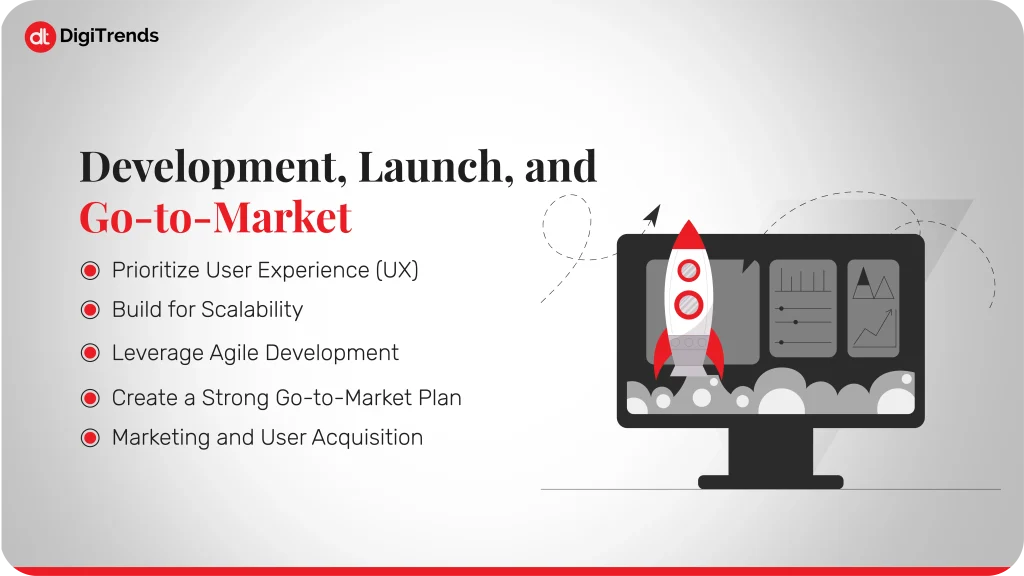
Once planning is solid, execution begins. This stage determines whether your vision becomes a viable product.
A study found that apps with poor usability risk losing 70% of users within the first week. Invest in clean design, intuitive navigation, and reliable performance. Your mobile app development for startups plan must treat UX as the foundation, not an afterthought.
Your architecture should support scaling from thousands to millions of users. Cloud infrastructure, modular code, and API integrations are critical. Apps that scale seamlessly are positioned for sustainable growth.
Agile reduces development cycles, incorporates feedback faster, and cuts risk. 47% of Agile organizations report improved customer satisfaction.
Your launch is as important as your build. Use these tactics for a successful go-to-market mobile app approach:
Pre-launch buzz through targeted content and PR.
Beta testing with early adopters.
Partnerships with influencers or corporate players in your industry.
A strong launch not only builds awareness but accelerates adoption. Consider how TikTok entered Western markets by pairing influencer partnerships with aggressive ad campaigns. That level of strategic go-to-market execution can determine whether your app scales globally or fades locally.
Acquiring users isn’t cheap, which makes efficiency critical. Your strategy should focus on tactics that deliver measurable returns:
App Store Optimization (ASO)
Paid advertising campaigns
Content marketing and SEO
Referral programs
Every effort should tie back to ROI. A campaign without clear outcomes isn’t just ineffective; it’s wasted capital.
Growth is the test of any mobile app startup strategy. Once you’ve launched, how do you scale sustainably?
Successful startups rely on analytics to refine their offerings. Monitor churn rate, daily active users (DAU), and lifetime value (LTV). Apps that adapt to insights are better positioned to survive and grow.
Acquiring new users is five times more expensive than retaining existing ones. Push notifications, loyalty programs, and personalized content boost retention.
Partnerships accelerate distribution. A startup app growth tactic is to align with larger enterprises for co-branding or platform integration. For example, Spotify partnered with Facebook to embed music sharing directly within social feeds, massively expanding reach.
The best apps evolve. Regular updates, new features, and timely bug fixes show commitment. A stagnant app quickly loses relevance. Apple’s constant iteration on iOS is a lesson in how small, consistent improvements create loyalty.
Prepare for exponential growth. Apps that scale smoothly avoid downtime, protect brand reputation, and secure long-term trust. Investing early in scalable infrastructure pays dividends later.
Even the strongest executives need reliable partners. That’s where DigiTrends comes in.
We specialize in mobile app development for startups with strategies that take you from concept to market leadership. Our expertise covers:
Whether you’re navigating MVP mobile app launching, building a roadmap for scaling, or applying proven startup app growth tactics, our team provides the insights and execution capabilities needed to win.
Partnering with DigiTrends means you don’t just build an app, you build a business asset designed to thrive.
A winning mobile app startup strategy is not just about building an app. It’s about aligning with real market needs, building a scalable product, launching with precision, and growing with discipline. For founders and executives, the opportunity is massive, but so is the risk of getting it wrong.
That’s why the smartest move is to work with an experienced partner. DigiTrends helps you design, build, and scale apps with a strategy that works in the real world. Whether you’re preparing for an MVP mobile app launch, designing your go-to-market mobile app plan, or applying proven startup app growth tactics, DigiTrends ensures your business moves forward with confidence.
If you’re serious about turning your idea into a sustainable business, now is the time to take the next step.

Have a look at the top 11 healthcare app developers in the USA in 2026 and what makes them stand out.
Continue Reading
Explore the mobile app marketing trends in 2026 that are important for an app to grow in this market.
Continue Reading

Explore an effective roadmap for custom application development that leaders need to understand, plan, and implement.
Continue Reading

Explore what Proof of Concept (PoC) in software development is, how it benefits teams in making better decisions, and how it works.
Continue Reading

Explore which delivery app pays the most in 2026 and how the top platforms combine smart technology and incentives to keep drivers earning more.
Continue Reading
DigiTrends has been officially recognized by Techreviewer.co as one of the Top Financial App Development Companies for 2025.
Continue Reading