



Top 11 Healthcare App Developers in the USA: A 2026 Guide
Have a look at the top 11 healthcare app developers in the USA in 2026 and what makes them stand out.
Continue Reading
We build AI-powered software solutions designed to transform your vision into powerful, results-driven applications.


Providing Avant-Garde Mobile App Solutions.
Powerful apps made for the Apple ecosystem
Scalable apps built for android
Single codebase apps that work across platforms
Efficient apps built using React Native
High-performance apps made using Flutter
Providing Bespoke Mobile Game Development Services.
Delivering Innovative And Avant- Garde AR Solutions.
Our VR Development Services Allow Interaction With Simulated Surroundings.
Customised mobile apps for your Shopify shopfront.
Web Development Services With A Stellar Record Of Excellence.
Providing Web Design Services For All Industries.
Offering Custom And Robust PWA Solutions.
Bespoke E-Commerce Solutions For All Industries.
An Exceptional Success Record In CMS Development Services.
Customised software solutions to match corporate requirements.
Providing Business With Bespoke MVP Development Solutions.
DigiTrends Produces Essential Custom Software Solutions.
Transforming Brands With Innovative Digital Marketing.
AI-Powered Solutions. Wide-Ranging Industries. From finance to healthcare, our intelligent technologies drive innovation across every sector.


Revolutionizing Financial Services with Innovative Technology Solutions
Developing digital software to upgrade healthcare
Innovating learning experience with technology
Helping you step up your advertisement game
Reshaping automotive business experiences with tech
Transforming Real Estate with digital solutions
Digitalizing hospitality management with e-solution
Transforming the retail industry for with digital transformation
Transforming data into intelligent insights that drive innovation across multiple industries.


Delivering exceptional services across different cities, innovating here; and thriving everywhere!


Seek exceptional mobile app development in Delaware.
Where creativity and tech unite for innovation.
Seek advanced mobile app development in LA.
Unleash your business with our innovative mobile apps
Step into Austin’s mobile innovation hub.
Each business is unique; tailored approaches for all.
Leaders of mobile app development in Saudi Arabia
Meet the best app developers in Dubai
Meet the Nordik mobile development experts

 27 January 2026
 2 months ago
 149 Views


Ever wondered what could be the fastest way possible for an organization to lose time and money while developing a product?
Well! When you jump straight into development without first analyzing whether an idea is technically feasible, scalable, or even worth the investment, you’re essentially building a software product without proper validation.
This is exactly where PoC (Proof of Concept) comes in.
With Proof of Concept, teams can test their ideas early, which helps reduce risk and make better decisions. They don’t need to commit to any serious resources before being sure about it.
Thinking of the benefits of PoC in software development? To answer this, we can say that sometimes software does not fail because of poor execution; it fails due to assumptions not being tested long before diving deep into development. It is important for teams not to operate on assumptions that a feature will work, a system will scale, or a technology will integrate smoothly, and to avoid this, Proof of Concept exists.
Explore what Proof of Concept in software development is, how it benefits teams, and how it works.
A Proof of Concept is an initial test that checks if a specific idea or solution can work. It helps confirm whether the concept can become a real product before investing significant resources. PoCs are especially useful when dealing with new or untested technologies, as they ensure the technical basis is strong and dependable.
Key elements of a PoC include:
Signs that You Need to Use a PoC:
Example: An organization planning to adopt blockchain for secure transaction management may begin with a PoC to test whether the technology can manage its expected transaction volume and data requirements.
As discussed before, Proof of Concept exists to reduce any uncertainties and get rid of assumptions that can fail the project. Software projects often involve new frameworks, integrations, or complex logic. Without validation, these elements become risks.
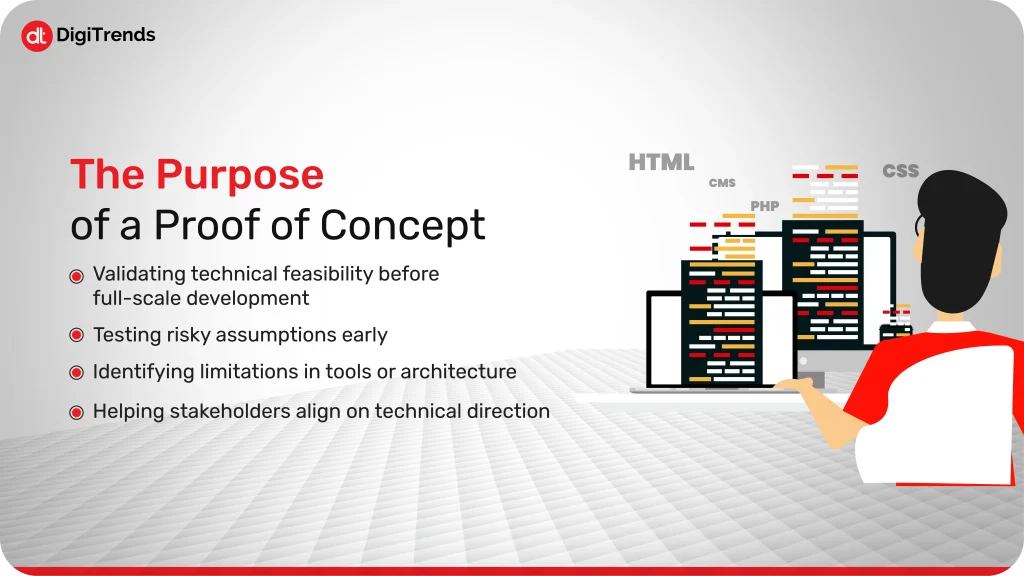
The main purpose of POC in software development includes:
A PoC will help you turn all your assumptions into evidence with which you can make better decisions.
There are a variety of Proof of Concept metrics in the software development industry. Let’s have a look at the three main types that are frequently used.
Proof of Technology is used to test if the technology will actually work before full development. You can think of it as checking the foundation before building the house. It helps in getting to know the technical risks involved and how different features would work together.
Steel thread is a way of connecting design, technology, and business logic in a simple way that can actually show how everything will fit together. Think of building some of the main screens to figure how the full flow would be like.
A pilot project is an early working version of the project that is shared with actual users. Companies often go with pilot projects to get feedback, validate their ideas, and make improvements, which helps them earn investor confidence. You can think of it as a run test before launch.
This is where many teams get confused. While these terms are often used interchangeably, they serve different purposes.
A PoC vs prototype vs MVP comparison looks like this:
Using the wrong approach at the wrong stage leads to wasted effort. When feasibility is uncertain, a PoC should always come first.
The benefits of PoC in software development go far beyond basic technical validation. A well-executed Proof of Concept helps teams make smarter decisions early, when changes are still affordable.
When teams test their ideas on a small scale, they get the upper hand in discovering any technical limitations, challenges they can encounter during integration, or performance issues before full development begins. This saves costs by reducing costs on hefty changes and avoiding committing to ideas that are not feasible.
When the stakeholders have proper evidence of what is working and what is not, they can easily review the outcomes of their decisions. This saves time on unnecessary opinion clashes over different assumptions and ideas, making it easier to decide whether to move forward, pivot, or stop entirely.
A PoC shows what is realistically possible with the chosen technology. It highlights what needs refinement and what should be removed from the scope. This clarity helps product teams plan roadmaps more accurately.
When engineers, product managers, and business leaders see working results, alignment improves. Everyone understands the technical boundaries and potential of the idea, which leads to stronger collaboration.
A successful Proof of Concept is not rushed or unstructured. It follows a clear PoC step-by-step process designed to validate feasibility, not build a full solution.
Start by identifying the exact problem the POC must address. The scope should be narrow and focused on one core question. A vague scope leads to vague results.
List the technical risks and unknowns. This may include system performance, third-party integrations, data handling, or security constraints. These assumptions define what the POC needs to test.
Choose frameworks, platforms, and tools that closely match the intended production environment. The goal is realistic validation, not experimentation with unrelated technologies.
Create only what is required to validate feasibility. This is not the place for polished interfaces or complete workflows. Keep the build lightweight and purpose-driven.
Run tests against defined success criteria. Document outcomes clearly so stakeholders can understand what worked, what didn’t, and why.
This structured approach is how POC works in software development when the goal is informed decision-making.
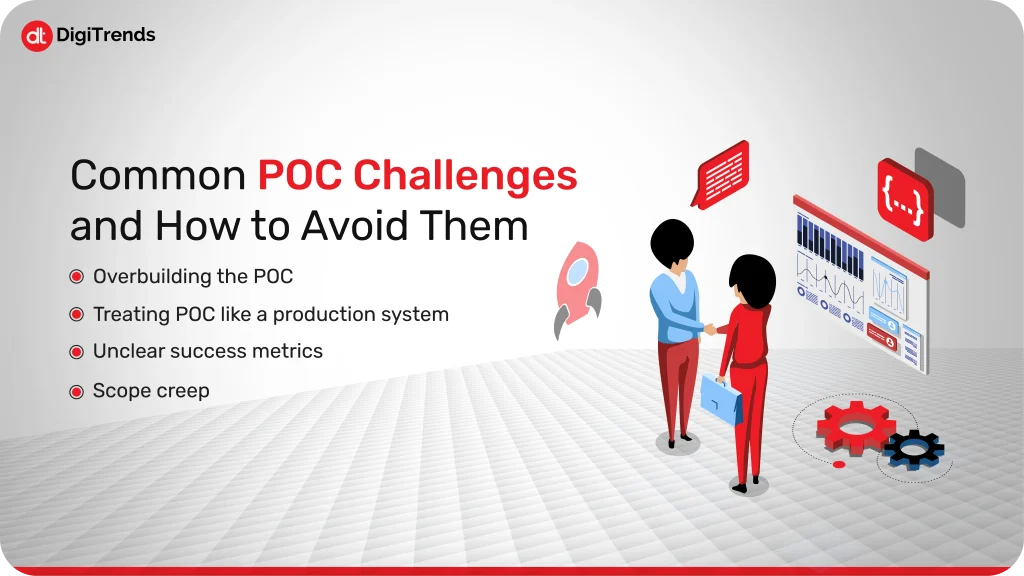
A Proof of Concept is meant to answer specific technical questions. Problems start when teams forget that purpose. Below are the most common POC challenges and how to avoid them.
One of the biggest mistakes teams make is building more than necessary. A POC does not need full features, refined logic, or edge-case handling. Its only job is to validate feasibility.
To avoid overbuilding, define a strict scope at the start. Decide exactly what the POC needs to prove and stop once that goal is met. Anything beyond that belongs in later development stages.
A PoC is not meant to meet production standards. It does not need full security hardening, scalability optimization, or a clean architecture.
When teams treat a PoC like a production system, timelines stretch, and costs increase without adding value. The solution is simple. Build just enough to test the idea, not enough to launch it.
Without clear success metrics, a PoC becomes subjective. Stakeholders may disagree on whether it worked, even if the implementation is complete.
Define success metrics before development starts. These metrics should be measurable and tied directly to the problem being tested, such as performance thresholds, integration reliability, or response times.
Scope creep happens when new ideas keep getting added during the PoC phase. Each addition may seem small, but together they dilute focus and delay results.
To prevent scope creep, lock the scope early and resist changes unless they directly impact feasibility. If a new idea is valuable, document it for future phases instead of adding it to the current PoC.
PoCs are used across industries to validate ideas before large investments.
In SaaS platforms, a PoC helps test scalability, performance under load, and multi-tenant architecture before launching full development.
For mobile applications, a PoC is often used to validate backend logic, API performance, or third-party integrations such as payments or analytics.
In enterprise systems, PoCs assess compatibility with legacy systems, the feasibility of data migration, and security constraints.
In AI projects, a software idea validation PoC is essential. It helps teams test data quality, model accuracy, and processing feasibility before committing to full AI implementation.
As an experienced software development company, we understand that turning ideas into products isn’t just about writing code; it’s about knowing when to validate, when to test, and when to scale, and we understand how tricky it can be sometimes.
That’s where DigiTrends comes in to lift off the burden. We help founders and decision-makers navigate the PoC and MVP stages with the right balance of speed and strategy.
Our team is highly focused on reducing risk while keeping your product vision intact, whether it is validating technical feasibility or building market-ready MVPs. Partnering with DigiTrens as your software development partner will help you move forward with clarity, confidence, and a product that’s built on real-world validation, not guesswork.

A Proof of Concept is more than just a technical exercise; it’s a smart strategy to validate ideas before committing time and resources. By identifying risks early, testing assumptions, and providing clear results, a POC helps teams make informed decisions, reduce costs, and avoid costly mistakes.
When done correctly, POC in software development builds confidence, aligns stakeholders, and sets the stage for successful product development. If there’s any uncertainty about feasibility or technical challenges, investing in a POC is always worth it; it turns assumptions into evidence and guides your next steps with clarity.
Have a look at the top 11 healthcare app developers in the USA in 2026 and what makes them stand out.
Continue Reading

Explore the mobile app marketing trends in 2026 that are important for an app to grow in this market.
Continue Reading
Explore an effective roadmap for custom application development that leaders need to understand, plan, and implement.
Continue Reading
Explore how to choose a software development company that will not just provide what you ask for but also align perfectly with your goals.
Continue Reading

Explore which delivery app pays the most in 2026 and how the top platforms combine smart technology and incentives to keep drivers earning more.
Continue Reading
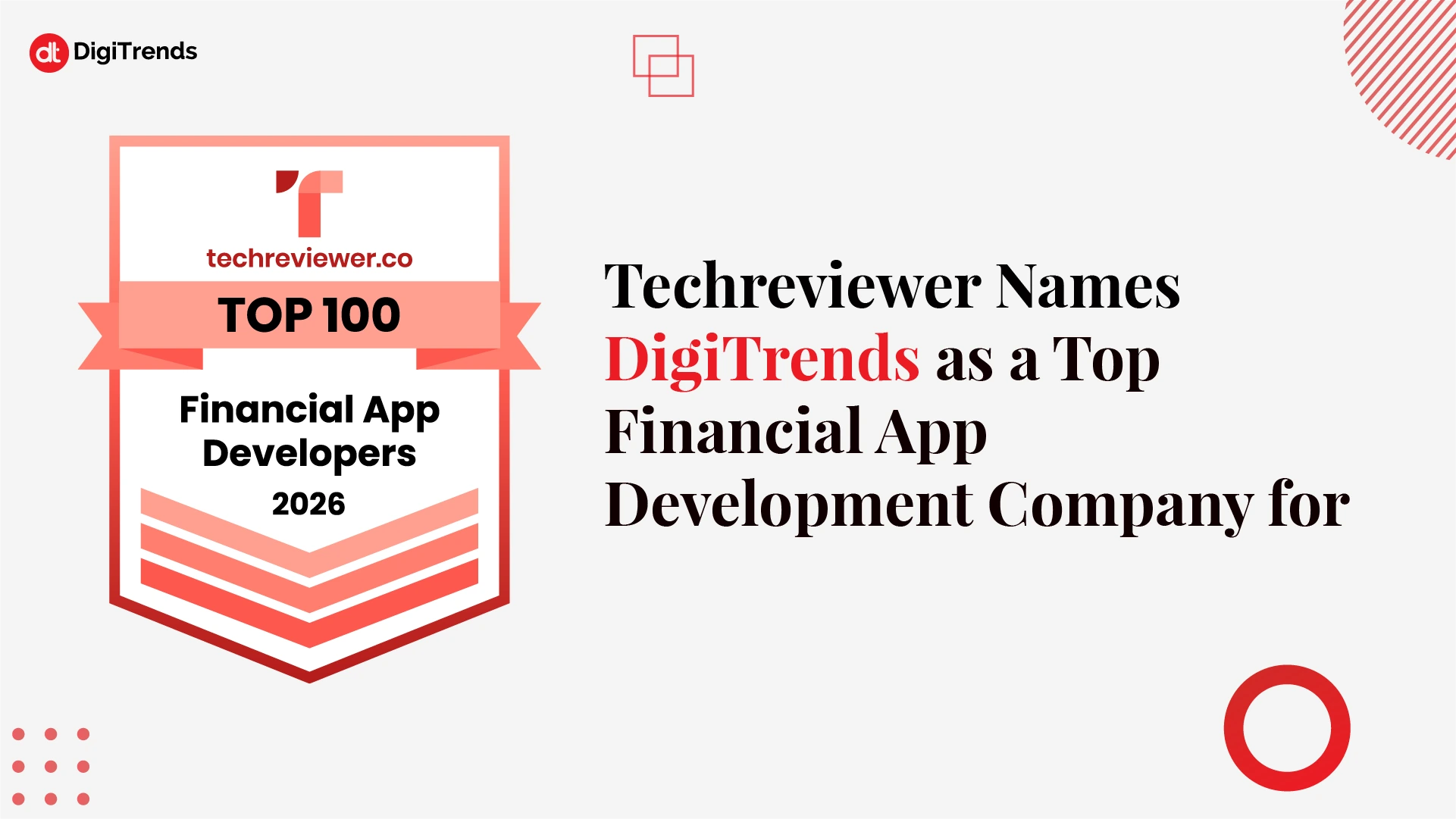
DigiTrends has been officially recognized by Techreviewer.co as one of the Top Financial App Development Companies for 2025.
Continue Reading