



Why Arabian Education App Development Is Gaining Serious Momentum
Success in Arabian education app development requires more than coding an app. Explore the education framework and regulatory environment.
Continue Reading
We build AI-powered software solutions designed to transform your vision into powerful, results-driven applications.
Providing Avant-Garde Mobile App Solutions.
Powerful apps made for the Apple ecosystem
Scalable apps built for android
Single codebase apps that work across platforms
Efficient apps built using React Native
High-performance apps made using Flutter
Providing Bespoke Mobile Game Development Services.
Delivering Innovative And Avant- Garde AR Solutions.
Our VR Development Services Allow Interaction With Simulated Surroundings.
Customised mobile apps for your Shopify shopfront.
Web Development Services With A Stellar Record Of Excellence.
Providing Web Design Services For All Industries.
Offering Custom And Robust PWA Solutions.
Bespoke E-Commerce Solutions For All Industries.
An Exceptional Success Record In CMS Development Services.
Customised software solutions to match corporate requirements.
Providing Business With Bespoke MVP Development Solutions.
DigiTrends Produces Essential Custom Software Solutions.
Transforming Brands With Innovative Digital Marketing.
AI-Powered Solutions. Wide-Ranging Industries. From finance to healthcare, our intelligent technologies drive innovation across every sector.


Revolutionizing Financial Services with Innovative Technology Solutions
Developing digital software to upgrade healthcare
Innovating learning experience with technology
Helping you step up your advertisement game
Reshaping automotive business experiences with tech
Transforming Real Estate with digital solutions
Digitalizing hospitality management with e-solution
Transforming the retail industry for with digital transformation
Transforming data into intelligent insights that drive innovation across multiple industries.


Delivering exceptional services across different cities, innovating here; and thriving everywhere!

Seek exceptional mobile app development in Delaware.
Where creativity and tech unite for innovation.
Seek advanced mobile app development in LA.
Unleash your business with our innovative mobile apps
Step into Austin’s mobile innovation hub.
Each business is unique; tailored approaches for all.
Leaders of mobile app development in Saudi Arabia
Meet the best app developers in Dubai
Meet the Nordik mobile development experts

 17 February 2026
 1 month ago
 147 Views


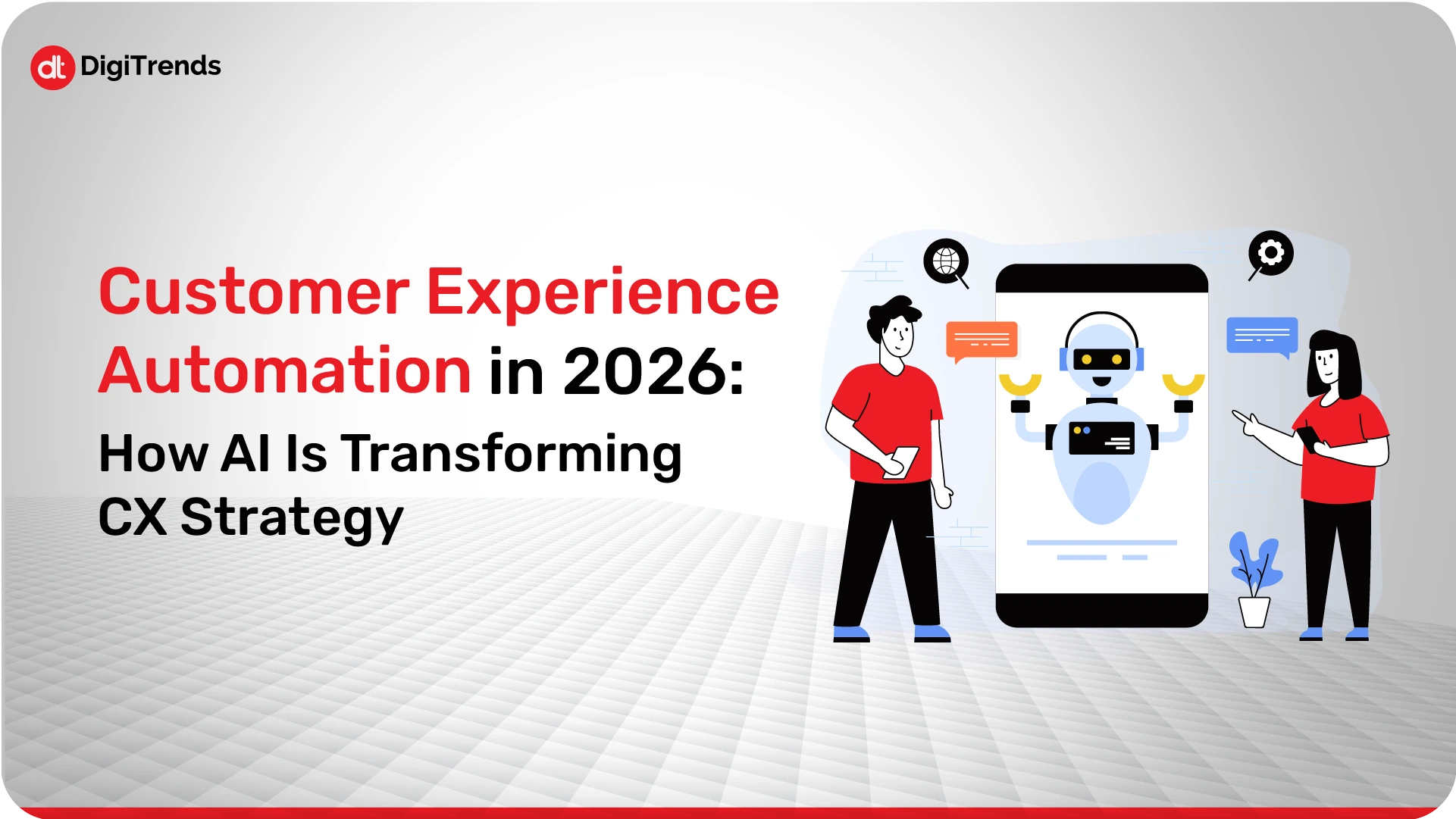
The drastic change in customer expectations regarding services is pretty evident.
Customers today are difficult to please; they demand personalized interactions, quick responses, and smooth multichannel communication. In order to increase customer retention and foster customer loyalty, it is now crucial for businesses to meet these expectations; otherwise, they risk losing clients to rivals. Every action you fail to take as a business to meet customer expectations is imitated by a rival brand.
To stay ahead of your competitors, you can choose customer experience automation, which will help you fulfill all the modern expectations of your targeted customers without any hassle.
Enhancing the entire customer journey with the aid of intelligent tools like chatbots, CRM automation, artificial intelligence, machine learning, and intelligent workflow systems is known as customer experience automation. Businesses can streamline customer interactions with the aid of all these tools.
You can get:
Automation will allow your business to deliver faster, smarter, and more personalized experiences at scale.
As we are moving forward with new technologies taking over the world at every step, AI in customer experiences will no longer be optional; it will soon be an important strategy for most businesses.
Explore how customer experience automation is used to fulfill modern customer demands, how AI helps in transforming CX strategy, key CX automation tools, real-world examples, and more.
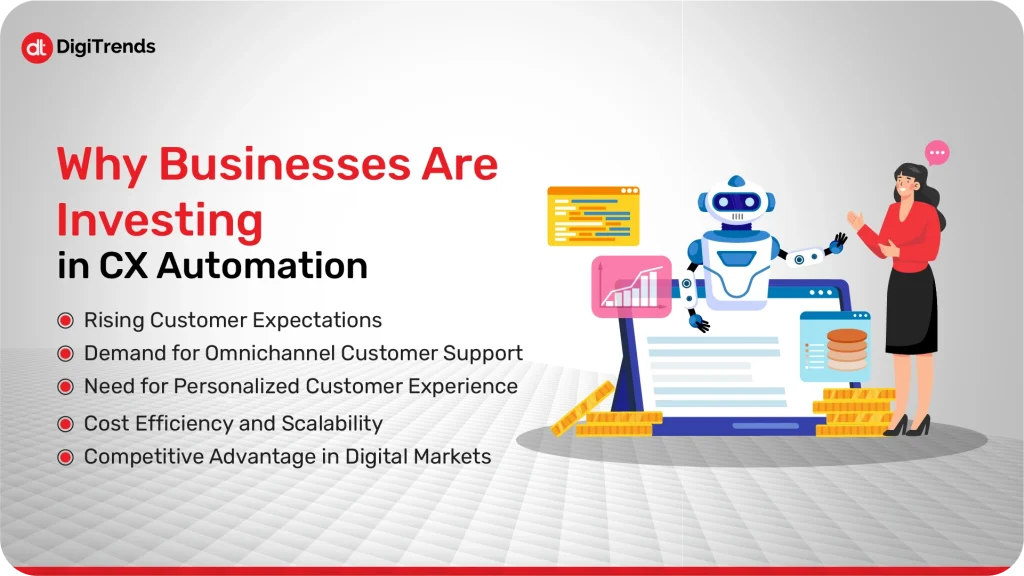
Customer experience automation is not just a concept that’s being adopted by businesses because it sounds innovative or fancy; it is being adopted due to the changed customer behaviour and rising competition.
Let’s have a look at the reasons:
With technology evolving and customer-first options available in almost every industry, customer expectations are not basic anymore. They now also expect instant responses, proactive updates, and zero friction. Waiting 24 hours for a reply is no longer acceptable.
This shift has made customer support automation and chatbots for customer service essential. AI-powered systems can be like power warriors behind a thriving customer experience as they can easily handle routine queries in seconds, escalate complex cases intelligently, and maintain consistency across touchpoints.
If you are a business looking to keep up with your customers, you need to automate basic interactions before you struggle to keep up with response time expectations.
Customers move between websites, mobile apps, email, social media, and live chat without thinking twice. They expect the conversation to follow them.
It takes more than just multiple channels to provide true omnichannel customer support. Real-time visibility into every interaction, unified customer profiles, and synchronized data are necessary.
This is where customer journey automation and CRM automation become important for businesses. When a business can help customers not repeat themselves again and again on every new channel, customers are highly satisfied.
Generic communication no longer works for most of the customers; hence, relatability is the most powerful tool businesses can use to actually mark their space in customers’ minds. If the brand is able to relate to the customers through offering services according to their purchase history and behavior patterns, there is a high chance of conversion.
Through automated customer engagement powered by AI, businesses can deliver tailored offers, relevant recommendations, and timely follow-ups.
A highly personalized customer experience cannot be achieved with manual, old ways. It is driven by data models that predict what the customer is likely to need next and trigger the right interaction at the right time.
Scaling customer operations manually is expensive. Hiring more agents for every increase in demand quickly impacts margins.
Customer experience automation enables businesses to scale interactions without scaling headcount at the same rate. Intelligent routing, automated workflows, and predictive systems reduce repetitive workloads and allow human teams to focus on high-value interactions.
The result is improved efficiency without sacrificing quality.
When businesses operate in a competitive digital market, the only differentiator is the experience they provide to their customers. This is because products, pricing, and quality can be easily copied, but experiences are hard to replicate.
Companies that invest in CX automation tools build faster response systems, smarter engagement models, and more consistent brand experiences. Over time, this strengthens retention, increases lifetime value, and builds a defensible competitive position.
Customer experience automation is not just about operational improvement. It is about protecting market share while accelerating growth.
Technology is the backbone of effective customer experience automation. But not every tool delivers real transformation.
The real impact happens when systems work together to automate the entire customer journey, not just isolated touchpoints. Here are the most important CX automation tools driving measurable results in 2026.
AI-powered chatbots for customer service are no longer basic FAQ responders.
Modern bots understand intent, analyze sentiment, and resolve complex queries without human intervention. They operate 24/7, reduce response times dramatically, and handle high volumes without performance drops.
When integrated into broader customer support automation systems, chatbots can escalate tickets intelligently, route conversations to the right agents, and provide full interaction history instantly.
CRM automation tool is used to connect the data of the customer, including behavior tracking, and engagement workflows into one intelligent system.
So, businesses don’t have to manually follow up on their leads or track support cases. The system has automated triggers that are used to send personalized emails, reminders, and updates based on real-time behavior.
This ensures consistent automated customer engagement and provides teams with full visibility into the customer lifecycle.
Beyond chatbots, advanced customer support automation includes intelligent ticket routing, automated case prioritization, and AI-assisted responses.
These systems reduce resolution times and eliminate repetitive manual tasks. Agents receive suggested responses, customer context, and predictive insights, allowing them to focus on complex or sensitive issues.
Customer journey automation engines can be used to track every interaction of the customer, and further actions are taken automatically by the smart systems.
For example:
This level of personalization for customers ensures they receive the best omnichannel customer support and helps in maintaining a consistent brand experience.
Predictive models analyze behavior patterns to anticipate churn, identify upsell opportunities, and forecast support demand.
Instead of reacting to problems after it’s too late, businesses can act early.
This is the exact approach that helps businesses turn their standard support system into a more strategic one. This strategy is built around intelligence and foresight.
Each customer experience automation tool helps in adding to the efficiency of the business and fully supports in enhancing the current systems to provide the best experience to their users.
AI makes decisions, while automation completes tasks.
In essence, when companies begin using AI to automate the customer experience, they stop offering reactive support and instead switch to using the data to analyze customers predictively. Data-driven engagement and better experiences are made possible by this data.
AI helps in analyzing the browsing patterns, purchase history, engagement frequency, and behavioral signals of each customer. So, businesses do not have to rely on generic campaigns; they can create personalized engagement content according to the customer’s liking of the customer.
For example:
This is how businesses deliver a truly personalized customer experience at scale.
Modern AI systems can detect tone, urgency, and frustration within conversations.
When integrated into chatbots for customer service and customer support automation, AI can escalate emotionally sensitive cases immediately or prioritize high-risk interactions.
This reduces churn and strengthens trust, especially in high-value or high-stakes industries.
Traditional support waits for problems. AI anticipates them.
Through advanced customer journey automation, businesses can detect anomalies such as service disruptions, unusual account activity, or product dissatisfaction signals.
Instead of reacting to complaints, companies reach out first. This proactive model transforms omnichannel customer support into a strategic retention engine.
AI continuously learns from customer interactions. It identifies bottlenecks, predicts peak demand, and optimizes routing logic.
When connected to CRM automation systems, AI ensures that every workflow adapts over time, improving resolution speed and engagement quality.
What this really means is that your digital customer experience strategy becomes smarter every quarter, not static.
AI is not replacing CX teams. It is equipping them with intelligence that scales. When done right, customer experience automation powered by AI creates faster responses, deeper personalization, and stronger long-term loyalty.
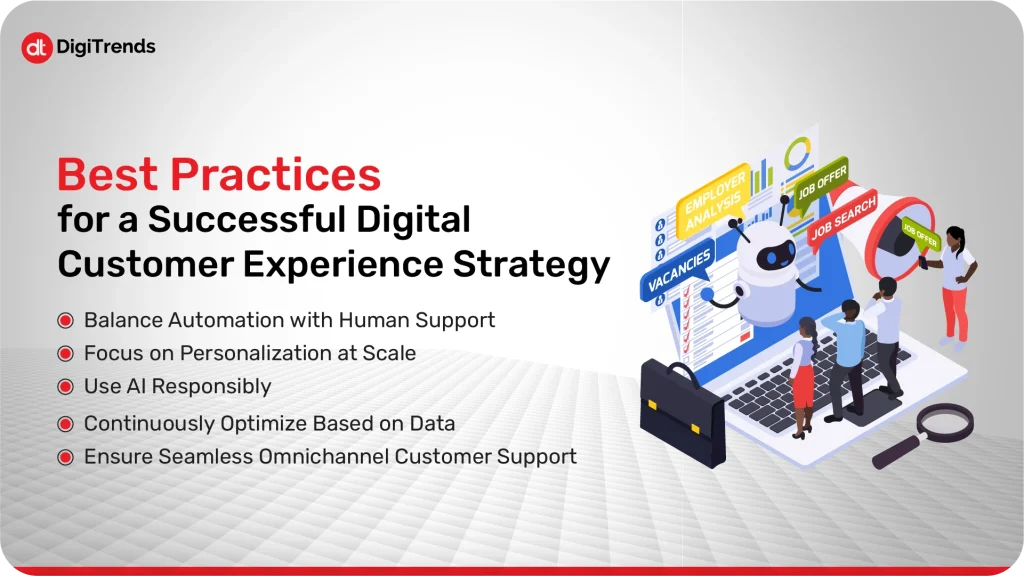
Automation should remove friction, not remove empathy.
While customer support automation and chatbots for customer service can handle repetitive tasks efficiently, complex or emotionally sensitive issues still require human judgment.
The smartest approach blends AI-driven efficiency with human intervention at the right moments. That balance strengthens trust and prevents customers from feeling trapped in automated loops.
Generic automation does more harm than good.
To deliver a meaningful personalized customer experience, businesses must combine AI insights, behavioral data, and CRM automation into one unified system.
This allows automated customer engagement to feel relevant rather than robotic. Every message, offer, and recommendation should reflect real customer behavior, not assumptions.
AI-driven customer experience automation relies on data. With that comes responsibility.
Transparency, consent, and data security must be built into your CX architecture. Customers are willing to share information when they see value, but misuse erodes trust quickly.
Responsible AI strengthens brand credibility and ensures long-term sustainability.
A strong customer journey automation system is never static.
Performance metrics such as response time, resolution rate, churn indicators, and engagement patterns should guide ongoing improvements.
AI systems improve over time, but only when businesses actively analyze and refine workflows.
Consistency across channels is critical.
True omnichannel customer support means customers can start a conversation on one channel and continue it on another without repeating themselves.
Integrated systems, unified data, and synchronized automation flows ensure that every interaction feels connected and intentional.
A successful digital customer experience strategy is not about adding more tools. It is about aligning customer experience automation with clear goals, measurable outcomes, and a customer-first mindset.
Theory is useful. Results are better.
Across industries, customer experience automation is moving from experimentation to execution. Businesses are using AI-driven systems to improve retention, increase revenue, and streamline operations.
Here’s how it plays out in real environments.
In e-commerce, speed and relevance drive conversions.
Through customer journey automation, brands trigger abandoned cart reminders, personalized product recommendations, and post-purchase follow-ups automatically.
AI-powered chatbots for customer service handle order tracking, returns, and FAQs instantly, while predictive models identify churn risks and recommend retention offers.
The result is faster resolution, higher average order value, and stronger repeat purchase rates.
Healthcare organizations use customer support automation to manage appointment scheduling, reminders, and patient inquiries.
With CRM automation, patient records and interaction history are centralized, enabling personalized communication and timely follow-ups.
AI-driven automation reduces administrative workload while maintaining a more responsive and consistent patient experience.
Banks and fintech companies rely on intelligent automation for fraud alerts, transaction updates, and onboarding journeys.
Through omnichannel customer support, customers can interact via mobile apps, chat, or email without losing context.
Predictive analytics strengthens risk detection while supporting a highly personalized customer experience for loans, credit offers, and investment services.
Telecom companies manage high volumes of service queries daily.
Customer experience automation enables proactive outage notifications, automated troubleshooting flows, and intelligent ticket routing.
AI systems analyze usage patterns to recommend plan upgrades, helping drive revenue while improving satisfaction.
When businesses integrate CX automation tools into a cohesive digital customer experience strategy, they shift from reactive service models to proactive engagement ecosystems.
As businesses look past 2026, customer experience automation is set to evolve in ways that feel almost anticipatory. One major trend is hyper-personalization. Companies will move beyond basic segmentation to deliver experiences tailored to an individual’s context, behavior, and even emotional state in real time. This level of personalization will not just meet expectations, it will anticipate them, creating interactions that feel intuitive rather than reactive.
Autonomous support systems are another frontier. AI-driven agents will handle complex queries independently, learning continuously from each interaction. This reduces the need for human intervention in routine issues, freeing teams to focus on strategic, high-value engagements. Customers will receive faster resolutions with minimal friction across all channels.
Finally, AI-led CX orchestration will allow businesses to coordinate every touchpoint seamlessly. From marketing to support to post-purchase engagement, AI will map the entire customer journey, predict pain points, and optimize interactions in real time. The result is a fully connected experience where every action feels consistent, timely, and meaningful.
This future isn’t distant; it’s already taking shape. Organizations that invest in these capabilities now will be the ones defining what exceptional customer experience looks like in the next decade.
DigiTrends can help bridge the gap between emerging CX automation technologies and real-world business outcomes. By combining AI, machine learning, and intelligent workflow systems, we help organizations implement hyper-personalized customer journeys that feel natural and relevant.
Our team can design and deploy autonomous support systems, from AI-powered chatbots to self-learning service agents, enabling faster resolution of customer issues and reducing the burden on human teams. Every solution will be built to scale, ensuring your CX operations grow alongside your business.
Partnering with DigiTrends means turning automation from a cost-saving tool into a strategic advantage, delivering experiences that keep customers engaged, satisfied, and loyal.

Customer experience automation is no longer just a support tool; it’s a strategic driver of growth and loyalty. From hyper-personalization to autonomous support systems and AI-led orchestration, the businesses that embrace these innovations will deliver interactions that feel seamless, timely, and relevant.
With the right partner, such as DigiTrends, organizations can navigate this evolving landscape confidently, turning automation into a competitive advantage while creating experiences that truly resonate with their customers. The future of CX is intelligent, connected, and proactive, and it’s already within reach.
Success in Arabian education app development requires more than coding an app. Explore the education framework and regulatory environment.
Continue Reading

Explore what smart home automation really is, how AI upgrades it, and the key use cases shaping modern homes today.
Continue Reading
Explore how voice recognition technology is being used across healthcare and the role of voice assistants in clinical environments.
Continue Reading

Explore how Unreal Engine 5 for enterprise applications is used and how organizations are using it in the real world.
Continue Reading
Explore more about multimodal AI applications in different industry sectors, their benefits, real-world applications and more.
Continue Reading

Explore the 19 best free offline iPhone games of different genres, including action, strategy, endless, horror, and more.
Continue Reading