2D vs 3D Game Development: Understanding the Key Differences
Published
11 December 2025
Time
9 months ago
Views
989 Views
Muhammad Ishaque
As the SEO Manager at DigiTrends, Muhammad leads organic growth initiatives by developing and executing data-driven SEO strategies that improve search visibility, drive qualified traffic, and support business growth. With extensive experience in technical SEO, on-page optimization, content strategy, keyword research, and performance analysis, he focuses on delivering sustainable search results that align with business objectives. His ability to identify search opportunities, analyze market trends, and implement scalable SEO solutions helps businesses strengthen their digital presence and achieve long-term success.
Table Of content
Share This Article
Behind every game is a spark, an idea that is slowly built into a reality where players can delve in. But it is not just the ideas that help in creating these entertaining experiences; the games are also backed by a ton of decisions we take for their development. One of the main questions that directs the game world we head into is 2D vs 3D game development.
This is the choice that will shape every factor of the game, from how it feels, how the players move, the time of development, to how heavy it is going to be on the pockets. To differentiate, you can think of how games like Ori and the Blind Forest take you into an emotional 2D art space, and on the other hand, The Last of Us Part 2 takes you into a completely immersive 3D environment that is almost real. That is the power of choosing the right format for your game idea.
As the industry grows, the global gaming industry is projected to be valued at $691.3 billion in 2029.
Let’s explore the practical differences between both formats, the cost differentiation, the tools, and the how much creative freedom both offer. This guide will help you make the right choice.
The Evolution of Gaming: From Simple Pixels to Full 3D Worlds
Before diving straight into exploring the main differences in 2D vs 3D development, let’s first try to understand the history behind it. We all know that games never started with the cinematic and photo-realistic experiences they offer now; this industry started small.
Let’s refresh our memory and go back to the arcade era. When players used ot stand in long lines to try titles like Pong, Pac-Man, or Space Invaders. These old games used to run on limited hardware, so their creation was very straightforward when it came to mechanics. This does not mean that old games weren’t addictive; what it means is that it was the first wave of gaming innovation that we witnessed.
By the early ’90s, home consoles made their way to almost everyone’s lounges, carrying a wave of next-level excitement with them. Games like Super Mario Bros., Sonic the Hedgehog, and The Legend of Zelda proved that games with only two dimensions can also offer great gameplay where you can create global icons. If you were a game lover in the early ’90s, then you must know how colorful pixel art and tight controls became the definition of the players of that generation.
But the thing about technology is that it evolves beautifully, one thing might feel like your best experience ever, and then there comes up something larger, greater, and more entertaining than that. That’s exactly what happened with games: the world got introduced to 3D graphics with the help of stronger hardware.
What changed?
The characters were not only moving left or right, but they were also able to step into a completely new world with games like Super Mario 64, Metal Gear Solid, and later, Skyrim, that changed the player’s expectations completely. These games brought a sense of depth, freedom, and realism for the players.
What we are trying to tell you here is that the discussion around 2D vs 3D development is not just about the graphics. It is also about how the gaming industry has changed over the past few years, how every year, developers come up with a better immersive experience. Today, it is safe to say that both formats are thriving because, be it 2D game development or 3D game development, both serve a different purpose and are played by different kinds of people.
The Shift From 2D to 3D: A New Era of Immersion
As the mechanics and hardware improved with time, developers were able to access better rendering, lighting, and animation tools. This is the pulling wire that takes the industry from 2D to 3D game development. This does not mean that 2D became irrelevant; the shift happened because 3D games opened doors that were previously impossible.
Think about the first time a player stepped into a realistic game world like Skyrim. Huge mountains. Weather cycles. How they must have felt alive in their characters, walking, climbing, fighting, or maybe just wandering, all feeling like the real world. This is the level of freedom that showed the true power of three-dimensional space and brought a shift in 2D vs 3D game development.
When the gaming industry moved more towards 3D game development, it gained access to more complex game mechanics. Developers started using physics engines that reacted to player actions. New lighting systems were used to add to the environment. New techniques like normal mapping and advanced shaders made textures look realistic, even on limited hardware.
So if a 3D game development did not replace 2D, what change did it actually bring?
3D game development completely expanded the limits of what games could become. Game started having a taste of storytelling, which also had an extra spice of camera angles, cutscenes, and detailed character animations that pull players deeper into the narrative. If you have played 3D games, you must know the feeling of actually feeling like the character and being in another world, like you actually live there.
All this progress of 3D games does not mean that 2D games went away; instead, games like Hollow Knight, Dead Cells, and Celeste are still proving that creativity isn’t tied to the number of dimensions the game is built on. These games use tight controls, expressive art, and smart level design to deliver unique experiences that can in no way be compared with 3D games.
So, now you have an idea that 3D game development isn’t a replacement for 2D game development. It has just set another stage for developers so they can choose the right dimension for the kind of gameplay they are looking to offer to their players, keeping in mind the emotions and the experience.
Difference Between 2D and 3D Games: What Sets Them Apart?
Mostly, when people think about 2D vs 3D game development, they often only think about the difference between the graphics of both. But the real picture is much bigger than that. The dimensions decide the movement, mechanics, development costs, player behavior, and even the emotional tone of the game.
Let’s break it down so you can have a look at a clear comparison.
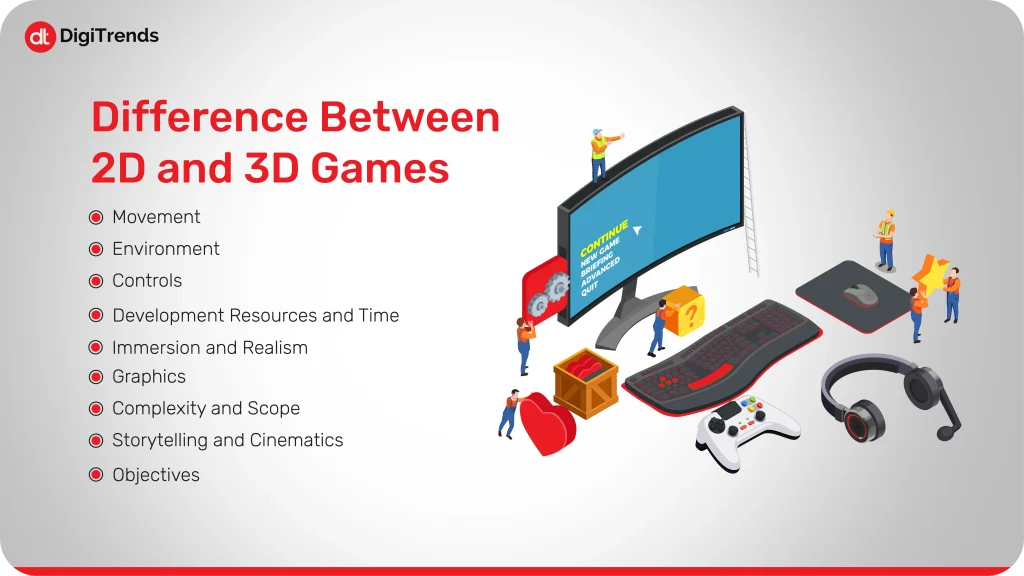
1. Movement
Movement is one of the easiest ways to understand the difference between 2D and 3D.
In 2D games, the movement of the character is limited to a single axis. The players are able to move left, right, jump, fall, and maybe climb. Usually in these games, the path of the layer is defined, which creates a more controlled and focused experience.
But in 3D games, players are able to move in all directions. Be it forward, backward, sideways, diagonally, up, or down, every kind of movement is possible. This adds a level of freedom for the players, but it also demands more from the developers and even players.
Examples
Cuphead (2D) sticks to horizontal movement and precise timing
Breath of the Wild (3D) lets you climb cliffs, glide through valleys, and explore full landscapes
This difference alone shapes how complex or simple a game feels.
2. Environment
The environment is also one of the best ways to differentiate between 2D vs 3D games.
In 2D game environments, everything is simple. These games rely on stylized visuals, flat backgrounds, and carefully crafted levels. The charm of 2D games is the simplicity, which is also intentionally created. If you are not a game lover, ask a gamer today who has played both formats; they will tell you all about the charm that simple 2D games still hold, even though 3D games provide a great immersive experience, but there is still no comparison.
If you are aiming for depth and realism in your game, then a 3D environment will not disappoint. All the landscapes will look alive, buildings will have structure, and the world will feel like something you can touch.
Examples
Celeste (2D) uses minimal mountains and pastel scenery
GTA V (3D) uses driving, shooting, flying, and camera control
4. Development Resources and Time
Development resources and time are the practical side of 2D vs 3D game development.
While building a 3D game, a larger team and a bigger budget are required for modeling objects, animating characters, designing lighting, creating realistic physics, and testing complex interactions.
2D development does not require complex development; the art is simpler, fewer assets are needed, and mechanics are also easier to test and make changes. This is ideal for indie studios or projects with fast turnaround needs.
Horizon Zero Dawn (3D) took hundreds of developers and years of production
5. Immersion and Realism
Immersion is where 3D naturally shines.
3D games can use realistic physics, detailed animations, and full camera control to make the player feel like they’re inside the world. That emotional draw is powerful, especially in story-driven games.
But 2D games create a different kind of immersion. It’s artistic, stylized, and sometimes more emotional because it leaves room for imagination.
Dead Cells (2D) focuses on speed, flow, and tight mechanics
6.Graphics
Graphics in 2D and 3D follow different philosophies. 2D graphics often use pixel art, flat illustrations, or a hand-drawn style. They’re iconic, expressive, and nostalgic.
3D graphics use polygon models, dynamic lighting, shaders, and textures to create fully formed spaces. Both can be beautiful. They just aim for different reactions.
2D games usually have linear objectives. You move forward, complete levels, and overcome challenges in a clear flow.
3D games offer layered objectives. Side quests. Exploration. Branching paths. Player-driven choices.
Key Differences Between 2D and 3D Games
Feature
2D Games
3D Games
Movement
Linear
Multi-directional
Environment
Simple, stylized
Realistic, detailed
Controls
Easy to learn
More complex
Development Time
Shorter
Longer
Budget
Lower
Higher
Immersion
Artistic
Realistic
Graphics
Pixel art, flat
Models, textures, lighting
Scope
Compact
Large-scale
Storytelling
Minimalist
Cinematic
Player Freedom
Limited
High
Development Workflow: How 2D and 3D Projects Actually Get Built
When people talk about 2D vs 3D game development, they often jump straight to visuals. But the real difference shows up in how the work moves from idea to finished game. The workflow shapes everything. Timeline. Skills needed. Tools. Cost. Even the number of people required to ship something playable.
Let’s break this down in a clear, practical way.
How the 2D Workflow Usually Looks
Most 2D projects follow a fast, linear cycle. You create your assets, plug them into the engine, add logic, test, refine, and ship. It’s clean and predictable. That’s why small teams and solo developers love it.
Here’s a quick walk-through of a typical flow:
Sketch characters, levels, and environments
Turn sketches into digital assets (vector art or pixel art)
Animate sprites frame by frame
Build levels inside the engine
Add physics, collisions, and movement
Test for timing, difficulty, and responsiveness
The best part is that changes are cheap. If a character looks too small or an animation feels stiff, the fix usually takes hours, not days.
How the 3D Workflow Ramps Up the Complexity
3D adds another layer on top of everything. It’s not only about making models look good. It’s about making them behave, react, animate, and live inside a fully dynamic space. This demands more tools, more skills, and more time.
Running optimization to keep the game from lagging
If 2D is like drawing a comic, 3D is like crafting a movie set and shooting a film inside it.
Side-by-Side Snapshot: Workflow Breakdown
Here’s a simple table that shows how both workflows compare at key stages:
Stage
2D Workflow
3D Workflow
Asset Creation
Sprites, hand-drawn art
Models, materials, shaders
Animation
Frame-based or skeletal
Rigging, 3D animation cycles
Level Design
Tiles, backgrounds, simple layers
Full environments, lighting, navigation
Physics
Basic movement and collisions
Advanced physics, real-time interactions
Tools Required
Photoshop, Aseprite, Unity
Blender, Maya, Unreal, Substance
Optimization
Light
Heavy (LOD, occlusion, baking)
The gap becomes obvious when you see it like this. There are simply more moving parts in 3D.
Why Workflow Matters for Developers
Choosing between 2D vs 3D game development isn’t just an artistic decision. It affects the entire production pipeline. A 2D game might take a few months to build with a small team. A complex 3D game can take years, even with dozens of people involved.
If your project needs speed, agility, and simple iteration, 2D is the clear winner. If your idea relies on immersion, realism, or spatial gameplay, 3D is the right call, even if it takes more effort.
The Real Bottleneck: Iteration Speed
Game development is basically a loop of making something, testing it, and then fixing whatever feels off. In 2D, that loop is tight. In 3D, every change echoes across multiple systems.
Want to resize a character in 2D? Easy.
Want to resize a character in 3D? Now the rig breaks, animations need adjustments, the collision capsule must be updated, and the camera might need rebalancing.
This is why 3D development demands more planning upfront. Mistakes get expensive quickly.
Impact on Collaboration
2D teams usually work with cross-functional roles. A single artist can handle characters, backgrounds, and animations. In 3D, roles split quickly:
Modeler
Texture artist
Rigger
Animator
Level designer
Lighting artist
This is why 3D development often requires bigger teams or outsourcing.
If you’re planning a game, the workflow question matters as much as the creative concept. Understanding how the pipeline works helps you set realistic deadlines, pick the right engine, and avoid a lot of stress later.
Game Engines and Tools: What Developers Actually Use
Before you commit to an idea, you need to know what tools will carry the weight. The engine you pick sets the whole tone for how your 2D vs 3D game development process will unfold. Some engines shine in 2D. Others are built for 3D from the ground up. A few give you both, but with different strengths.
Let’s walk through the practical landscape so you know exactly what each option means for your project.
Engines Built for 2D
Some engines were created with 2D in mind, so the workflow feels quick and intuitive.
Godot
Fast, lightweight, and a favorite for indie teams. The 2D tools feel natural, collision shapes are easy to manage, and the scripting language is simple enough that beginners don’t get stuck.
Unity (2D mode)
Unity didn’t start as a 2D engine, but its 2D toolset has grown strong. Sprite packs, tilemaps, and animation tools make it smooth for building platformers or mobile titles.
GameMaker Studio
This is where many successful 2D indie titles came from. Drag-and-drop tools help beginners, and the scripting gives pros enough control to build polished games.
The main attraction with these engines is speed. You can go from concept to prototype in days, not weeks.
Engines Dominant in 3D Development
3D demands more horsepower and more specialized tools, so engines built for that purpose naturally dominate the space.
Unreal Engine
High-quality lighting, realistic environments, and features like Nanite and Lumen make it a powerhouse for 3D realism. If you’re aiming for AAA visual quality, this is the standard.
Unity (3D mode)
Much more flexible than people give it credit for. Unity is great for stylized 3D, simulations, mobile 3D, and AR/VR. The workflow is easier compared to Unreal if you’re not chasing ultra-realistic worlds.
CryEngine
Known for beautiful rendering and detailed environments. Used less now, but still respected for high-end visuals.
These engines offer deep physics, dynamic lighting, powerful animation systems, and AI tools that support complex 3D mechanics.
Support Tools You Can’t Ignore
Engine aside, both 2D and 3D rely on extra tools that plug into the workflow:
For 2D
Aseprite (pixel art)
Photoshop or Krita (digital art)
Spine (2D skeletal animation)
For 3D
Blender or Maya (modeling, rigging, animation)
Substance Painter (texturing)
ZBrush (sculpting)
In 2D, a single tool can handle most tasks.
In 3D, you often need a full toolbox.
What This Means for Budget and Planning
A 2D pipeline usually costs less because the asset production is simpler. Even paid tools are affordable.
3D workflows multiply costs through:
software licenses
hardware upgrades
specialized artists
longer production time
This is why teams often underestimate 3D development. The hidden costs stack up fast.
A Quick Engine Comparison Table
Here’s a clear snapshot to help you decide
Engine
Best For
Strenghts
Considerations
Godot
2D
Fast, lightweight, free
Smaller ecosystem
Unity (2D)
2D mobile, indie
Easy workflow, big community
Needs plugins for advanced features
GameMaker
Pure 2D
Beginner-friendly
Not ideal for 3D at all
Unreal Engine
High-end 3D
AAA visuals, strong physics
Heavy learning curve
Unity (3D)
Flexible 3D
Good balance of features
Requires optimization for a large scene
CryEngine
High realism
Advanced rendering
Smaller developer base
If your game lives or dies on visual realism or spatial complexity, go for a 3D engine. If your strength lies in tight gameplay, fast iteration, or simple art styles, a 2D-first engine will keep you focused.
Choosing the right engine is half the battle in 2D vs 3D game development. The wrong choice slows you down. The right one accelerates everything.
Factors That Affect Game Development Costs
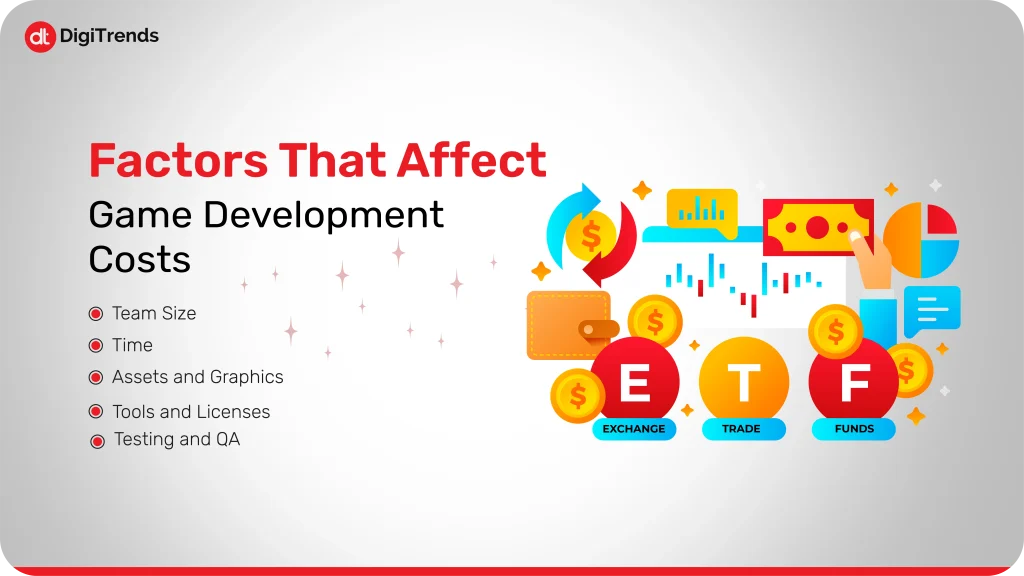
Here’s what drives the budget:
1. Team Size
2D: Smaller teams (2–5 people) can handle most projects. 3D: Larger teams (10–50+ for AAA) are common due to specialized roles.
2. Time
2D games can take months. 3D games may take years depending on complexity and scope.
3. Assets and Graphics
2D: Pixel art or vector graphics are cheaper and faster. 3D: Modeling, rigging, textures, lighting, and animation drive up costs.
2D: Fewer variables, so QA is quicker. 3D: Physics, AI, and large worlds require extensive testing.
General Cost Range by Game Type
Game Type
2D Game Cost
3D Game Cost
Simple Mobile Game
$3,000–$10,000
$30,000–$50,000
Mid-range Mobile/PC
$15,000–$50,000
$100,000–$500,000
AAA PC/Console
$100,000–$500,000
$10 million–$265 million
Cost-Saving Options
Not every project has a big budget. Here’s how developers manage costs:
Outsourcing: Small teams can hire specialists for 3D modeling, animation, or sound.
Asset Stores: Pre-made models, textures, or animations reduce creation time.
Hybrid Approach: Some games mix 2D mechanics with 3D environments to balance cost and immersion.
Iterative Development: Start small and scale up gradually, especially for indie studios.
Why Cost Should Guide the 2D vs 3D Choice
Cost isn’t the only factor, but it’s critical. If your budget is small, 2D development is usually safer. You can still produce a polished, memorable experience without overspending.
For ambitious, immersive, or cinematic experiences, 3D development is worth the investment, but be ready to commit serious time and resources.
Choosing Between 2D and 3D: A Practical Guide
So, you’ve seen the differences, the workflows, the skills required, and the cost implications. Now comes the most important question: how do you decide which dimension is right for your game?
This section provides a step-by-step guide to make an informed choice in 2D vs 3D game development.
1. Define Your Game Type
The first step is to clearly define your genre and the type of experience you want to create. Casual mobile games, platformers, and puzzle games are often best suited for 2D because they rely on simple mechanics and linear progression. On the other hand, RPGs, open-world adventures, and simulation games benefit from 3D because they require depth, exploration, and more immersive environments. Understanding your game type early helps set realistic expectations for both design and resources.
2. Assess Budget and Timeline
Budget and timeline are critical factors in deciding between 2D and 3D. 2D games generally cost less and can be developed faster due to simpler assets and smaller teams. 3D games, however, demand more resources, larger teams, and longer development cycles because of complex modeling, animation, and physics. Aligning your budget and schedule with the game’s complexity ensures that your project remains feasible and avoids delays or overspending.
3. Pick a Game Engine
The choice of a game engine impacts both development speed and final quality. Engines like Godot, GameMaker Studio, and Construct 3 are excellent for 2D games, providing lightweight tools and fast iteration. For 3D, Unity, Unreal Engine, and CryEngine offer powerful tools for creating immersive worlds with realistic graphics and physics. Choosing the right engine also depends on your team’s familiarity and the level of support and community resources available.
4. Evaluate Gameplay Requirements
Gameplay requirements often dictate the dimensional choice. Games with simple mechanics, linear progression, or stylized visuals can thrive in 2D without losing engagement. Titles that require realistic physics, dynamic interactions, open-world exploration, or complex AI typically need 3D. Understanding the level of freedom and complexity your game demands will help you match it with the right format, ensuring both player satisfaction and smooth development.
5. Consider Audience Preferences
Audience expectations are crucial when deciding between 2D and 3D. Casual mobile gamers often prefer 2D for its simplicity and accessibility, while console and PC audiences expect immersive 3D worlds with high-quality graphics and deeper interactions. Knowing your target demographic helps you design games that resonate with players, increasing engagement and retention. Ignoring audience preference can risk lower adoption, regardless of your game’s quality.
6. Think About Long-Term Vision
Your game isn’t just about launch; it’s about updates, expansions, and longevity. 2D games allow faster updates, easier iteration, and smaller incremental improvements due to simpler assets and systems. 3D games can sustain long-term engagement with rich worlds, but each update requires careful planning, often involving asset changes, animations, and additional testing. Planning your long-term vision ensures your game remains engaging without straining your resources.
7. Make the Final Decision
After weighing all factors, game type, budget, engine, gameplay, audience, and long-term goals, you can make an informed choice. 2D is perfect for simplicity, faster development, and cost efficiency, while 3D works for immersion, realism, and complex gameplay. The key is alignment: choosing the format that fits your vision, resources, and player expectations ensures a successful and enjoyable game experience.
Discover DigiTrends Game Development Services
At DigiTrends, we transform your game ideas into engaging experiences, whether you’re aiming for 2D charm or 3D immersion. Our team specializes in end-to-end game development, handling everything from coding, animation, to testing. We work closely with you to ensure your game aligns with your vision, target audience, and platform requirements.
Partnership with DigiTrends and bringing your next gaming project to life with creativity, precision, and innovation.
Conclusion
What is the difference between 2D and 3D games?Choosing between 2D and 3D game development is more than a technical decision; it shapes gameplay, visuals, audience engagement, and project costs. 2D games offer simplicity, fast development, and cost-efficiency, making them ideal for casual or mobile experiences. 3D games provide immersive worlds, realistic interactions, and complex gameplay, perfect for players seeking depth and cinematic experiences.
Ultimately, the right choice depends on your game’s vision, budget, target audience, and long-term goals. Understanding the differences, assessing resources, and planning carefully will ensure your game stands out in today’s competitive market. Whether you choose 2D or 3D, the goal is the same: creating a memorable, engaging experience that players will love.
Submit Your Message
Author :Muhammad Ishaque
As the SEO Manager at DigiTrends, Muhammad leads organic growth initiatives by developing and executing data-driven SEO strategies that improve search visibility, drive qualified traffic, and support business growth. With extensive experience in technical SEO, on-page optimization, content strategy, keyword research, and performance analysis, he focuses on delivering sustainable search results that align with business objectives. His ability to identify search opportunities, analyze market trends, and implement scalable SEO solutions helps businesses strengthen their digital presence and achieve long-term success.
Recent Blogs
May 18th, 2026
How Predictive Analytics Helps Financial Services Stay Ahead of the Competition
Several technologies have been contributing to changes in how financial institutions operate and provide services to their customers. For a long time, AMCs, banks, and insurance companies have been changing their operations, moving towards digitalization and AI-powered solutions to enhance the customer experience and gain a competitive advantage in the finte...
Customer Experience Automation in 2026: How AI is Transforming CX Strategy
Explore how customer experience automation is used to fulfill modern customer demands, how AI helps in transforming CX strategy, key CX automation tools, real-world examples, and more.
Enabling First-Mover Advantage through Structured AI Adoption in KSA.
Driven by regional expertise and practical implementation experience, we help organisations in KSA move confidently from strategy to scalable AI execution with an approach aligned with Saudia’s Vision 2030 and SDAIA mandate.








 11 December 2025
  9 months ago
  989 Views