


Top 11 Healthcare App Developers in the USA: A 2026 Guide
Have a look at the top 11 healthcare app developers in the USA in 2026 and what makes them stand out.
Continue Reading
We build AI-powered software solutions designed to transform your vision into powerful, results-driven applications.


Providing Avant-Garde Mobile App Solutions.
Powerful apps made for the Apple ecosystem
Scalable apps built for android
Single codebase apps that work across platforms
Efficient apps built using React Native
High-performance apps made using Flutter
Providing Bespoke Mobile Game Development Services.
Delivering Innovative And Avant- Garde AR Solutions.
Our VR Development Services Allow Interaction With Simulated Surroundings.
Customised mobile apps for your Shopify shopfront.
Web Development Services With A Stellar Record Of Excellence.
Providing Web Design Services For All Industries.
Offering Custom And Robust PWA Solutions.
Bespoke E-Commerce Solutions For All Industries.
An Exceptional Success Record In CMS Development Services.
Customised software solutions to match corporate requirements.
Providing Business With Bespoke MVP Development Solutions.
DigiTrends Produces Essential Custom Software Solutions.
Transforming Brands With Innovative Digital Marketing.
AI-Powered Solutions. Wide-Ranging Industries. From finance to healthcare, our intelligent technologies drive innovation across every sector.


Revolutionizing Financial Services with Innovative Technology Solutions
Developing digital software to upgrade healthcare
Innovating learning experience with technology
Helping you step up your advertisement game
Reshaping automotive business experiences with tech
Transforming Real Estate with digital solutions
Digitalizing hospitality management with e-solution
Transforming the retail industry for with digital transformation
Transforming data into intelligent insights that drive innovation across multiple industries.

Delivering exceptional services across different cities, innovating here; and thriving everywhere!


Seek exceptional mobile app development in Delaware.
Where creativity and tech unite for innovation.
Seek advanced mobile app development in LA.
Unleash your business with our innovative mobile apps
Step into Austin’s mobile innovation hub.
Each business is unique; tailored approaches for all.
Leaders of mobile app development in Saudi Arabia
Meet the best app developers in Dubai
Meet the Nordik mobile development experts

 01 December 2025
 3 months ago
 65 Views


Whenever we feel too emotionally distressed, the first thing we do is reach for our phone.
But you must have noticed that most of the people now don’t search for things on the web platforms like ‘why does my chest hurt,’ instead, they reach out for tools like ChatGPT, Gemini, and others, talking to it, wanting to make sense of the feelings they don’t have words for.
What does this shift mean?
Well, people are now turning towards AI tools for more immediate, private, and judgment-free responses, which web searches can’t provide. If you search for things you are going through on the web, you’ll get hundreds of blue links to articles, blogs, and research related to mental health. But people now want more personalized responses, a platform where they won’t have to wait for weeks to get an appointment. We are all aware of how much the mental health crisis has deepened globally, which is the main reason why AI in mental health is becoming a strong support for people who really need someone, or something that can listen. This does not mean that AI is replacing therapists; it is just helping in creating a support platform for moments when people can’t reach out to professionals.
There are some very useful tools for people struggling with mental health issues. Some tools guide breathing when someone is dealing with anxiety, and others give them space to dump thoughts that they can’t say out loud. Many of these tools are built through the field of mental health development, where developers, clinicians, and researchers work together to make care accessible for patients.
The AI-Powered mental health solutions market size is expected to reach USD 7.83 billion by 2030. The demand for AI mental health tools is rising because they are becoming smarter as they are backed by machine learning, which allows apps to recognize patterns, flag any risks, and offer suggestions that are highly personalized according to the feelings of a specific person.
Technology is not being used to create mental health apps; it is being used in building an entire ecosystem of AI mental health tools that are designed to understand mood changes, analyze speeches, study behaviors, and respond efficiently to emotional queries.
AI has been very helpful in supporting people dealing with mental health problems, and the use of generative AI in healthcare has added new possibilities to this world. With generative AI for mental health, users don’t get static or scripted replies for their questions; instead, they get a companion with whom conversation can feel more human. What’s different about these tools is that these tools never stop learning, they learn from every interaction, adapt to the recognized needs of the individual, and also provide them with a personalized exercise guide that can help them deal with their symptoms.
The rise of digital mental health solutions has completely changed the way some people approach their mental health issues. A virtual support is not plan B for them; it is the first step they take to gather their thoughts before they can seek help from a mental health professional. For some people, it is also a substitute for therapists that is affordable and accessible at any time. The way these tools are evolving, AI in mental health is now about to become an everyday part of emotional support for people.
This transformation depicts hope and a new understanding of what mental health support can look like. Explore how AI in mental health is helping people navigate their inner world without being judged, its impact on patients, caregivers, and the entire mental health solution system.
The demand for mental health support has reached a level where traditional systems are not able to keep up. According to new data released by the World Health Organization (WHO), more than 1 billion people are living with mental health disorders, with conditions such as anxiety and depression inflicting immense human and economic tolls.
This has led to long waiting lists for appointments, increased therapy fees, and the shortage of mental health professionals. This has created a gap between the patients and support. AI in mental health is created to close this gap, and it has successfully made its presence known. AI mental health tools offer a sense of understanding and support in moments when people can no longer wait for months-long appointment dates to get help.
As mentioned before, millions are dealing with these issues, whether severe or not. As awareness about mental health support is also growing, so are the numbers of people looking for help. The traditional systems were not built for this type of demand, which is why AI in mental health is important at this time, as it is accessible for people 24/7, while looking for a professional can take up a lot of time.
Wondering why people have suddenly shifted towards digital support?
This is because constant exposure to technology has changed the way people process information and deal with emotional distress. Many people prefer talking about their feelings and emotions with digital supporters rather than sitting face-to-face with a therapist. They feel safe, familiar, and not judged with digital tools. This behavior of the users is the reason why the world is now switching towards digital mental health solutions.
Mental health app development has also become a full-fledged industry now. Development companies now focus on tools that are intuitive, efficient, and easy to access for all users, no matter what their age is. Organizations around the world are now building apps that offer therapy exercises, mood tracking, psychoeducation, and crisis support, a combination of everything. The competition around it is also increasing as the demand increases; hence, the tools are becoming more sophisticated. Many more features are being added, to like sleeping habits detector, a word choice analyzer, and a changing mood observer.
For hospitals and clinics, AI mental health tools help them with early detection and ongoing monitoring. It provides features like speech analysis, facial cues, and behavioral signals that can provide insight into a patient’s emotional state before they even express it themselves. This is possible because generative AI in healthcare is now being used to analyze unstructured information and data, such as conversations or journals, and then it also interprets it into context. So, these systems create a personalized offering for the users according to their history, behavior, and current state.
You must be thinking that AI in mental health is all about innovation and convenience, but the reality is that it is strongly tied to necessity. Millions of people are struggling silently when it comes to mental health issues, and they have their own reasons for not going to therapy. AI helps in providing support to these types of people. Technology is finally breaking the stigma by making support private and accessible. It has become the best alternative for people who can’t afford therapy, live in areas where they can’t find therapists, or maybe are just not ready to make that decision, but still need some kind of help. It is also opening ways for early intervention in cases where the right timing matters a lot.
People today want solutions that fit into their lives. They want support that feels responsive, flexible, and available in difficult moments, not just during scheduled sessions. These expectations were only possible through the trust that people have in technology nowadays. And AI in mental health is not supporting; it never stops learning. The more people reach out, the more it will evolve through the experience of different cases and the addition of new tools. The time is not far when AI will be an important part of the mental health landscape.
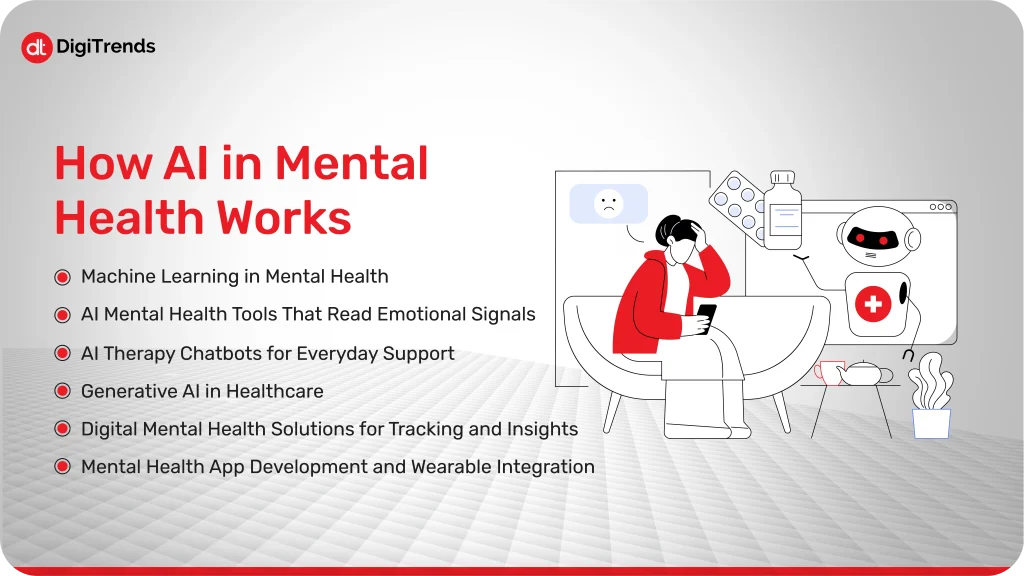
The rise of AI in mental health is driven by several powerful technologies that are combined to read patterns, understand emotional signals, and give people support that feels like it’s coming from a human and at the right time. These systems are in no way replacing the therapists; instead, you can think of them as new companions that will help you deal with difficult times while also helping mental health professionals work efficiently.
The main technology that backs up the AI mental health tools is machine learning. It is the technology behind models understanding speech patterns, behavior, and mood shifts, all of which help the systems understand signs of stress and things that users don’t even describe directly. It can easily take your hidden hints.
Let’s have a look at the major technologies that are shaping AI in mental health:
Platforms and apps will efficiently understand whatever you say and will provide solutions and help you deal with issues according to that, but with machine learning, the systems can also detect emotional trends that you might not make obvious. So, the solutions become more personal and not just generic.
What ML contributes:
What if someone could analyze your tone, pauses, sentence length, and typing rhythm to decode what you never express?
For some people, it is nothing less than a blessing, because many people don’t like expressing their emotions and expect someone to understand them. These systems can easily detect all these hidden signs and offer personalized insights based on that.
These tools can:
If you still think that AI chatbots are answering with scripted answers. That is not the case anymore, because these chatbots can now hold natural conversations and guide users through different techniques like grounding exercises, helping in dodging negative thoughts, or suggesting calming routines.
What makes them effective:
These chatbots are the first platform that most people now approach before they go for therapy, while some also use them for ongoing emotional support while also taking therapy from a professional.
Generative AI in healthcare has changed the way digital mental health tools respond. These systems understand context, create detailed guidance, and adjust their responses based on the user’s unique emotional history.
Generative AI helps by:
Modern digital mental health solutions are now also coming with features that guide users about how their lifestyle habits are influencing their mental health.
Common features include:
These are the features that help users understand what they can change in their lives to feel better emotionally, rather than crashing over issues and worsening their symptoms.
Thanks to the growth of mental health app development, many apps now connect with wearable devices to provide deeper insight into physical and emotional health.
These integrations allow apps to:
Wearable data helps paint a full picture of a person’s daily state, giving them insights they may not notice on their own.
Together, these technologies make AI in mental health more responsive, more personalized, and more accessible. The systems don’t replace human care, but they make support available at times when traditional options feel out of reach. And as these tools continue to evolve, their role in emotional well-being will only become stronger.
Here’s the thing. When you strip away the tech jargon and the hype, the real story is about people. The rise of AI in mental health is not just a timeline of smarter tools. It’s a shift in how patients experience care, how they ask for help, and how quickly they get it.
For someone sitting through a panic attack at two in the morning, support that responds instantly matters. For someone who feels ashamed to talk about their trauma, a tool that listens without judgment can make the difference between reaching out or staying silent. For someone who lives in a remote area with no trained therapists in sight, digital help may be the only option that feels within reach.
Different patients benefit in different ways, but a few themes keep showing up.
How people feel the impact:
What this really means is that support is no longer limited to a weekly session or a rare appointment slot. It’s something patients can carry with them. Something that adapts, responds, and grows with them.
One of the strongest reasons digital mental health solutions are gaining ground is accessibility. Not everyone has the finances, the time, or the cultural acceptance to seek therapy. Not everyone feels safe speaking openly with another person, especially when they’ve spent years masking their emotions.
AI for mental health support breaks down several of those barriers at once.
It helps people who:
The rise of AI mental health tools doesn’t erase the need for human therapists, but it creates an entry point for people who would otherwise fall through the cracks.
AI therapy chatbots have quietly become the backbone of digital support. They don’t replace complex, long-term treatment. But they excel at the small moments that matter more than people realize.
Moments like:
These moments often decide how a person’s day unfolds. They decide whether someone spirals or steadies. And that’s why AI therapy chatbots have earned a place in the mental health landscape. They fill the emotional gaps that happen between appointments, between crises, and between the big steps a person takes in their healing process.
The shift we’re seeing isn’t just about immediate support. It’s about emotional maintenance. Patients are beginning to treat digital tools the same way people treat fitness apps or nutrition trackers. They’re using them to stay aware, stay balanced, and stay connected to their inner world.
Even small habits build emotional resilience. And digital solutions make those habits far easier to stick with.
Walk into any busy clinic today, and you’ll see one thing immediately: clinicians are drowning in cases. Not because they lack skill, but because the volume of people needing help is far beyond what traditional systems were designed for. This is where AI in mental health quietly steps in, not to treat patients, but to give professionals the kind of visibility they rarely have time to gather on their own.
Instead of combing through pages of notes or relying on memory, therapists can now pull up dashboards that summarize mood patterns, sleep shifts, journaling themes, or spikes in anxious behavior. These insights aren’t guesses. They’re built on machine learning in mental health that observes changes over time and highlights anything that seems unusual.
Some clinicians use AI mental health tools to prepare for a session. Others use them to shape treatment plans. And for many, these systems help catch early warning signs they might have missed: sudden disengagement, erratic sleep logs, unusually negative language, or emotional flattening.
The point isn’t to replace their judgment. It’s to strengthen it so care becomes more proactive, not reactive.
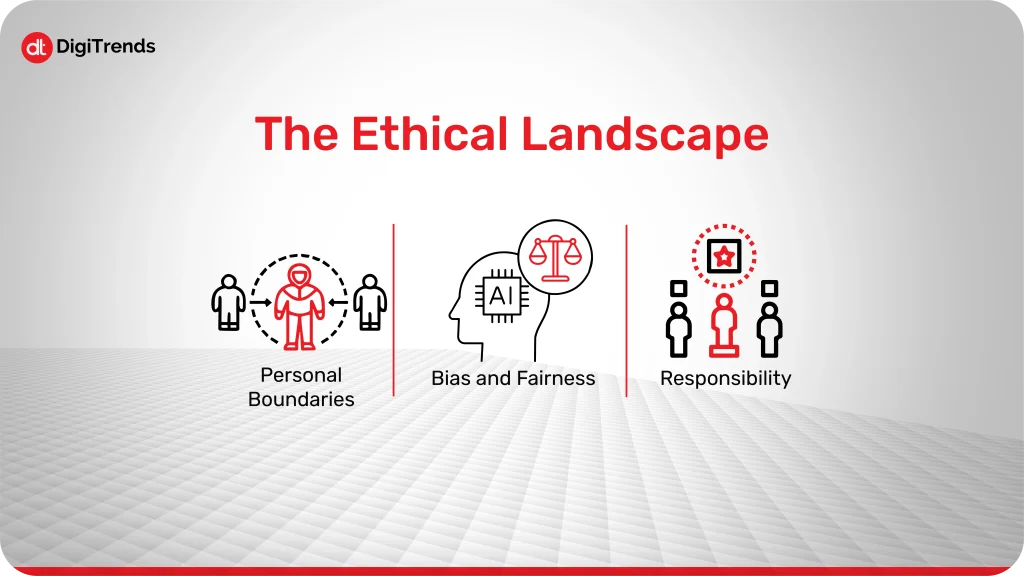
Once you introduce technology into something as personal as mental health, the questions get louder. Rightfully so. People want to know where their data goes, who sees it, and how it’s used. They should ask those questions. Developers should answer them transparently.
Instead of a long checklist, think of the ethical concerns in three simple layers:
People share their rawest emotions with these systems, sometimes more openly than with humans. That kind of vulnerability demands protection and clear guardrails.
AI in mental health only works if the data it learns from is representative. Algorithms trained on narrow groups can misunderstand cultural or linguistic nuances, leading to unhelpful or harmful suggestions.
AI for mental health support can guide, not diagnose. When someone is at risk, humans have to lead, not code.
Ethics isn’t a side note in this field. It’s the backbone. And every tool, from AI therapy chatbots to advanced digital mental health solutions, needs to be built with that reality in mind.
We’re heading toward a world where emotional support fits naturally into everyday life. Not as a crisis button. Not as a backup plan. As something woven into the rhythm of daily routines.
Imagine a future where:
This isn’t distant or speculative. The pieces are already here.
AI in mental health is expanding from a tool into a partner. not to heal for you, but to stay beside you while you heal.
DigiTrends can support organizations exploring AI in mental health by helping design and build thoughtful, user-friendly digital solutions. From mental health app development to AI therapy chatbots and wearable integrations, we focus on creating tools that are secure, intuitive, and responsive, helping technology complement care in meaningful ways.
AI in mental health isn’t a replacement for human care. It’s a companion, a guide, and in many cases, a bridge for people seeking support when traditional systems can’t respond quickly enough. From AI therapy chatbots to digital mental health solutions powered by machine learning and generative AI in healthcare, these tools are helping patients, caregivers, and clinicians navigate emotional challenges more effectively.
The promise lies in accessibility, personalization, and prevention, support that meets people where they are, when they need it. As technology evolves, the role of AI in mental health will continue to grow, not as a standalone solution, but as a partner in creating a more responsive, understanding, and supportive mental health ecosystem.
Have a look at the top 11 healthcare app developers in the USA in 2026 and what makes them stand out.
Continue Reading
Explore how customer experience automation is used to fulfill modern customer demands, how AI helps in transforming CX strategy, key CX automation tools, real-world examples, and more.
Continue Reading
Explore what smart home automation really is, how AI upgrades it, and the key use cases shaping modern homes today.
Continue Reading
Explore how voice recognition technology is being used across healthcare and the role of voice assistants in clinical environments.
Continue Reading
Explore more about multimodal AI applications in different industry sectors, their benefits, real-world applications and more.
Continue Reading
Explore healthcare software development costs in the Middle East and how businesses can plan smarter in 2026 without compromising quality.
Continue Reading