Unreal Engine 5 for Enterprise Applications and Real-Time 3D Use Cases
Published
30 January 2026
Time
8 months ago
Views
989 Views
Muhammad Ishaque
As the SEO Manager at DigiTrends, Muhammad leads organic growth initiatives by developing and executing data-driven SEO strategies that improve search visibility, drive qualified traffic, and support business growth. With extensive experience in technical SEO, on-page optimization, content strategy, keyword research, and performance analysis, he focuses on delivering sustainable search results that align with business objectives. His ability to identify search opportunities, analyze market trends, and implement scalable SEO solutions helps businesses strengthen their digital presence and achieve long-term success.
Table Of content
Share This Article
Back in time, Unreal Engine was only associated with game studios and creative experiments, but as time changed, it has also made its place in enterprise environments, where real-time 3D is becoming a practical business tool rather than a visual luxury.
Well, in these times, anything related to technology is surprising but not unbelievable. Unreal Engine 5 for enterprise makes complete sense when you think about how enterprises have to deal with complex systems, large visual datasets, and high-stakes decisions. In this case, teams need quick clarity over stuff, and static diagrams, slide decks, and pre-rendered visuals often fall short in providing clarity. This is exactly where real-time 3D applications step in. They allow businesses to visualize, simulate, and interact with environments in ways that feel closer to the real world.
Businesses can leverage Unreal Engine 5 to build interactive 3D experiences that help them understand complex concepts and structures internally and scale across platforms. As an example, think about a construction company being able to explain the process of a complex building structure to the team, so the team isn’t left guessing how the process is going to work and what the outcomes would be; instead, they can simulate scenarios before acting.
Many enterprises are already making use of Unreal Engine to support digital transformation initiatives, improve training programs, create digital twins, and enhance product visualization. These enterprises are not focused on creating cinematic visuals; the focus is on accuracy, speed, and better decision-making.
Explore how Unreal Engine 5 for enterprise applications is used, how organizations are using it in the real world, and the value it drives for businesses.
What Is Unreal Engine 5? An Enterprise-Focused Overview
Unreal Engine 5 is a real-time 3D development platform for building interactive applications for complex business environments. While it is often associated with gaming, Unreal Engine 5 for enterprise applications has gained traction across industries that rely on visualization, simulation, and data-driven decision-making.
At a functional level, Unreal Engine 5 enables real-time 3D enterprise applications that respond instantly to user input. Unlike traditional enterprise visualization tools that depend on static renders or delayed processing, Unreal Engine 5 renders scenes dynamically. This allows teams to explore designs, processes, and environments as they evolve, rather than reviewing fixed outputs after the fact.
For many organizations, this capability supports Unreal Engine 5 real-time 3d applications used in planning, training, and operational analysis. Engineers can interact with detailed 3D models, operations teams can test scenarios in simulated environments, and stakeholders can review complex systems without relying on technical interpretations.
Unreal Engine 5 for business use cases stands out because it combines high visual accuracy with performance at scale. It can handle large environments and detailed assets while maintaining smooth interaction, which is critical for industries such as manufacturing, construction, and healthcare. This level of fidelity also supports Unreal Engine 5 visualization for enterprises, where precision and clarity directly affect outcomes.
Beyond visuals, Unreal Engine 5 functions as a full development platform. It supports custom logic, system integrations, and data connectivity, making it suitable for enterprise 3D application development. This allows real-time environments to connect with enterprise data sources, turning 3D experiences into practical tools rather than standalone visual demos.
In enterprise settings, Unreal Engine 5 is increasingly used as Unreal Engine 5 simulation software, supporting realistic training environments and operational simulations. These applications help organizations understand complex systems, reduce risk, and improve decision-making through immersive, interactive experiences.
Why Real-Time 3D Is Becoming Critical for Enterprise Applications
As businesses expand, enterprise systems become more complex due to multiple teams, data sources, and physical environments being in one place.
Teams struggle with understanding these systems and sometimes processes through static documents or two-dimensional visuals, which often creates friction in daily workflow and outcomes. This is why real-time 3D enterprise applications are moving from experimental projects to practical business tools.
Real-time 3D allows enterprises to see systems as they actually function. Instead of reviewing a fixed model or waiting for updated renders, teams can interact with environments that respond immediately to changes. This shift reduces interpretation errors and shortens feedback loops, especially in industries where accuracy and timing matter.
For many organizations, Unreal Engine 5 real-time 3D applications support better collaboration between technical and non-technical stakeholders. Designers, engineers, and decision-makers can explore the same environment together, ask questions in real time, and test assumptions on the spot. This shared understanding leads to faster approvals and fewer costly revisions.
Another reason real-time 3D is gaining traction is its role in simulation. Enterprises increasingly rely on Unreal Engine 5 simulation software to model scenarios that are expensive, risky, or impractical to test in the real world. From operational workflows to safety procedures, simulation enables teams to evaluate outcomes before changes are made.
Real-time 3D also plays a growing role in enterprise visualization. Traditional tools often struggle to represent scale, depth, and movement accurately. In contrast, Unreal Engine 5 visualization for enterprises provides interactive environments that reflect real-world conditions more closely. This improves planning, training, and communication across departments.
As enterprises invest in digital transformation, the demand for interactive and immersive systems continues to rise. Unreal Engine 5 for business use cases align with this demand by enabling organizations to turn complex data into environments people can explore, understand, and act on. Real-time 3D is no longer just a visual upgrade. It is becoming a practical requirement for modern enterprise applications.
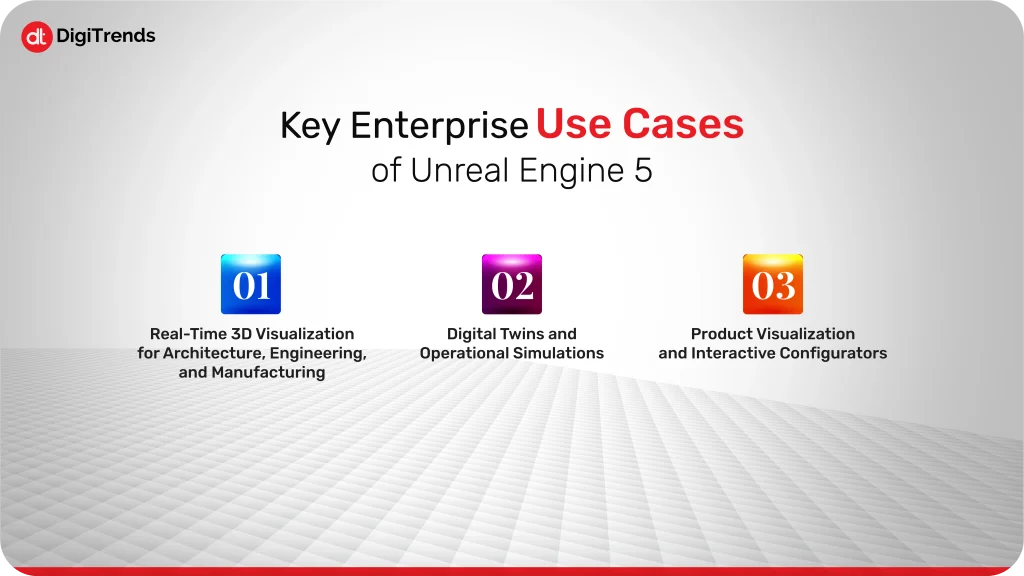
Key Enterprise Use Cases of Unreal Engine 5
The real value of Unreal Engine 5 for enterprise applications becomes clear when it is applied to real business problems. Enterprises are not adopting real-time 3D for experimentation alone. They are using it to solve challenges related to design accuracy, operational efficiency, training effectiveness, and decision-making.
Let’s have a look at the most common and high-impact Unreal Engine 5 enterprise use cases seen across industries today.
1. Real-Time 3D Visualization for Architecture, Engineering, and Manufacturing
In industries where physical space, scale, and precision matter, visualization plays a critical role. Unreal Engine 5 enables real-time 3D enterprise applications that allow teams to interact with environments instead of reviewing static drawings or pre-rendered models.
Architectural and engineering teams use Unreal Engine 5 to walk through designs before anything is built. Manufacturing organizations use it to visualize production lines, equipment layouts, and facility changes in a shared digital environment. These interactive experiences reduce misunderstandings early in the planning stage and help identify design issues before they turn into costly revisions.
This approach to Unreal Engine 5 visualization for enterprises also improves communication with stakeholders who may not have technical backgrounds. Instead of interpreting complex schematics, decision-makers can explore designs directly and provide feedback with confidence.
2. Digital Twins and Operational Simulations
Digital twins are becoming a core part of enterprise digital transformation strategies. Unreal Engine 5 supports the creation of high-fidelity digital environments that reflect real-world systems, processes, and assets.
Using Unreal Engine 5 simulation software, enterprises can model operations, test scenarios, and evaluate outcomes without disrupting live systems. Manufacturing companies simulate production changes. Energy and utilities organizations model infrastructure performance. Logistics teams explore workflow adjustments before implementation.
These Unreal Engine 5 real-time 3D applications allow enterprises to analyze cause and effect visually. Instead of relying solely on reports or dashboards, teams can see how changes impact operations over time, leading to more informed and confident decisions.
3. Product Visualization and Interactive Configurators
Enterprises are also using Unreal Engine 5 to improve how products are presented and understood. High-quality product visualization allows customers, partners, and internal teams to explore products interactively rather than viewing static images or videos.
Through Unreal Engine 5 real-time 3d applications, users can customize products, explore variations, and view components in detail. This is especially valuable in industries such as manufacturing, automotive, and industrial equipment, where products are complex and highly configurable.
These experiences support sales, marketing, and engineering teams by aligning expectations early and reducing back-and-forth during the sales process. Unreal Engine 5 for enterprise applications makes it possible to deliver this level of interaction without sacrificing performance or visual clarity.
Business Benefits of Using Unreal Engine 5 for Enterprise Applications
Adopting Unreal Engine 5 for enterprise applications isn’t just about impressive visuals. The real advantage lies in the measurable impact it brings to operations, decision-making, and overall business performance. Organizations that leverage Unreal Engine 5 for business report improvements across multiple areas.
1. Faster Decision-Making and Improved Collaboration
Traditional tools often delay decisions because teams must wait for updated models, reports, or physical prototypes. With real-time 3D enterprise applications built on Unreal Engine 5, teams can interact with models, test scenarios, and evaluate outcomes immediately.
This accelerates approvals, reduces miscommunication, and allows cross-functional teams, design, engineering, operations, and management, to collaborate in the same digital environment. Stakeholders can see changes live, ask questions, and provide feedback in context, which shortens project timelines significantly.
2. Cost Reduction and Efficiency Gains
Developing physical prototypes or conducting repetitive simulations is expensive and time-consuming. Unreal Engine 5 real-time 3d applications replace or supplement these processes by creating interactive, digital versions of products, facilities, or operations.
This reduces material costs, minimizes rework, and lowers the need for on-site training setups. Enterprises in manufacturing, healthcare, and construction benefit from more efficient workflows, which directly impact the bottom line.
3. Enhanced Training and Risk Management
Using Unreal Engine 5 simulation software, organizations can provide training in high-risk or complex environments without exposing employees to danger. From industrial safety to healthcare procedures, realistic simulations improve learning retention while reducing accidents or errors.
This leads to better-prepared teams and lower operational risk, a direct business benefit that executives can quantify.
4. Better Product and Process Visualization
Interactive 3D experiences, enabled by Unreal Engine 5 visualization for enterprises, allow teams to explore products, layouts, and processes in detail. This clarity helps in early-stage planning, identifying design flaws, and refining workflows before physical implementation.
For sales and marketing, interactive configurators let customers explore products virtually, increasing engagement and reducing misalignment between expectations and delivered products.
5. Scalability and Future-Proofing
Unreal Engine 5 is designed to handle complex environments and high-fidelity visuals without performance issues. Enterprises can scale applications across departments, facilities, and even remote teams. By integrating with existing enterprise systems, enterprise 3d application development ensures that investments in Unreal Engine 5 remain valuable as business needs grow.
By combining these benefits, Unreal Engine 5 transforms enterprise processes from static, slow, and error-prone into interactive, efficient, and informed. It’s no longer just a visualization tool; it becomes a platform for digital transformation and decision support.
Unreal Engine 5 vs Traditional Enterprise Visualization Tools
When enterprises consider adopting real-time 3D, a common question is why choose Unreal Engine 5 over existing tools. Traditional enterprise visualization tools often rely on static models, pre-rendered images, or limited interactivity, which can slow decision-making and reduce accuracy.
Unreal Engine 5 for enterprise applications addresses these limitations by combining high-fidelity visuals with real-time responsiveness. Unlike legacy tools, real-time 3D enterprise applications built on UE5 allow users to manipulate, explore, and test models interactively. Teams can adjust layouts, simulate processes, or visualize product changes instantly, rather than waiting for updated renders or relying on static diagrams.
Key Differences
Feature
Traditional Tools
Unreal Engine 5
Rendering
Pre-rendered or static
Real-time, Interactive
Interactivity
Minimal
Full, responsive user input
Scalability
Often Limited
Handles large environments and great detail
Collaboration
Sequential feedback loops
Simultaneous multi-user collaboration
Integration
Standalone
Supports APIs, data pipelines, and enterprise systems
Why Enterprises Are Making the Switch
Faster Insights: Teams can test scenarios immediately and make decisions without delays.
Improved Accuracy:Real-time feedback reduces misinterpretation and errors.
Flexible Deployment: Works across desktops, immersive setups, and cloud environments.
Cost Efficiency: Reduces the need for physical prototypes and repetitive simulations.
By supporting Unreal Engine 5 visualization for enterprises, UE5 gives businesses a clear advantage over traditional visualization solutions. Enterprises can move from static reporting to interactive, actionable insights, which is critical for modern digital transformation initiatives.
Technical and Integration Considerations for Enterprises
Adopting Unreal Engine 5 for enterprise applications requires more than just installing the software. Enterprises need to consider how real-time 3D applications will integrate with existing systems, workflows, and hardware to deliver maximum business value.
1. Integration with Existing Enterprise Systems
One of the key advantages of Unreal Engine 5 is its flexibility. Enterprise 3d application development with UE5 can connect to ERP, CRM, or other business software through APIs and data pipelines. This ensures that 3D visualizations and simulations reflect accurate, up-to-date information, rather than static or outdated data.
For example, manufacturing teams can link digital twins to live production data, enabling real-time monitoring and predictive maintenance. Similarly, training simulations can pull actual operational data to replicate realistic scenarios for employees.
2. Hardware and Performance Considerations
While Unreal Engine 5 is optimized for high-performance rendering, enterprises should plan for hardware requirements, especially when working with large datasets or immersive setups. Modern desktops, VR workstations, or cloud-based rendering can support real-time 3D enterprise applications, ensuring smooth interaction without lag.
Planning for scalability is critical. UE5 can handle complex environments and high levels of detail, but system architecture, network speed, and GPU performance must be considered to maintain consistent user experiences across teams.
3. Deployment Options
Enterprises can deploy UE5 applications in multiple ways: on-premises, cloud-hosted, or hybrid solutions. Each approach has trade-offs:
On-premises: Full control and security, but higher hardware costs.
Cloud: Easier scaling and collaboration, lower local hardware requirements.
Hybrid: Balances performance, flexibility, and cost.
The right choice depends on business needs, security requirements, and user access patterns.
4. Talent and Workflow Integration
Implementing unreal engine 5 real-time 3D applications may require training or hiring personnel familiar with UE5 development. Enterprises can build internal teams, leverage external partners, or combine both approaches. Planning workflows that integrate UE5 seamlessly into existing processes ensures adoption is smooth and value is realized quickly.
By considering integration, hardware, deployment, and talent, enterprises can maximize the impact of Unreal Engine 5. The goal is to move beyond a visual tool and make UE5 a functional part of operations, training, and decision-making.
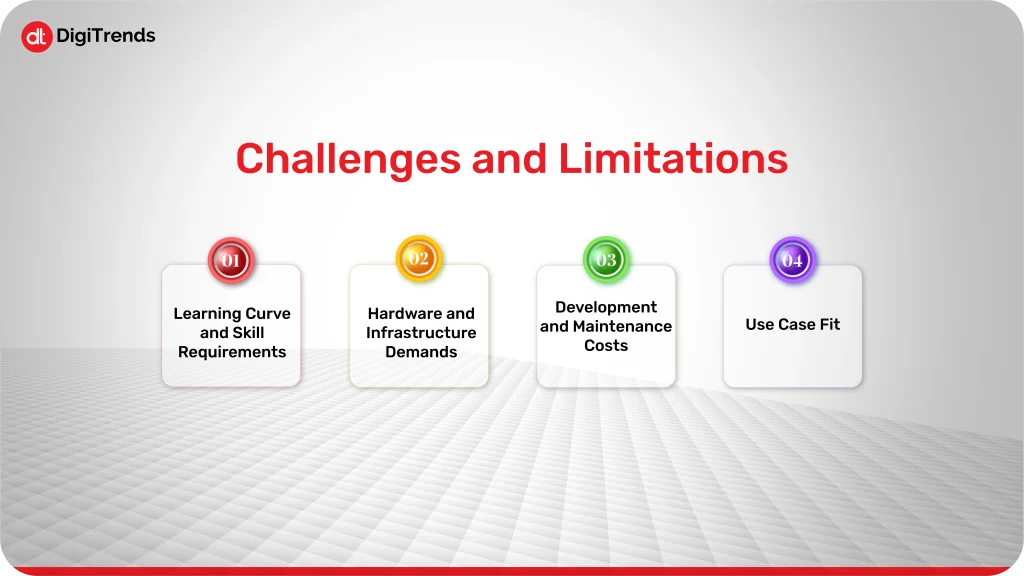
Challenges and Limitations of Unreal Engine 5 in Enterprise Environments
While Unreal Engine 5 for enterprise applications offers clear advantages, it is not a one-size-fits-all solution. Enterprises should understand their limitations before committing resources. A realistic view helps teams plan better and avoid friction during adoption.
1. Learning Curve and Skill Requirements
Unreal Engine 5 is powerful, but that power comes with complexity. Building real-time 3D enterprise applications requires skills that go beyond traditional enterprise software development. Teams may need time to learn new workflows, tools, and 3D concepts.
For organizations without in-house experience, this can slow early progress. Many enterprises address this by gradually upskilling teams or working with development partners specializing in enterprise 3D application development using Unreal Engine.
2. Hardware and Infrastructure Demands
High-quality real-time rendering places demands on hardware. Applications that rely on Unreal Engine 5 real-time 3D applications may require capable GPUs, especially for large environments or immersive simulations.
While cloud rendering can reduce local hardware constraints, it introduces considerations around latency, bandwidth, and ongoing operational costs. These factors should be evaluated early to avoid performance issues later.
3. Development and Maintenance Costs
Compared with simpler visualization tools, Unreal Engine 5 projects often require greater initial development effort. Creating accurate simulations or digital environments takes time, testing, and iteration.
In addition, Unreal Engine 5 simulation software must be maintained as enterprise systems, data sources, and workflows evolve. Enterprises should account for long-term updates and support, not just initial development.
4. Use Case Fit
Not every enterprise problem requires real-time 3D. For straightforward data reporting or simple workflows, traditional tools may be more efficient. Unreal Engine 5 delivers the most value when interactivity, realism, and simulation directly support business outcomes.
Understanding where UE5 adds measurable value is critical to successful adoption.
Addressing these challenges early allows enterprises to approach Unreal Engine 5 with realistic expectations. When applied to the right problems, its benefits often outweigh the limitations, but strategic planning makes the difference.
Is Unreal Engine 5 the Right Choice for Your Enterprise?
Deciding whether to adopt Unreal Engine 5 for enterprise applications depends on the problems you are trying to solve. Unreal Engine 5 delivers the most value when organizations need more than static visuals or basic simulations.
If your enterprise works with complex systems, physical environments, or processes that are difficult to explain through documents alone, real-time 3D enterprise applications can provide clarity. Industries such as manufacturing, healthcare, construction, and energy often benefit because their workflows involve scale, movement, and real-world constraints.
Budget and internal readiness also matter. Unreal Engine 5 projects typically require a higher upfront investment than traditional visualization tools. This includes development effort, hardware planning, and ongoing maintenance. Enterprises that view Unreal Engine 5 for business as a strategic capability rather than a short-term experiment tend to see stronger long-term returns.
Another key factor is integration. Unreal Engine 5 works best when it connects to existing enterprise systems and data sources. Organizations already investing in digital transformation, simulation, or immersive training are often better positioned to adopt enterprise 3D application development using UE5 successfully.
In simple terms, Unreal Engine 5 is the right choice when realism, interactivity, and simulation directly support decision-making, training, or operational improvement. When those needs exist, real-time 3D becomes a business enabler rather than a visual upgrade.
How DigiTrends Supports Enterprise Unreal Engine 5 Projects
DigiTrends works with enterprises that are exploring real-time 3D, AR/VR, and simulation as part of their digital transformation efforts. Our focus is on building practical solutions that align with real business needs rather than experimental or purely visual projects.
We support Unreal Engine 5 for enterprise applications by combining enterprise software development with immersive technology expertise. This includes designing and developing real-time 3D enterprise applications, interactive visualizations, and simulation-based solutions that integrate with existing systems and workflows.
In AR and VR projects, DigiTrends helps enterprises identify where immersive experiences add measurable value, such as training, visualization, or process understanding. Our approach emphasizes usability, performance, and long-term maintainability, ensuring that Unreal Engine 5 applications can scale as enterprise requirements evolve.
Conclusion
Unreal Engine 5 is no longer confined to creative industries. Across the US market, enterprises are using it to rethink how they design, train, simulate, and communicate. What sets Unreal Engine 5 apart is its ability to combine realism with interactivity, turning complex information into environments people can explore and understand.
For organizations adopting Unreal Engine 5 real-time 3D applications, the impact goes beyond visuals. Teams collaborate more effectively, decisions are made faster, and risks are reduced through simulation and testing. These outcomes support broader digital transformation goals and help enterprises adapt to increasing operational complexity.
At the same time, Unreal Engine 5 is not a universal solution. Its value depends on clear use cases, thoughtful integration, and long-term planning. When applied strategically, Unreal Engine 5 visualization for enterprises and simulation-driven workflows can deliver measurable business impact.
As real-time 3D continues to move into the enterprise mainstream, Unreal Engine 5 stands out as a platform that supports both innovation and practical business needs. For enterprises willing to invest with purpose, it represents a shift toward more informed, immersive, and effective ways of working.
Frequently Asked Questions
Unreal Engine 5 for enterprise applications is used to build real-time 3D environments for visualization, simulation, training, and digital twin development. Enterprises use it to explore complex systems interactively, test scenarios before implementation, and improve collaboration across technical and non-technical teams.
No. While Unreal Engine 5 is widely known for gaming, it is increasingly used for real-time 3D enterprise applications. Businesses apply it in industries such as manufacturing, healthcare, construction, and energy for simulation, training, and interactive visualization.
Unreal Engine 5 supports unreal engine 5 real-time 3d applications by rendering environments instantly as users interact with them. This allows enterprises to visualize changes, simulate workflows, and explore scenarios without waiting for static renders or offline processing.
Yes, Unreal Engine 5 is suitable for large-scale projects when used for the right use cases. It supports enterprise 3d application development through system integrations, scalable architecture, and deployment across on-premises, cloud, or hybrid environments. Proper planning and integration are essential for long-term success.
Submit Your Message
Author :Muhammad Ishaque
As the SEO Manager at DigiTrends, Muhammad leads organic growth initiatives by developing and executing data-driven SEO strategies that improve search visibility, drive qualified traffic, and support business growth. With extensive experience in technical SEO, on-page optimization, content strategy, keyword research, and performance analysis, he focuses on delivering sustainable search results that align with business objectives. His ability to identify search opportunities, analyze market trends, and implement scalable SEO solutions helps businesses strengthen their digital presence and achieve long-term success.
Recent Blogs
May 18th, 2026
How Predictive Analytics Helps Financial Services Stay Ahead of the Competition
Several technologies have been contributing to changes in how financial institutions operate and provide services to their customers. For a long time, AMCs, banks, and insurance companies have been changing their operations, moving towards digitalization and AI-powered solutions to enhance the customer experience and gain a competitive advantage in the finte...
Customer Experience Automation in 2026: How AI is Transforming CX Strategy
Explore how customer experience automation is used to fulfill modern customer demands, how AI helps in transforming CX strategy, key CX automation tools, real-world examples, and more.
Enabling First-Mover Advantage through Structured AI Adoption in KSA.
Driven by regional expertise and practical implementation experience, we help organisations in KSA move confidently from strategy to scalable AI execution with an approach aligned with Saudia’s Vision 2030 and SDAIA mandate.








 30 January 2026
  8 months ago
  989 Views