


 26 January 2026
  2 months ago
  156 Views

Unreal Engine 5 for Enterprise Applications and Real-Time 3D Use Cases
Explore how Unreal Engine 5 for enterprise applications is used and how organizations are using it in the real world.
Continue Reading
We build AI-powered software solutions designed to transform your vision into powerful, results-driven applications.

Providing Avant-Garde Mobile App Solutions.
Powerful apps made for the Apple ecosystem
Scalable apps built for android
Single codebase apps that work across platforms
Efficient apps built using React Native
High-performance apps made using Flutter
Providing Bespoke Mobile Game Development Services.
Delivering Innovative And Avant- Garde AR Solutions.
Our VR Development Services Allow Interaction With Simulated Surroundings.
Customised mobile apps for your Shopify shopfront.
Web Development Services With A Stellar Record Of Excellence.
Providing Web Design Services For All Industries.
Offering Custom And Robust PWA Solutions.
Bespoke E-Commerce Solutions For All Industries.
An Exceptional Success Record In CMS Development Services.
Customised software solutions to match corporate requirements.
Providing Business With Bespoke MVP Development Solutions.
DigiTrends Produces Essential Custom Software Solutions.
Transforming Brands With Innovative Digital Marketing.
AI-Powered Solutions. Wide-Ranging Industries. From finance to healthcare, our intelligent technologies drive innovation across every sector.


Revolutionizing Financial Services with Innovative Technology Solutions
Developing digital software to upgrade healthcare
Innovating learning experience with technology
Helping you step up your advertisement game
Reshaping automotive business experiences with tech
Transforming Real Estate with digital solutions
Digitalizing hospitality management with e-solution
Transforming the retail industry for with digital transformation
Transforming data into intelligent insights that drive innovation across multiple industries.
Delivering exceptional services across different cities, innovating here; and thriving everywhere!
Seek exceptional mobile app development in Delaware.
Where creativity and tech unite for innovation.
Seek advanced mobile app development in LA.
Unleash your business with our innovative mobile apps
Step into Austin’s mobile innovation hub.
Each business is unique; tailored approaches for all.
Leaders of mobile app development in Saudi Arabia
Meet the best app developers in Dubai
Meet the Nordik mobile development experts



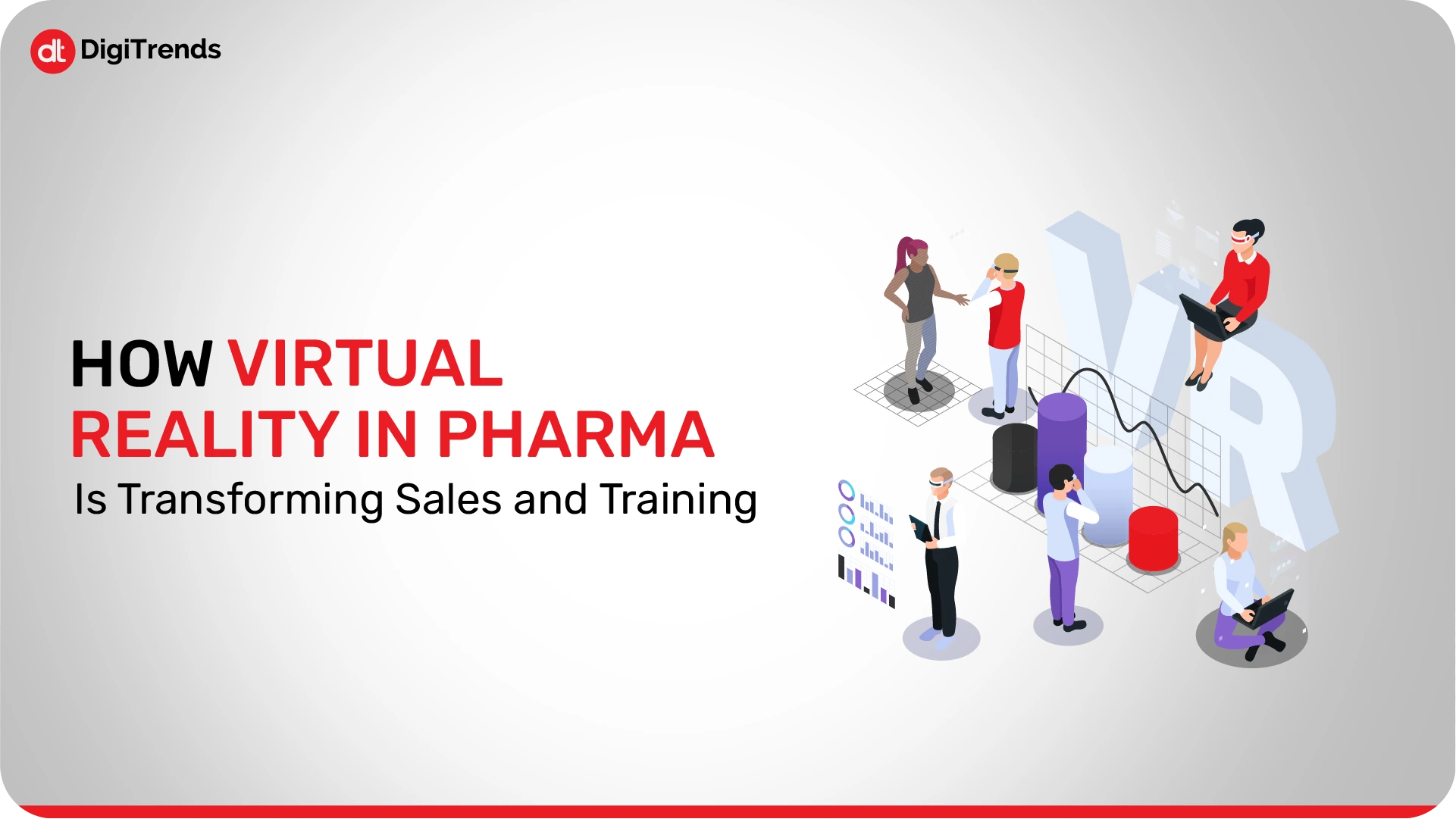
Every new drug launch or therapy is backed by a story, a story of complex science, clinical breakthroughs, and patient impact.
However, brand and product managers in the pharmaceutical industry struggle to present that story to doctors effectively enough for them to remember it. This occurs due to various reasons, including limited face time with healthcare professionals, crowded therapy areas, and the challenge of explaining mechanisms of action in simple and memorable terms. It proves to be challenging with traditional methods of showcasing, like brochures, slides, and videos; these methods often fall flat and leave no mark.
Imagine trying to demonstrate how a biologic drug interacts at the cellular level with traditional methods like 2D charts and slides in a fifteen-minute RTD. The message you would want to convey for your product might get lost in boredom and zoning out, leaving your team to hope the science sticks with doctors long enough.
This is exactly where VR in pharma caught the pain point and flipped the script. Now, instead of sales representatives going and explaining every little detail in hopes of getting some attention, they can just let doctors actually see it, interact with it, and provide them with such an experience that it sticks. Sales teams can demonstrate complex mechanisms in immersive 3D, product managers can ensure every message is consistent, and training teams can simulate real-world scenarios without losing precision or engagement.
If you are a pharma leader and are still not leveraging VR for your product as part of your marketing strategy, then you are seriously missing out on a very useful tool that can make products understood, remembered, and adopted. VR in pharma is already helping many brands leave extra explaining noise behind, boost engagement, and give every product the attention it deserves. Explore its applications, real-world use cases, and how it is the best for your strategy.
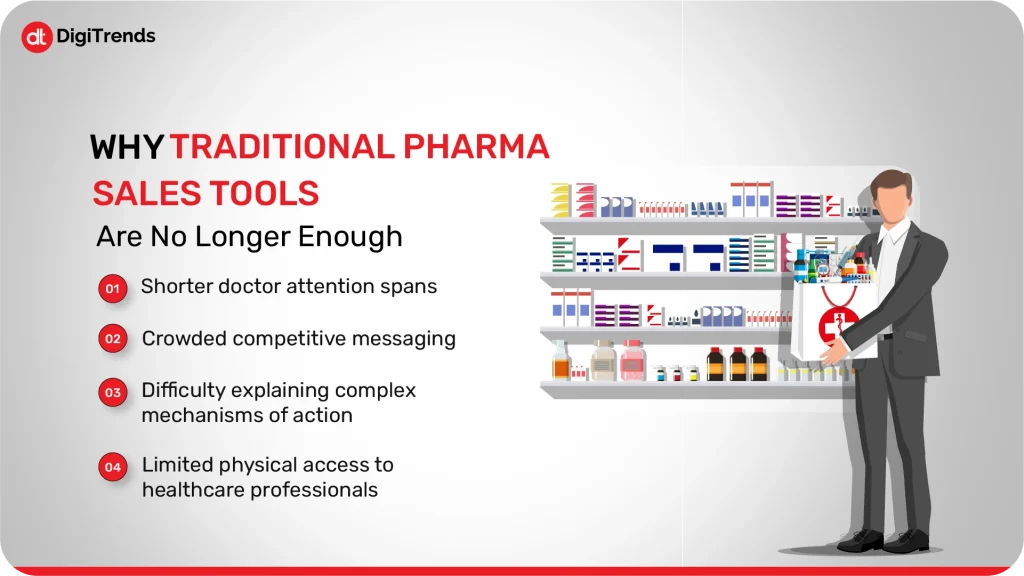
Traditional pharma tools and methods were made for a time when access to doctors was easier, and they had longer attention spans than now. The dynamics have changed long ago; now doctors expect a more differentiated messaging, and that too in less time, and this is the only way to earn their attention and interest. This is the reason why traditional approaches are near death now. Let’s have a look at some key reasons why traditional pharma sales tools are no longer enough.
Doctors are always under a strict schedule and usually do not have too much time for sessions which is why sales pitches are shorter, they usually get interrupted, and long explanations cannot work in such situations. When the product is described using slides, decks, and printed material, some information might be missed by the eyes, some might get skipped in a rush; this does not leave a good image of the product and doesn’t make it memorable. Complex product stories need more than a quick walkthrough, yet the time to explain them keeps shrinking.
This is one of the main gaps in pharma sales, and virtual reality in pharma can help address this perfectly. With virtual reality, you wouldn’t need to fit in too much information into small static slides; instead, you can create immersive experiences that will take less time, describe more, and 100% leave a mark.
In many therapy areas, differentiation is subtle. Multiple products compete with similar claims, clinical data, and outcomes. When every brand uses similar brochures and presentations, messages blur together.
Traditional tools make it difficult to stand out. VR in pharma offers a different approach by creating experiences that are memorable and distinctive. Within the broader virtual reality pharma landscape, brands are using immersive storytelling to cut through noise and position their products more clearly in the minds of healthcare professionals.
Mechanisms of action are often the most important part of a product’s story and the hardest to explain. Two-dimensional diagrams can only go so far when the science involves molecular interactions, biological pathways, or disease progression.
This is where VR in pharma becomes especially relevant. Immersive visualization allows doctors to see how a drug works within the body, making complex science easier to understand and recall. This capability is one of the strongest drivers of adoption.
Access restrictions, remote engagement, and changing interaction models have reduced the number of in-person meetings. While digital channels help fill the gap, many lack the depth needed to communicate complex value.
Virtual experiences bridge this divide. Whether used in-person or remotely, virtual reality in pharma creates meaningful engagement without depending entirely on physical access. For brand and product managers, this means maintaining strong product communication even when traditional face time is limited.
At a practical level, the value of virtual reality in pharma comes down to one thing: making complex products easier to understand, remember, and communicate. It doesn’t replace existing sales or training tools. It strengthens them where traditional formats fall short.
One of the biggest advantages of VR in pharma is how it turns abstract science into something tangible. Instead of relying on verbal explanations or flat visuals, virtual experiences allow healthcare professionals to see mechanisms of action unfold in three dimensions. This improves comprehension and reduces the need for lengthy explanations during short interactions.
For brand and product managers, consistency is another major challenge that virtual reality pharma solutions help address. VR experiences are built around a single, approved narrative. Every representative delivers the same core message, regardless of region or market. This reduces variation, supports compliance, and gives product teams more control over how their story is told.
VR in pharma also changes how engagement works. Doctors are no longer passive listeners. They interact, explore, and focus. This active participation leads to higher recall of key messages compared to traditional detailing methods. This shift from presentation to experience is one of the most valuable outcomes.
Ultimately, virtual reality in pharma solves a communication problem. It helps brands explain what matters, in less time, with greater impact, while aligning sales, training, and product strategy around a clearer, more memorable story.
Virtual reality is changing the way pharmaceutical sales conversations happen. Instead of relying on static materials and one-way explanations, virtual reality in pharma introduces interaction, clarity, and stronger recall into every engagement.
Let’s have a look at the key ways VR is reshaping pharma sales:
With VR in pharma, sales representatives can walk doctors through three-dimensional product experiences. Mechanisms of action, treatment pathways, and outcomes can be explored visually, making complex science easier to understand within limited visit times.
When multiple products compete with similar claims, it becomes difficult to stand out. Virtual reality pharma experiences create a distinct impression by turning product information into an experience rather than a presentation, helping brands stay memorable.
VR in pharma shifts doctors from passive listeners to active participants. This interaction improves focus and message retention, leading to more meaningful discussions during and after the visit.
As access to healthcare professionals becomes more restricted, virtual reality in pharma enables consistent, high-quality engagement both in-person and remotely. Sales teams can deliver the same approved experience regardless of location.
VR is proving to be a practical sales enablement tool. It helps sales teams communicate value more effectively, reduces reliance on lengthy explanations, and ensures that every interaction leaves a lasting impression.
Across the pharmaceutical industry, VR in pharma is being applied in ways that directly support sales, marketing, and training goals. These use cases are no longer experimental. They are solving real communication and engagement challenges for brand and product teams.
One of the most common applications of virtual reality in pharma is immersive detailing during doctor visits. Sales representatives use VR to demonstrate mechanisms of action, disease progression, or treatment impact in a visual, interactive format. This approach improves understanding and recall, especially for complex or differentiated products.
Product launches have evolved beyond physical events. Virtual reality pharma experiences are now used to support virtual or hybrid launches, allowing healthcare professionals to explore products in an immersive environment regardless of location. This expands reach while maintaining engagement and consistency across regions.
VR in pharma is also being used to explain diseases, symptoms, and treatment journeys in a more accessible way. Immersive storytelling helps healthcare professionals and patients better understand conditions that are difficult to explain through text or static visuals, supporting education and informed decision-making.
Within organizations, VR in pharma supports training, onboarding, and certification. Sales teams can practice real-world scenarios, reinforce scientific knowledge, and stay aligned with approved messaging. This leads to faster onboarding, stronger confidence, and more consistent communication in the field.
These use cases highlight how immersive technology is becoming a practical extension of pharma sales, marketing, and training strategies, not a replacement, but a powerful enhancement.
To see how virtual reality in pharma works in practice, it helps to look at how it can be applied to a specific product challenge.
DigiTrends developed a VR-based drug training and education solution for a pharmaceutical product focused on pneumonia awareness and treatment. The objective was not just to share information, but to improve understanding, recall, and confidence around the disease and the product’s role in treatment.
Instead of relying on traditional training modules, the experience was designed as a virtual clinic environment. Users entered a realistic clinical setting where a patient presented with symptoms and concerns related to pneumonia. This setup closely mirrors real-world interactions that healthcare professionals and sales teams encounter.
Within the experience, users were guided through a series of scenarios and questions. These interactions encouraged active decision-making rather than passive learning. By answering questions, exploring patient conditions, and progressing through the case, users gained a deeper understanding of pneumonia, its impact, and how the product fits into the treatment journey.
This approach reflects the real strength of VR in pharma. Learning happens through experience. Complex medical information becomes easier to absorb when users see it applied in a realistic context. The virtual clinic format also ensured consistency, accuracy, and alignment with approved messaging, which is critical across the VR in the pharma industry.
For brand and product teams, this type of virtual reality pharma solution supports multiple goals at once. It raises disease awareness, reinforces product knowledge, and equips teams with a stronger, more memorable understanding of the therapy. At the same time, it creates an engaging training environment that feels relevant, practical, and grounded in real clinical scenarios.
For brand and product managers, the real value of virtual reality in pharma lies in control, clarity, and impact. VR doesn’t just enhance presentations. It strengthens how products are positioned, understood, and remembered throughout their lifecycle.
In competitive therapy areas, small differences matter. VR in pharma helps highlight those differences by turning product benefits into experiences. When doctors can see how a drug works and why it matters, the message becomes harder to forget.
Virtual reality pharma experiences are built around a single, approved narrative. This ensures that every sales representative delivers the same core message, reducing variation and maintaining scientific accuracy across regions and teams.
Immersive experiences naturally hold attention longer than static materials. VR in pharma encourages interaction, which leads to stronger recall of key messages long after the interaction ends.
VR-based training allows teams to learn by doing. Sales representatives gain confidence faster, understand the product more deeply, and are better prepared for real-world conversations with healthcare professionals.
Adopting virtual reality in pharma signals innovation and leadership. It positions brands as forward-thinking and aligned with modern engagement expectations, an important factor in long-term brand perception.
Together, these benefits help brand and product managers move from simply delivering information to shaping how their products are truly understood in the market.

Pharmaceutical products are becoming more advanced, but the challenge of explaining them clearly has only grown. Limited time with doctors, crowded markets, and complex science demand better ways to communicate value.
Virtual reality in pharma offers a practical answer. By transforming product stories into immersive experiences, VR improves understanding, engagement, and recall across both sales and training. It helps brands stand out, equips teams to perform better, and ensures that complex science is communicated with clarity and consistency.
For brand and product managers, the shift is already underway. The question is no longer whether VR has a place in pharma, but how soon it will become part of the product strategy.
The brands that adopt AR VR in the pharma industry today are not just keeping up with change. They are setting the standard for how pharmaceutical products are presented, learned, and remembered.

Explore how Unreal Engine 5 for enterprise applications is used and how organizations are using it in the real world.
Continue Reading
AR virtual try-ons can be the game changer for your e-commerce brand, explore how various industries are using it and its challenges.
Continue Reading

Explore how AR apps for business can be a game-changer for you, and how a business can use AR for enhancing user experience.
Continue Reading
Let’s explore how AR, VR, and holograms are transforming the meaning, function, and interaction with public spaces.
Continue Reading
Explores the role of wearable tech integration in healthcare, the benefits, the challenges, and what the future holds for the best health wearable tech.
Continue Reading
Explore what Virtual Reality in healthcare is, its benefits, practical use cases, implementation challenges, future trends, and answers to FAQs.
Continue Reading