Unreal Engine vs Unity: A Comprehensive Comparison for 2026
Published
19 December 2025
Time
4 months ago
Views
186 Views
Muhammad Ishaque
I’m a dedicated SEO specialist who propels brands to new heights of online visibility and growth through digital strategies and analytical insights.
Table Of content
Share This Article
We’ve all come across gamers and even non-gamers who have these crazy game ideas, and honestly, some are really good.
You might also have thoughts like “Why has no one ever made a game like that?” This is because so much goes into game development that even the best game ideas never get to see the shine in the eyes of gamers because they get stuck in development issues.
Many crucial decisions need to be made when developing a game, like which tech stack to use, what content should be added, and even how to monetize it. Developers come across many choices when developing a game, and one of them is deciding between Unreal Engine vs Unity.
Unreal Engine and Unity are different game engines, and both are industry giants, but they offer different benefits. Unity is the perfect game engine if you are looking for flexibility or rapid prototyping, which makes it an ideal choice for mobile games and indie projects. On the other hand, Unreal Engine is built for cinematic games, which are high-fidelity and can rival AAA titles.
So, if you are someone planning to bring your own game idea to life, Unity vs Unreal is one of the choices you’ll have to make. Explore what each engine brings to the table so you can save time, effort, and frustration.
What is Unreal Engine?
Unreal Engine was developed by Epic Games in 1998, originally made for use in a first-person shooter video game called Unreal. It is a well-reputed gaming engine known for its cutting-edge graphics and flexibility, as it delivers high-fidelity visuals and immersive experiences.
The game engine has evolved through multiple versions over the past few years, and now the latest version, Unreal Engine 5, offers real-time rendering, photorealism, and advanced physics for games and interactive media.
In this game development platform, developers can use C++ for full control or Blueprints, a visual scripting system, to create complex logic without deep programming knowledge. Unreal Engine has various use cases like AAA games, VR experiences, and architectural visualization.
Statistics of Unreal Engine:
Unreal Engine holds a share of 28% of the games made on Steam in 2024.
Games that were powered by Unreal Engine sold 31% per unit compared to Unity.
What is Unity
Unity is quite a popular and widely used game development platform, which is known for the flexibility and speedy development it offers. It is also known to be beginner-friendly.
This game engine was released in 2005, designed to make game development more accessible for indie developers and small teams. It has now become the most popular engine in the world of game development, being used in the development of mobile games, 2D and 3D games, AR, VR, WebGL, and even cross-platform experiences.
What makes Unity easier to learn and quicker to implement ideas is its use of C# for scripting. It makes the lives of game developers easy by its lightweight architecture, massive asset store, and strong cross-platform support, which helps developers in building and deploying games across different devices with minimal friction.
Statistics of Unity:
71% of the top 1000 mobile games were created using the Unity engine, as identified by data.ai.
Unity was used in approximately 47.3% of the games published on Itch.io in 2025.
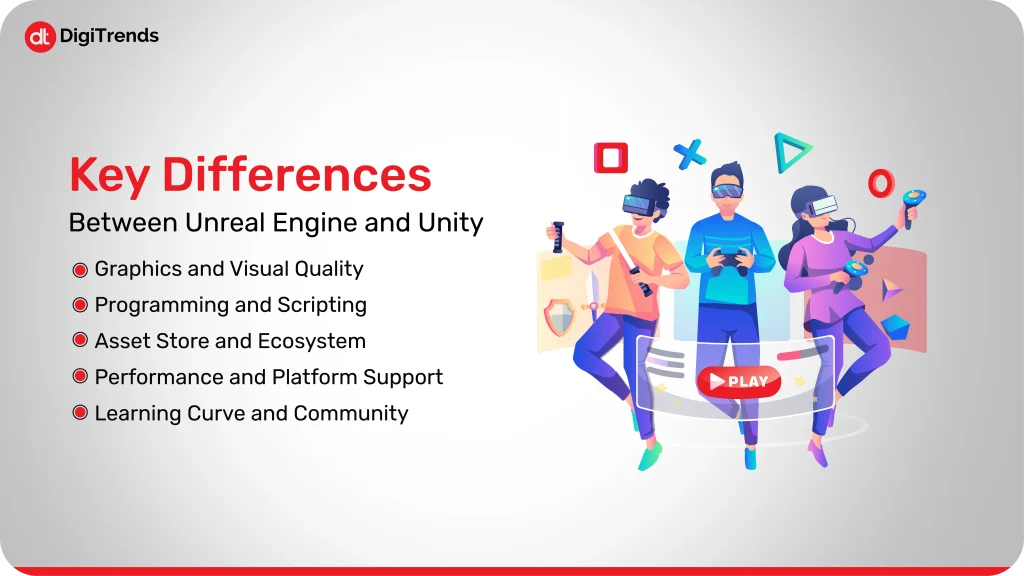
Key Differences Between Unreal Engine and Unity
It might look and sound like Unreal Engine and Unity solve the same problems, but in reality, when in practice, the approach of both engines in game development is very different, and those differences will only show the moment you start building your game.
Graphics and Visual Quality
The foundation of Unreal Engine is visual realism. This engine uses technologies like Nanite and Lumen that allow developers to work with highly detailed assets and dynamic lighting without heavy manual optimization. This is why Unreal Engine fits well with cinematic, photo-realistic games and large open worlds.
Unity, on the other hand, is more focused on efficiency rather than visual power. That does not mean that Unity is not for visuals; Unity can also produce impressive visuals for the fact, but its priority is performance and adaptability rather than strong aesthetic graphics and visuals.
Programming and Scripting
Unreal Engine provides game developers with C++ for engine-level control and Blueprints for visual scripting, which is called the hybrid approach. This is used by developers to mix high-level design with low-level optimization, but it can be complex for beginners in the gaming industry.
For scripting language, Unity relies on C#, which is considered easier comparatively in terms of easier and faster learning. The result of using an easier scripting language is cleaner workflows, and it proves to be the right fit for small teams and indie developers.
Asset Store and Ecosystem
Unity holds the strongest advantage when it comes to the ecosystem of game engines, as its asset store is huge and offers everything from UI kits and scripts to complete game templates, which helps developers work faster.
Unreal Engine’s marketplace is comparatively smaller, but the assets have high fidelity and are production-ready. Epic Games also offers free high-quality especially for creating realistic environments.
Performance and Platform Support
Unreal Engine works well for PCs and consoles while being demanding for system resources because it is optimized for high-end hardware.
On the other hand, Unity is a great choice for mobile games, web platforms, and AR/VR projects as it is comparatively more lightweight and highly scalable. It allows developers to create games for multiple devices with few adjustments through its smooth cross-platform deployment.
Learning Curve and Community
Unreal Engine’s power comes with a steeper learning curve, particularly when working directly with C++ and advanced rendering systems.
Unity is generally easier to pick up, thanks to simpler scripting, extensive documentation, and a huge global community. That community translates into tutorials, plugins, and troubleshooting support that make learning faster and less intimidating.
If you are stuck in choosing between Unreal Engine vs Unity, consider these key differences and reflect them with your game idea and demands to make the right choice.
Feature
Unity
Unreal Engine
Best Use Case
2D games, mobile, indie projects, AR/VR
AAA games, 3D titles, cinematic and high-fidelity experiences
Unreal Engine vs Unity: Advantages and Disadvantages
When it comes to game development, the debate around Unreal Engine vs Unity often comes down to priorities. There’s no universal winner here. The real question is whether your project benefits more from speed and flexibility or from visual depth and realism. Understanding the strengths and trade-offs of Unity vs Unreal makes that decision far easier.
Advantages of Unity
Unity shines when fast development and cross-platform reach matter most. It’s lightweight, flexible, and designed for rapid iteration, which is why many developers choose Unity or Unreal based on how quickly they want to move. Unity’s C# scripting is approachable, its asset store is massive, and deploying to mobile, web, AR, or VR platforms is relatively straightforward. For indie teams and startups, Unity versus Unreal often favors Unity because it lowers technical barriers and development costs.
Disadvantages of Unity
Where Unity falls short is in high-end visual realism. Achieving cinematic-quality graphics usually requires extra effort, custom shaders, or third-party tools. For large-scale or visually demanding projects, teams debating Unreal or Unity may find Unity less suitable unless significant optimization work is planned.
Advantages of Unreal Engine
Unreal Engine is built for visual impact. Its advanced rendering systems, real-time lighting, and physics capabilities make it ideal for AAA games and immersive worlds. Developers choosing between Unreal Engine and Unity often lean toward Unreal when realism and performance on high-end hardware are critical. Blueprints also allow designers to build complex mechanics without writing extensive code, making collaboration smoother on larger teams.
Disadvantages of Unreal Engine
That power comes with complexity. Unreal Engine has a steeper learning curve and can be demanding on both hardware and development time. For smaller projects or mobile-first games, teams comparing Unity vs Unreal may find Unreal excessive for their needs.
In the end, Unreal Engine vs Unity isn’t about which engine is better overall. It’s about choosing the one that aligns with your goals, your team’s expertise, and the type of game you want to build.
Unreal Engine vs Unity: Understanding Licenses and Subscriptions
When it comes to pricing and licensing, Unreal Engine vs Unity is less of a technical debate and more of a business decision. The engine you choose affects your budget, team structure, and how easily your game can scale. That’s why understanding how each platform charges is critical before committing long-term.
Unity Pricing Tiers and Subscription Models
Starting January 1, 2025, Unity officially rolled back its controversial Runtime Fee and returned to a seat-based subscription model. This move brought clarity and predictability back into the Unity vs Unreal comparison.
For teams weighing Unity versus Unreal, Unity’s pricing structure favors consistency. You know your costs upfront, which is especially useful for smaller teams focused on steady growth and predictable expenses.
Unreal Engine 5 Royalties and Licensing Terms
Unreal Engine follows a very different model. There’s no upfront cost to start building your game. Epic Games only applies royalties once your title crosses $1 million in lifetime revenue. This distinction plays a major role in the Unreal Engine or Unity decision.
In 2025, Epic also introduced the “Launch Everywhere with Epic” program. Games that launch on the Epic Games Store across platforms qualify for a reduced royalty rate of 3.5%, down from the standard 5%. This makes Unreal more appealing for developers planning multi-platform releases.
For anyone debating Unreal or Unity, Unreal’s pricing scales with success. That can be a huge advantage for high-budget projects, but it also introduces complexity for smaller studios that need tighter cost control.
In short, Unreal Engine vs Unity comes down to how you plan to fund, launch, and grow your game. Unity favors predictable subscriptions, while Unreal rewards commercial success with flexibility early on.
Well-Known Games Built with Unity
Title
Launch Year
Platforms
Game Type
Why It stands Out
Among Us
2018
PC, Mobile, Consoles
Social Deduction
Simple mechanics that scale perfectly across devices
Pokémon GO
2016
iOS, Android
AR Adventure
Blends real-world exploration with location-based gameplay
Beat Saber
2018
PC VR, PS VR
Rhythm / VR
Showcases Unity’s strong XR and VR capabilities
Call of Duty: Mobile
2019
iOS, Android
FPS / Battle Royale
Console-like shooter optimized for mobile
Cuphead
2017
PC, Consoles
Action Platformer
Hand-drawn art with smooth cross-platform performance
Genshin Impact
2020
PC, Mobile, Consoles
Action RPG
Large-scale open world built with mobile-first optimization
Hollow Knight
2017
PC, Consoles
Metroidvania
Indie classic known for performance and artistic polish
Well-Known Games Built with Unreal Engine
Title
Launch Year
Platforms
Game Type
Why It stands Out
Fortnite
2017
PC, Consoles, Mobile
Battle Royale
Live-service scalability and real-time updates
PUBG: Battlegrounds
2017
PC, Consoles
Battle Royale
Large maps with realistic lighting and physics
Gears 5
2019
PC, Xbox
Third-Person Shooter
High-end visuals and cinematic storytelling
Final Fantasy VII Remake
2020
PC, Consoles
Action RPG
Film-quality environments and character detail
Hellblade: Senua’s Sacrifice
2017
PC, Consoles
Action Adventure
Photorealistic facial capture and lighting
The Matrix Awakens
2021
PS5, Xbox Series X/S
Tech Demo
Showcases Unreal Engine 5’s Nanite and Lumen
ARK: Survival Evolved
2017
PC, Consoles
Survival
Massive open-world environments with dynamic systems
Make Your Game Idea A Playable Reality With DigiTrends
At DigiTrends, game development isn’t just about picking the right engine. It’s about turning raw ideas into experiences people actually want to play. Whether you’re building a fast-paced mobile game, an immersive experience, or a visually rich AR/VR 3D world, our team works across both Unity and Unreal Engine to match the technology with your vision, not the other way around.
We handle the full game development lifecycle, from concept design and prototyping to development, testing, and post-launch support. Our developers focus on performance, scalability, and player experience, making sure your game runs smoothly across platforms without sacrificing quality. From indie studios looking to launch their first title to businesses exploring gamified solutions, DigiTrends brings technical depth and creative clarity to every project.
If you’re deciding between Unity or Unreal, we help you make that call based on your goals, budget, and long-term roadmap. The result is a game that doesn’t just look good on paper, but performs in the real world.
Conclusion
The 2025 changes from Unity and Epic have reshaped the game development landscape. Unity’s return to a seat-based subscription and expanded accessibility for indie developers bring stability and predictability, while Epic’s reduced royalty rates through the “Launch Everywhere with Epic” program make Unreal Engine even more attractive for multi-platform projects.
Ultimately, the choice between Unity and Unreal comes down to a studio’s size, budget, and release strategy, with both engines offering compelling options for developers at every stage.
Frequently Asked Questions
Unity is generally better for beginners because of its simpler learning curve, C# scripting, and extensive tutorials. Unreal Engine is more powerful visually, but its tools and C++ foundation can feel overwhelming for first-time developers.
Unreal Engine is better for high-end, cinematic, and AAA-style games, while Unity excels in mobile, indie, and cross-platform game development. The better choice depends on your project goals, team size, and target platforms.
Unity uses a subscription-based pricing model with fixed annual costs, while Unreal Engine is free upfront and charges royalties only after your game reaches a revenue threshold. Unity offers predictable expenses, whereas Unreal’s costs scale with success.
Yes, Unity can be used to build AAA-quality games, but it often requires more optimization and custom work to match Unreal Engine’s visual realism. Unreal Engine is purpose-built for high-fidelity graphics and large-scale environments.
Unity is typically the preferred choice for mobile game development due to its lightweight architecture, strong performance optimization, and easier deployment across iOS and Android. Unreal Engine is more suitable for mobile games that require advanced visuals and higher processing power.
Submit Your Message
Author :Muhammad Ishaque
I’m a dedicated SEO specialist who propels brands to new heights of online visibility and growth through digital strategies and analytical insights.
Recent Blogs
November 17th, 2025
How Many Levels Are in Candy Crush Saga? Insights From DigiTrends
If you are someone who has played Candy Crush Saga or knows about this game, you must have at least once wondered how many levels are in Candy Crush Saga. Get to know now.
How to Make a VR Game: Complete Beginner Guide 2025
Virtual Reality feels like a science fiction concept, but it is a reality, and it is changing the way we experience games. Learn how to make a VR game.
How to Build a Mobile Game Like PUBG: A Complete Guide to Mobile Game Development in 2025
This post comprehensively guides the development of a mobile game like PUBG in 2025, covering concept planning, game design, production, testing, marketing, monetization, and future trends such as AI, AR/VR, and blockchain.









 19 December 2025
  4 months ago
  186 Views