


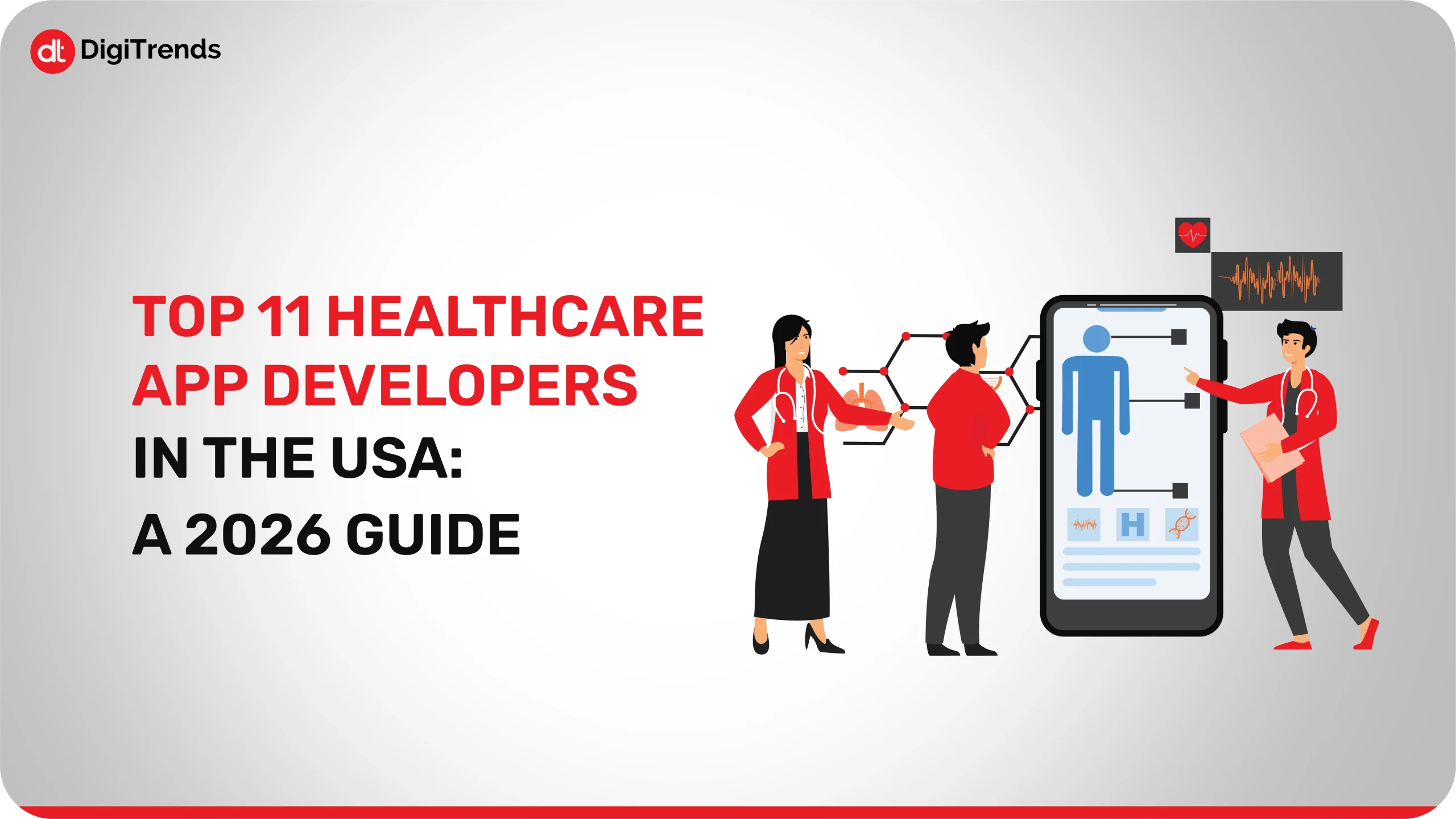
Top 11 Healthcare App Developers in the USA: A 2026 Guide
Have a look at the top 11 healthcare app developers in the USA in 2026 and what makes them stand out.
Continue Reading
We build AI-powered software solutions designed to transform your vision into powerful, results-driven applications.
Providing Avant-Garde Mobile App Solutions.
Powerful apps made for the Apple ecosystem
Scalable apps built for android
Single codebase apps that work across platforms
Efficient apps built using React Native
High-performance apps made using Flutter
Providing Bespoke Mobile Game Development Services.
Delivering Innovative And Avant- Garde AR Solutions.
Our VR Development Services Allow Interaction With Simulated Surroundings.
Customised mobile apps for your Shopify shopfront.
Web Development Services With A Stellar Record Of Excellence.
Providing Web Design Services For All Industries.
Offering Custom And Robust PWA Solutions.
Bespoke E-Commerce Solutions For All Industries.
An Exceptional Success Record In CMS Development Services.
Customised software solutions to match corporate requirements.
Providing Business With Bespoke MVP Development Solutions.
DigiTrends Produces Essential Custom Software Solutions.
Transforming Brands With Innovative Digital Marketing.
AI-Powered Solutions. Wide-Ranging Industries. From finance to healthcare, our intelligent technologies drive innovation across every sector.

Revolutionizing Financial Services with Innovative Technology Solutions
Developing digital software to upgrade healthcare
Innovating learning experience with technology
Helping you step up your advertisement game
Reshaping automotive business experiences with tech
Transforming Real Estate with digital solutions
Digitalizing hospitality management with e-solution
Transforming the retail industry for with digital transformation
Transforming data into intelligent insights that drive innovation across multiple industries.


Delivering exceptional services across different cities, innovating here; and thriving everywhere!

Seek exceptional mobile app development in Delaware.
Where creativity and tech unite for innovation.
Seek advanced mobile app development in LA.
Unleash your business with our innovative mobile apps
Step into Austin’s mobile innovation hub.
Each business is unique; tailored approaches for all.
Leaders of mobile app development in Saudi Arabia
Meet the best app developers in Dubai
Meet the Nordik mobile development experts

 06 March 2026
 3 weeks ago
 146 Views


In application development, businesses should avoid standard solutions as the market is increasingly competitive across industries. Every business operates with different objectives, goals, and target audiences, which means a custom software application is the best way to achieve its goals and gain a competitive advantage.
Let’s explore an effective roadmap for custom application development that leaders need to understand, plan, and implement to help business leaders make decisions based on a balanced approach that can lead to both short-term and long-term growth.
Custom application development involves creating software that includes features useful for addressing specific business requirements and objectives. It contrasts with normal development, where all is developed based on the ground, to suit specific company workflows, procedures, and objectives, unlike standard software that is used by a more general population.
What it includes:
Custom software application development can range from internal tools for improving operational efficiency to external platforms that enhance customer engagement. For executives, the value of a custom app does not lie in its functionality but in the ability to align technology closely with business strategy.
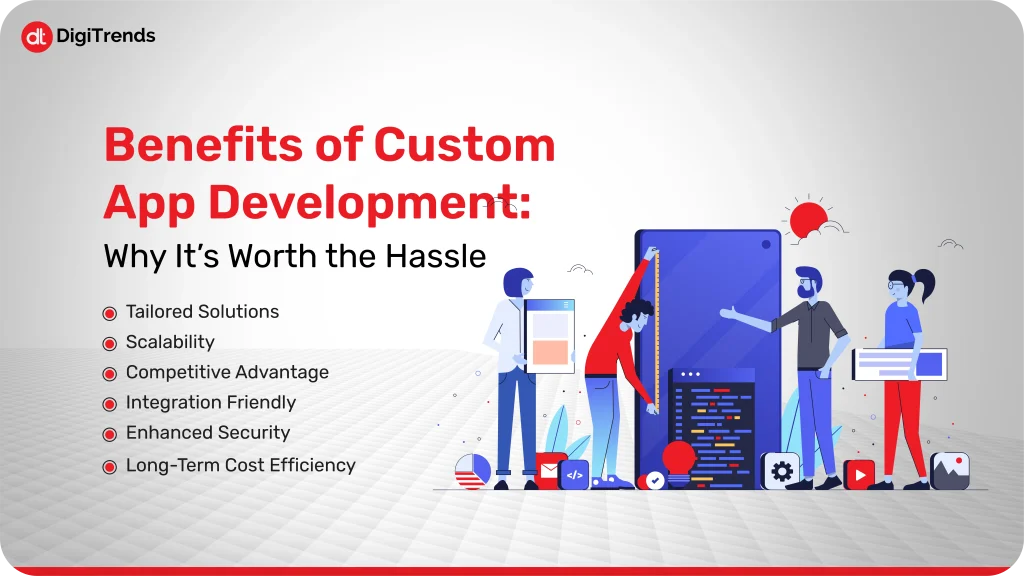
Well! Because custom app development is more expensive and time-consuming than using an off-the-shelf solution, businesses might feel hesitant to opt for it. But businesses need to focus on the long-term advantages it provides, as it helps them grow and obtain a competitive edge.
Off-the-shelf software often forces businesses to adapt their processes to the software. With a custom business application development approach, every feature is built to fit your operations, reducing inefficiencies and errors.
As your business grows, so do your software needs. Custom software application development allows you to add new modules, accommodate more users, and integrate emerging technologies without major disruptions. Hence, your software should be able to scale with the business accordingly.
With a custom application development strategy, businesses can achieve a competitive advantage in the market by having a workflow, analytics tool, or customer-facing platform specially created for their target audience and goals.
Many companies operate with multiple systems, CRM, ERP, analytics tools, and more. Custom applications are designed to integrate seamlessly, ensuring smooth workflows and data consistency.
Security is a very important part of every digital platform, and custom app development lets you implement protocols according to your organization’s risk profile, from encryption standards to access control policies.
While upfront investment is higher, avoiding recurring licensing fees and unnecessary features of generic software can make custom software application development more cost-effective over time.
These benefits make it clear why investing in custom application development is not just a technical decision; it’s a strategic business move.
Opting for generic software seems like a cost-effective option at first, but the real cost occurs when growth is paused.
And this reflects in data silos, human errors, and long processes. The biggest sign is when the organization begins to adapt to the software instead of the software adapting to the business growth.
These shifts do not feel like a problem at first, as it starts occurring slowly through procedures that no one notices. Such as:
If we think about it, no one would be able to notice that these are the signs of the software failing to provide the organization with what it is supposed to provide, and that is improved operations. As the business grows, those small gaps turn into daily friction. Employees spend more time managing systems than serving customers or improving strategy.
A custom application makes sure there are no gaps left in the workflows and processes. It is designed according to the way the business works. As a business, your workflows, approval processes, reporting needs, and growth plans shape the system from day one.
The result of a custom solution in the long-term comes in the form of simpler operations, clearer data, and faster decisions. You just have to keep in mind that whatever tool you choose should be able to bend according to your business instead of the other way around, because this is the difference that becomes more valuable with every stage of growth.
One of the most common executive challenges is whether to build or purchase software. The difference is also important because, as a business, you should know how to make informed decisions.
Off-the-Shelf Solutions
Custom Application Development
Many business leaders decide on choosing between of the shelf solution and custom application development by asking which is better, but what they usually ignore is which option will help them achieve growth by reducing operational complexity and pushing towards long-term goals. If flexibility, scalability, and differentiation are your priorities, then custom application development is your best option.
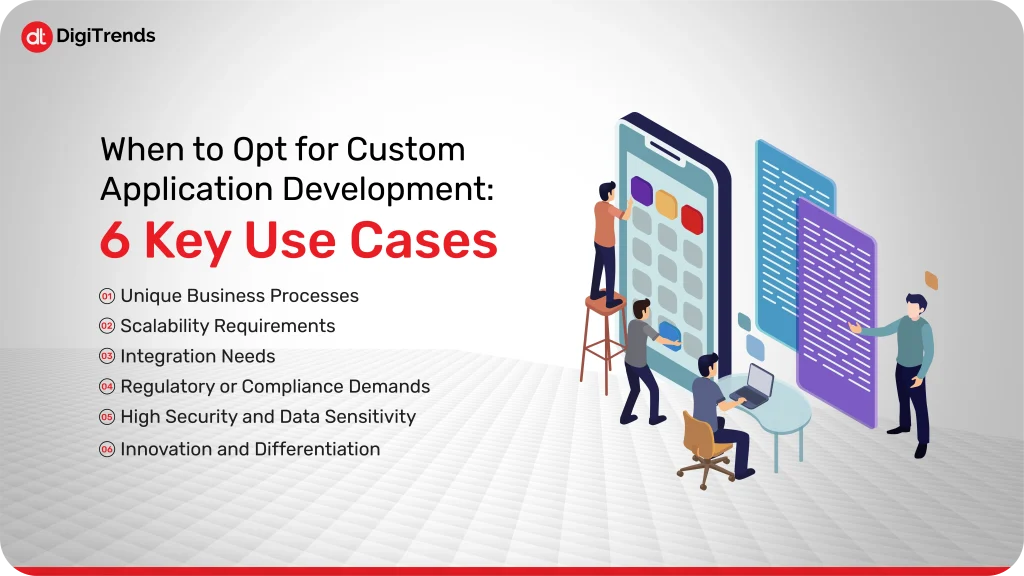
It is difficult to understand when your business needs a custom solution and when you can go with standard software. Let’s have a look at six use cases where custom app development provides clear value:
Off-the-shelf software may not accommodate specialized workflows. A custom business application development approach ensures processes are automated and optimized without forcing changes that disrupt operations.
If you look forward to rapid business growth and the business experiences fluctuating demand, then custom software application development is the best option for you, as it will allow your technology to scale seamlessly with minimal downtime.
Businesses often rely on multiple systems. If you opt for a custom application, you will be able to integrate data from CRM, ERP, or analytics platforms, which will further ensure that the workflows are connected and efficient.
Industries with strict regulations, such as finance, healthcare, or legal services, benefit from custom application development that includes compliance checks, reporting, and audit trails built in.
Companies handling sensitive data require tailored security measures. Custom software application development allows implementation of advanced protocols, encryption, and controlled access.
When your business strategy relies on unique offerings, custom app development enables features and services competitors cannot easily replicate, positioning your organization as a market leader.
Understanding these scenarios helps executives make strategic decisions about when the investment in a custom solution will yield the greatest ROI.
Building a custom software application can feel complex, but a structured approach simplifies the process.
Clearly outline the business problems the application will solve, the target users, and measurable goals. A well-defined scope sets the foundation for successful development.
Decide whether to develop in-house or partner with a specialized firm. Evaluate technology stacks, frameworks, and methodologies suitable for your objectives.
Develop wireframes and prototypes to visualize workflows and user interfaces. This stage ensures that stakeholders align on functionality before coding begins.
Implement coding in iterations, conduct rigorous testing, and gather feedback. Custom application development benefits from agile methodologies, allowing refinements throughout the process.
Launch the application and monitor performance. Gather user feedback and plan regular updates. A custom software application is never truly “finished”; it evolves with business needs.
Following these steps ensures that your custom app development efforts result in a solution that delivers both operational efficiency and strategic value.
Even with a clear roadmap, certain factors are critical to ensure success in custom software application development. Let’s have a look at the main ones:
If you are looking to develop a custom application for your business the these are the factors that can help you achieve the best possible results.
DigiTrends transforms the development of custom applications into a competitive advantage. We create unique software programs that work flawlessly, scale effectively, and integrate with your current systems by comprehending your business objectives and procedures. Each solution is specifically crafted to provide business leaders with complete control and insight while yielding quantifiable outcomes.
DigiTrends oversees the entire lifecycle, from design and planning to deployment and continuing support. Their collaborative, agile approach guarantees timely, secure, and long-term growth-optimized custom app development, enabling your company to stay ahead of the competition and innovate more quickly.
Conclusion
Custom application development is more than a technical initiative; it is a strategic lever for business growth, operational efficiency, and market differentiation. While off-the-shelf solutions may suffice for standard processes, companies that require scalability, integration, or unique features gain the most from a tailored approach.
By understanding what custom app development entails, weighing its benefits, and following a structured approach from planning to deployment, executives can make informed decisions that drive measurable impact. Investing in custom software application development positions organizations to not only meet current business needs but also adapt and thrive in an ever-evolving market.
Have a look at the top 11 healthcare app developers in the USA in 2026 and what makes them stand out.
Continue Reading
Explore the mobile app marketing trends in 2026 that are important for an app to grow in this market.
Continue Reading
Explore how to choose a software development company that will not just provide what you ask for but also align perfectly with your goals.
Continue Reading
Explore what Proof of Concept (PoC) in software development is, how it benefits teams in making better decisions, and how it works.
Continue Reading

Explore which delivery app pays the most in 2026 and how the top platforms combine smart technology and incentives to keep drivers earning more.
Continue Reading
DigiTrends has been officially recognized by Techreviewer.co as one of the Top Financial App Development Companies for 2025.
Continue Reading