


Mastering Custom Application Development: A Playbook for Business Leaders
Explore an effective roadmap for custom application development that leaders need to understand, plan, and implement.
Continue Reading
We build AI-powered software solutions designed to transform your vision into powerful, results-driven applications.
Providing Avant-Garde Mobile App Solutions.
Powerful apps made for the Apple ecosystem
Scalable apps built for android
Single codebase apps that work across platforms
Efficient apps built using React Native
High-performance apps made using Flutter
Providing Bespoke Mobile Game Development Services.
Delivering Innovative And Avant- Garde AR Solutions.
Our VR Development Services Allow Interaction With Simulated Surroundings.
Customised mobile apps for your Shopify shopfront.
Web Development Services With A Stellar Record Of Excellence.
Providing Web Design Services For All Industries.
Offering Custom And Robust PWA Solutions.
Bespoke E-Commerce Solutions For All Industries.
An Exceptional Success Record In CMS Development Services.
Customised software solutions to match corporate requirements.
Providing Business With Bespoke MVP Development Solutions.
DigiTrends Produces Essential Custom Software Solutions.
Transforming Brands With Innovative Digital Marketing.
AI-Powered Solutions. Wide-Ranging Industries. From finance to healthcare, our intelligent technologies drive innovation across every sector.


Revolutionizing Financial Services with Innovative Technology Solutions
Developing digital software to upgrade healthcare
Innovating learning experience with technology
Helping you step up your advertisement game
Reshaping automotive business experiences with tech
Transforming Real Estate with digital solutions
Digitalizing hospitality management with e-solution
Transforming the retail industry for with digital transformation
Transforming data into intelligent insights that drive innovation across multiple industries.

Delivering exceptional services across different cities, innovating here; and thriving everywhere!
Seek exceptional mobile app development in Delaware.
Where creativity and tech unite for innovation.
Seek advanced mobile app development in LA.
Unleash your business with our innovative mobile apps
Step into Austin’s mobile innovation hub.
Each business is unique; tailored approaches for all.
Leaders of mobile app development in Saudi Arabia
Meet the best app developers in Dubai
Meet the Nordik mobile development experts

 24 February 2026
 1 month ago
 196 Views


Ever wondered why the most innovative and creative software ideas fail to create the expected impact or drive good results?
Most would say “The idea didn’t work how it was expected to.”
But in most cases, that is not true; what sinks the whole software project is the software development partners chosen by the owners.
Yes! Your software’s success highly depends on which custom software development company you choose because it’s not only a simple decision; It’s a strategic move that can either accelerate your growth or quietly drain your resources.
If you’re wondering how to choose a software development company, here’s the reality: the decision impacts far more than code quality. It affects your product roadmap, operational efficiency, customer experience, and ultimately, revenue.
Your wrong decision when choosing a software development partner won’t look like a loud fail; it will reflect in different setbacks like missed deadlines, unclear communication, constant rework, or a product that technically works but never truly scales.
This happens because some businesses rush into decisions and agreements with software development companies, when they should first validate if the company’s skills and work culture align with the set project goals or not. This leads the business to pull far from its long-term vision and drown in budget overruns, frustrated internal teams, and products that stall before reaching market potential.
Mostly, when businesses realize their project is sinking due to the wrong choice of the software development company, it’s too late, as either the project is now complete, or they are in the middle of development now, which is worse.
Always keep in mind that what seems like a lower upfront investment often turns into the most expensive decision in the lifecycle of your product. So it’s better to go through a checklist of “how to choose a software development company that can drive desired results” rather than rushing into making a not so thought-out decision.
Now let’s see what would happen if everything goes right.
If you choose the right custom software development company, they will do a lot more than just execute tasks for you. They will challenge assumptions, refine your product thinking, and help you make smarter technical decisions early.
That’s why it is crucial to understand how to choose the right software development partner, because this way you can move beyond transactional outsourcing and into strategic collaboration. That’s where the real value of your project will be created.
Strong software development partners contribute to:
In simple words, the right software development company will not just cut to cut provide what you ask for, they will also help you build what actually aligns with your long-term goals.
Whether you’re launching a new platform or replacing an underperforming vendor, understanding what to look for in a software development company is critical. Let’s have a look at how to choose a software development company that can help achieve the best results.
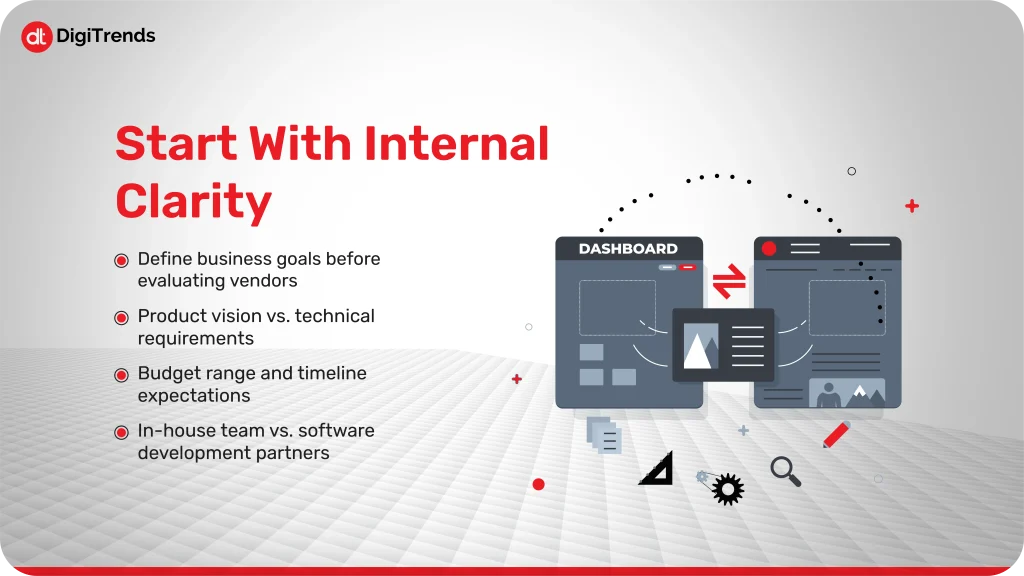
Before you even reach out to potential software development partners, it’s essential to get your own house in order. Many businesses fail to define their objectives clearly, which leads to misaligned expectations and wasted time.
Start by asking yourself:
Clear goals will help you:
Without this clarity, even the most competent custom software development company can struggle to deliver results that truly matter.
A common mistake is confusing technical requirements with product vision. Your product vision defines what success looks like for your users and business. Technical requirements are just the roadmap to get there.
By separating the two, you can:
Be realistic about what you can invest and when you need results. Transparent budget and timeline ranges allow software development partners to propose realistic solutions rather than over-promising and under-delivering.
Factors to consider:
Finally, evaluate what capabilities you already have internally. Some projects require full outsourcing, while others benefit from a hybrid model where your in-house team collaborates with a software development partner.
This assessment will guide your selection process, ensuring that the partner complements your strengths rather than duplicating efforts.
When looking for the right software development partner, do not only look for immediate delivery, but also look for a collaborator who can help you grow your business and build software that adapts to that growth, too.
Technical skills are important, but alignment in work culture and communication style often determines success. You can ask yourself questions like:
A mismatch in collaboration style can lead to misunderstandings, delays, and frustration, even if the code itself is solid.
Hidden fees and ambiguous contracts are a common pitfall. The right custom software development company will offer:
This transparency builds trust and ensures there are no surprises mid-project.
Understanding the vendor’s development methodology is crucial. Agile approaches offer:
Waterfall might suit projects with well-defined, stable requirements, but most modern digital products benefit from an Agile partnership that encourages iterative improvement.
Long-term success depends on measurable outcomes. Set Key Performance Indicators (KPIs) to monitor:
Regular performance reviews with your software development partner keep the project on track and aligned with business objectives.
Every project has risks, scope creep, technology mismatches, or shifting priorities. The best partners proactively:
A vendor who addresses risk thoughtfully reduces surprises and ensures project continuity.
When evaluating software development partners, price is only part of the equation. What truly matters is the overall value they deliver, quality, efficiency, scalability, and long-term impact. Understanding the trade-offs can prevent costly mistakes.
Choosing between offshore and onshore teams involves balancing cost with collaboration efficiency:
| Factor | OffShore Teams | OnShore Teams |
| Hourly Rate | Lower | Higher |
| Time Zone Alignment | Can be challenging | Tightly Aligned |
| Communication | Potential delays | Easier real-time collaboration |
| Cultural Fit | May require adaptation | Generally easier to align |
| Access to Talent | Wide global pool | Local expertise only |
| Project Management Overhead | Higher | Lower |
Lower cost doesn’t always mean better value if communication gaps or time differences slow your progress.
Don’t focus solely on the hourly rate. Total cost of ownership considers the complete lifecycle of your product:
A custom software development company with a higher rate upfront may reduce long-term costs through clean architecture, efficient code, and fewer bugs.
Value is about the business impact. Ask:
Focusing on ROI ensures the software delivers measurable outcomes beyond just completing tasks.
Cutting corners might save money at the start, but lead to high costs later:
Selecting a software development partner based on expertise, reliability, and strategic alignment usually outweighs the temptation to go for the lowest bid.
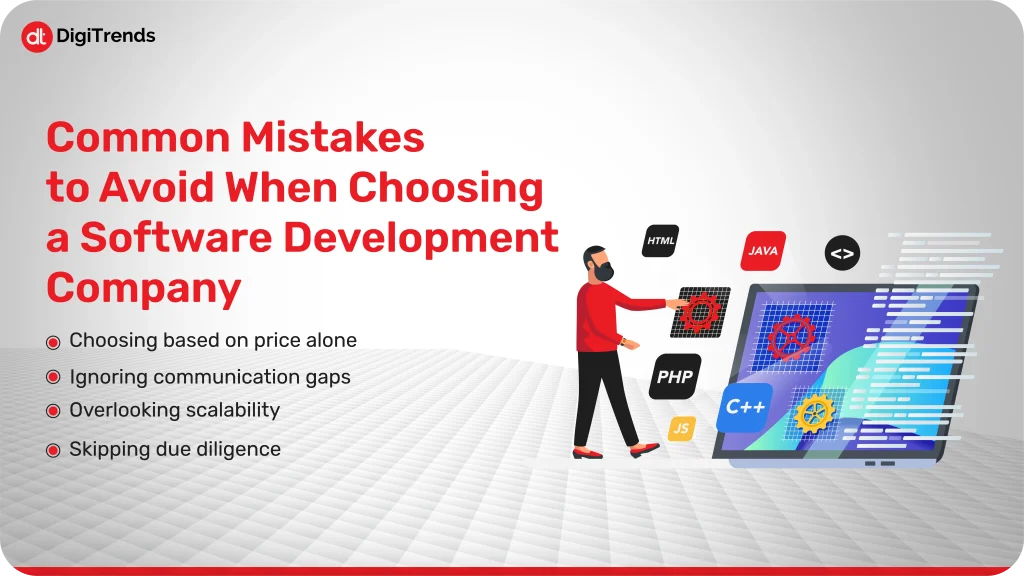
Even seasoned decision-makers can make missteps when selecting a software development partner. Being aware of these common pitfalls can save both time and money.
Going for the lowest bid may seem cost-effective initially, but it often leads to compromised quality, slower delivery, and hidden technical debt. Focus on the overall value the partner brings, not just the upfront rate.
Technical expertise won’t matter if updates and expectations are unclear. Poor communication can cause misunderstandings, missed deadlines, and rework. Choose a partner who prioritizes transparency and responsiveness.
A solution that works today might not meet tomorrow’s needs. Ensure the vendor builds systems that can grow with your business, support additional features, and handle increasing user demand without major rework.
Rushing the selection process or neglecting reference checks can backfire. Evaluate past projects, talk to existing clients, and confirm the team’s experience in your industry to avoid surprises down the line.
Choosing the right software development partner is one thing, and DigiTrends bridges that gap by offering end-to-end solutions tailored to your business goals.
We specialize in custom software development, combining technical expertise with strategic insight to ensure your projects not only meet requirements but also deliver measurable impact. From early-stage consultation to post-launch support, DigiTrends acts as a collaborative partner, guiding you through every decision and helping you scale efficiently.
Our approach emphasizes:
With DigiTrends, your software development journey becomes more than outsourcing; it becomes a strategic advantage.
Selecting a software development partner is more than a one-off decision; it’s an investment in your company’s future. The right partner goes beyond coding tasks, becoming a strategic collaborator who helps you innovate, scale, and achieve your business objectives.
When you understand how to choose a software development company, you focus not just on immediate delivery, but on long-term value: aligning culture, setting clear KPIs, mitigating risks, and ensuring your software grows with your business.
A strong custom software development company transforms from a vendor into a trusted extension of your team, guiding decisions, refining processes, and driving measurable outcomes. By prioritizing transparency, collaboration, and scalability, you turn your partnership into a sustainable competitive advantage.
Investing time and thought into selecting the right partner today saves high costs, headaches, and missed opportunities tomorrow. Your software development partner should be someone you can rely on, not just for a project, but for ongoing innovation and growth.
Explore an effective roadmap for custom application development that leaders need to understand, plan, and implement.
Continue Reading
Explore what Proof of Concept (PoC) in software development is, how it benefits teams in making better decisions, and how it works.
Continue Reading
Explore healthcare software development costs in the Middle East and how businesses can plan smarter in 2026 without compromising quality.
Continue Reading

Explore how DigiTrends approached HCP Portal Development with features like webinars, telemedicine, online CMEs, and more.
Continue Reading

Explore the predictive analytics in healthcare examples, Its benefits, and the impact it’s creating for both patients and professionals.
Continue Reading
Looking for HCM software development that will fit with your business goals? This blog will walk you through the full process from planning to launch.
Continue Reading