



Top 11 Healthcare App Developers in the USA: A 2026 Guide
Have a look at the top 11 healthcare app developers in the USA in 2026 and what makes them stand out.
Continue Reading
We build AI-powered software solutions designed to transform your vision into powerful, results-driven applications.

Providing Avant-Garde Mobile App Solutions.
Powerful apps made for the Apple ecosystem
Scalable apps built for android
Single codebase apps that work across platforms
Efficient apps built using React Native
High-performance apps made using Flutter
Providing Bespoke Mobile Game Development Services.
Delivering Innovative And Avant- Garde AR Solutions.
Our VR Development Services Allow Interaction With Simulated Surroundings.
Customised mobile apps for your Shopify shopfront.
Web Development Services With A Stellar Record Of Excellence.
Providing Web Design Services For All Industries.
Offering Custom And Robust PWA Solutions.
Bespoke E-Commerce Solutions For All Industries.
An Exceptional Success Record In CMS Development Services.
Customised software solutions to match corporate requirements.
Providing Business With Bespoke MVP Development Solutions.
DigiTrends Produces Essential Custom Software Solutions.
Transforming Brands With Innovative Digital Marketing.
AI-Powered Solutions. Wide-Ranging Industries. From finance to healthcare, our intelligent technologies drive innovation across every sector.


Revolutionizing Financial Services with Innovative Technology Solutions
Developing digital software to upgrade healthcare
Innovating learning experience with technology
Helping you step up your advertisement game
Reshaping automotive business experiences with tech
Transforming Real Estate with digital solutions
Digitalizing hospitality management with e-solution
Transforming the retail industry for with digital transformation
Transforming data into intelligent insights that drive innovation across multiple industries.
Delivering exceptional services across different cities, innovating here; and thriving everywhere!

Seek exceptional mobile app development in Delaware.
Where creativity and tech unite for innovation.
Seek advanced mobile app development in LA.
Unleash your business with our innovative mobile apps
Step into Austin’s mobile innovation hub.
Each business is unique; tailored approaches for all.
Leaders of mobile app development in Saudi Arabia
Meet the best app developers in Dubai
Meet the Nordik mobile development experts

 10 October 2025
 6 months ago
 178 Views


The way people approach fitness keeps evolving with time as technology changes.
A few years ago, whenever someone mentioned fitness, the only things that came to mind were gyms or workout spaces. But now things have changed a lot. Now, when someone mentions fitness, we think about fitness apps, home workouts, diets, etc. This shows how much the fitness industry has changed over time.
Today, millions of people turn towards their phones, iPads, or tablets for structured workouts, motivation, progress, tracking, and even personalized workout routines.
This shift in the trend has given rise to home workout apps as they come with both convenience and personal guidance.
So what is the challenge for people looking to build a home workout app?
The challenge is that the market is now full of fitness app options; there are many categories of these types of apps, such as home workout apps, dieting apps, progress tracking apps, etc. Only some apps can keep users engaged long-term, so the competition is tough, and it is about which app stands out for the users.
For someone looking to build the best home workout app, you need to understand the expectations of modern users and how to build an intuitive and rewarding experience for them.
Explore the market trends and user expectations for the must-have features, design approach, and tech stack that can set your home workout app apart from others.
The fitness app boom started in the early days of the pandemic, and it has not slowed down since due to the convenience that comes with it. Users are now not only looking for quick home workouts, but they are also looking for complete fitness ecosystems that can easily adapt to their lifestyles.
According to a recent study, the home workout app market size is projected to reach USD 6.04 billion by 2033. This depicts the rising demand for these apps.
While the demand for home workout apps is strong, the challenge is to keep retaining users beyond 30 days. The best performing apps in this market use features like gamification, personalization, and community features to keep their users engaged.
As artificial intelligence is shaping the future of almost every industry, it is also changing things for the fitness industry, and users now expect AI-driven routines, progress tracking, and real-time feedback too.
Some users also like to switch between home workouts and gym workouts, so home workout apps that seamlessly integrate wearables and other platforms can gain a competitive advantage.
Today, success in home workout app development depends on creating meaningful engagement and real value, not just offering another digital gym.
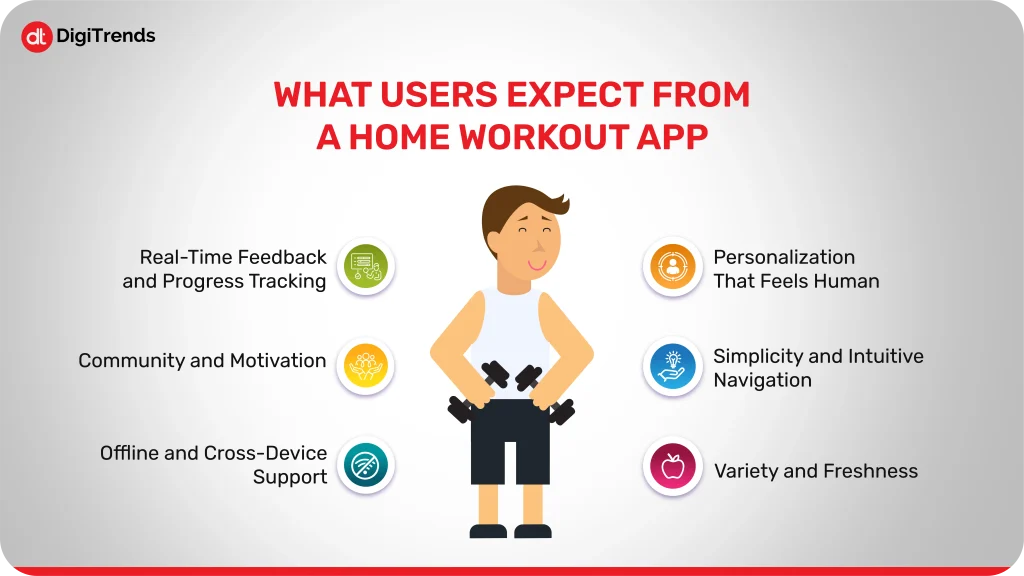
Based on the current trends in the fitness app industry, there are some basic expectations of the users regarding home workout apps. Let’s break down what makes an app truly useful from the user’s point of view.
Users no longer want to see generic programs disguised as personalization. They expect custom routines that can adjust to their fitness level, available equipment, and goals. AI-powered recommendations that learn from user progress and feedback make the experience feel specially created for them, almost like working with a personal trainer.
No one likes to use an app that is cluttered or fumbled with endless menus. Users expect a clean, intuitive interface for their workout app, one where users can start their workout in just a few taps. In 2025, convenience beats complexity every time.
People lose motivation when workouts feel repetitive. Good at-home workout apps include diverse training formats, HIIT, yoga, strength, mobility, and even quick “10-minute challenges.” Regular updates or seasonal challenges help maintain interest.
To build the best home workout app, your app must integrate with wearables or smartphone sensors to give instant feedback on heart rate, reps, or form. Users love seeing tangible progress over time; it turns effort into measurable success.
Users like community features in fitness apps because they keep them accountable, and this way, they get to focus on their goals better than ever. Features like challenges, leaderboards, and group sessions drive engagement. Even lightweight social tools, like sharing streaks or progress badges, increase retention.
Users expect the app to work anytime, anywhere. If you are looking to build a good at-home workout app, then enabling offline downloads or syncing across devices (smartphones, tablets, smart TVs) will help meet that demand.
While many users are willing to pay for quality, the market for free at-home workout apps is still massive. Offering a freemium model, free basic workouts with premium add-ons, strikes the perfect balance between reach and revenue.
Let’s have a look at the must-have features that define a modern home workout app:
| Category | Features |
| Core Functionality | Workout library (videos, guides), progress tracking, AI-based recommendations |
| User Experience | Clean UI, voice guidance, timer integration, easy navigation |
| Engagement | Challenges, leaderboards, streak tracking, reward systems |
| Integration | Wearable device sync (Apple Watch, Fitbit), diet, and calorie tracker APIs |
| Accessibility | Custom difficulty levels, low-impact workouts, and inclusive options |
| Monetization | Freemium model, in-app purchases, subscriptions, partnerships |
| Support & Feedback | Chatbots, trainer support, user reviews, performance analytics |
If you want your app to rank among the best home workout apps, you should focus on a combination of user-centric features, strong backend infrastructure, and a design that motivates consistency.
A lot of at-home workout app development projects fail, but they are usually not solely due to poor functionality; some fail due to poor design and user experience as well. Let’s have a look at what type of design a modern fitness app should deliver.
A home workout app with visual clutter will surely kill motivation, which is why you should go for a clean, goal-driven interface that focuses on one action per screen. Use bright visuals, easy-to-read typography, and accessible color contrasts.
Your app should show users their weekly goals, calories burned, and progress graphs in a single view, and the dashboard should feel like a fitness companion, not a data dump.
Animations are a great way to keep the workouts fun and keep the users engaged, too. You can consider adding animations like show rep counts, progress rings, or rest timers to make workouts more engaging. Even subtle feedback, like confetti after completing a workout streak, reinforces positive behavior.
Your app design should include visual cues, captions for video workouts, and options for low-impact routines to make your app accessible to people of all fitness levels.
Leaderboards, badges, and progress levels turn workouts into a challenge. Gamified design isn’t a gimmick; it’s proven to improve skill retention by up to 40%.
What decides how smooth and scalable your app is going to be is the tech behind it. Let’s have a look at what typically powers successful home workout apps:
Languages: Swift (iOS), Kotlin (Android), React Native, or Flutter for cross-platform development
UI Frameworks: Jetpack Compose, SwiftUI, or Material Design 3
Video & Animation: AVFoundation, ExoPlayer, Lottie
Languages: Node.js, Python, or Ruby on Rails
Databases: PostgreSQL, Firebase, MongoDB
Hosting: AWS, Google Cloud, or Azure for scalability and security
Authentication: OAuth 2.0, Firebase Auth
TensorFlow or CoreML for AI-based workout suggestions
Predictive analytics for performance insights
Cloud storage for user progress and media files
APIs for wearables (Google Fit, Apple HealthKit, Fitbit)
Payment gateways (Stripe, PayPal, Razorpay)
Push notifications (Firebase Cloud Messaging, OneSignal)
When all this tech is done right, it will ensure your home workout app runs smoothly across devices while handling personalization and real-time data securely.

The revenue of your home workout app will depend on how you strike a good balance between free access and premium value. Let’s have a look at some proven monetization models in home workout app development:
1. Freemium: Free access to basic workouts, with premium content behind a paywall.
2. Subscription-based: Monthly or yearly plans offering full access.
3. In-app purchases: Users buy specialized plans (like yoga or strength challenges).
4. Advertisements: Non-intrusive ads or partner offers in free on at-home workout apps.
5. Corporate Wellness Partnerships: Offer bulk subscriptions to companies promoting employee fitness.
Each model can be adjusted depending on your audience. For example, the Freemium model works best when it is paired with regular content updates and visible progress tracking.
There are so many home workout apps in the market, so what will make your app stand out among others? Let’s have a look:
You will have to show measurable progress, weekly summaries, before-and-after visuals, or milestone achievements. People who work out or into fitness stay loyal when they can see visible results.
Apps that have a mission (“fitness made simple,” “train anywhere, anytime”) are more likely to build stronger emotional connections.
You should keep updating your content and keep up with trends such as new workouts, trainers, and playlists. This will help in keeping the experience fresh. Stagnant apps lose user trust quickly.
Speed matters. Load videos fast, ensure offline access, and test across devices. Small performance improvements directly impact retention.
Regularly analyze reviews and app-store ratings. The most successful home workout apps continuously evolve based on user insights.
DigiTrends has years of experience building high-impact digital products, including fitness apps. We don’t just develop software; we craft experiences that make users want to come back.
Our team handles everything from ideation to launch, including:
If your goal is to build a home workout app that not only ranks among the best but also keeps users hooked, DigiTrends can turn that idea into a reality.
The home workout app market in 2025 is bigger, smarter, and more competitive than ever, but it’s also full of opportunity. Users aren’t just looking for workouts; they’re looking for motivation, guidance, and measurable progress they can trust.
If you build with that mindset, blending personalization, simplicity, and genuine user value, your app won’t just compete. It’ll lead.
Have a look at the top 11 healthcare app developers in the USA in 2026 and what makes them stand out.
Continue Reading

Explore the mobile app marketing trends in 2026 that are important for an app to grow in this market.
Continue Reading

Explore an effective roadmap for custom application development that leaders need to understand, plan, and implement.
Continue Reading

Explore what Proof of Concept (PoC) in software development is, how it benefits teams in making better decisions, and how it works.
Continue Reading

Explore which delivery app pays the most in 2026 and how the top platforms combine smart technology and incentives to keep drivers earning more.
Continue Reading

DigiTrends has been officially recognized by Techreviewer.co as one of the Top Financial App Development Companies for 2025.
Continue Reading