Why Arabian Education App Development Is Gaining Serious Momentum
Published
11 February 2026
Time
1 month ago
Views
137 Views
Muhammad Ishaque
I’m a dedicated SEO specialist who propels brands to new heights of online visibility and growth through digital strategies and analytical insights.
Table Of content
Share This Article
As part of the Saudi government’s digitalization plans, education in Arabia is also going digital at scale. Arabian education app development has become an important part of the strategy across the region.
The initiative is being taken by investing heavily in digital infrastructure, modernizing schools and expanding university offerings. Let’s see how the Arabian education ecosystem has evolved in recent years.
Arabian Education Ecosystem
In the past few years, vision-led national programs have been initiated in public and private institutions across Saudi Arabia, the UAE, and other GCC countries. The focus on this has created strong demand for reliable, secure, and scalable education app solutions.
These initiatives are also taken to fulfill the gap between rising demands and delivery. Every user expects digital solutions no matter if it is students, parents, or educators.
Students expect intuitive mobile experiences.
Parents want real-time performance tracking.
Educators need tools that reduce administrative load instead of adding to it.
Basic education platforms fall short in fulfilling these modern demands. Hence, institutions are looking for integrated education platforms that connect learning management, assessments, communication, analytics, and content delivery in one ecosystem.
This shift has positioned Arabian education app development as a high-growth opportunity for institutions and technology partners alike. The market is not just expanding in numbers. It is maturing in expectations. Decision-makers are asking tougher questions about scalability, data privacy, long-term maintenance, and measurable learning outcomes.
Success in Arabian education app development requires more than coding an app. It requires understanding the regional education framework, cultural context, regulatory environment, and the operational realities of schools and universities across the Arabian education landscape.
The result is a market that rewards thoughtful architecture, strong UX, and scalable education app design built for institutional growth rather than short-term adoption.
What’s Driving Growth in Arabian Education App Development
The surge in Arabian Education App Development is not accidental. It is backed by structural change across the region. Policy, demographics, infrastructure, and institutional ambition are all moving in the same direction.
Let’s break down what’s fueling this momentum.
1. Government-Led Digital Transformation
Across the Arabian education ecosystem, governments are pushing long-term digital transformation agendas. National visions place education at the center of economic diversification and workforce development.
This has translated into funding for smart classrooms, e-learning initiatives, and centralized education platforms that connect institutions under unified systems. When public infrastructure improves, demand for advanced Arabian education app solutions naturally follows.
2. A Young, Tech-Native Population
Arabia has one of the youngest populations globally. Students entering schools and universities are digital-first. They are comfortable with mobile apps, cloud systems, and interactive learning tools.
Traditional systems cannot meet these expectations. Institutions are now investing in Arabian education app development to create engaging, intuitive digital environments that reflect how students actually consume information.
3. Expansion of Private and International Institutions
Private schools and international universities are expanding across the region. Competition is rising. With competition comes differentiation.
Institutions are using customized education platforms to stand out. From advanced learning management systems to parent engagement apps, technology is becoming a key brand asset. A scalable education app is no longer optional. It is a competitive advantage.
4. Hybrid and Remote Learning Models
The shift toward hybrid learning has permanently altered how education is delivered. Even fully on-campus institutions now rely on digital systems for assessments, communication, attendance, and performance tracking.
This hybrid reality has strengthened the demand for reliable Arabian education app solutions that can handle both in-person and remote workflows without friction.
5. Data-Driven Decision Making
Educational leaders are increasingly focused on measurable outcomes. They want insights into attendance patterns, academic performance, engagement metrics, and institutional efficiency.
Modern education platforms are built with analytics at their core. Arabian education app development now prioritizes dashboards, reporting tools, and real-time data visibility to support smarter institutional decisions.
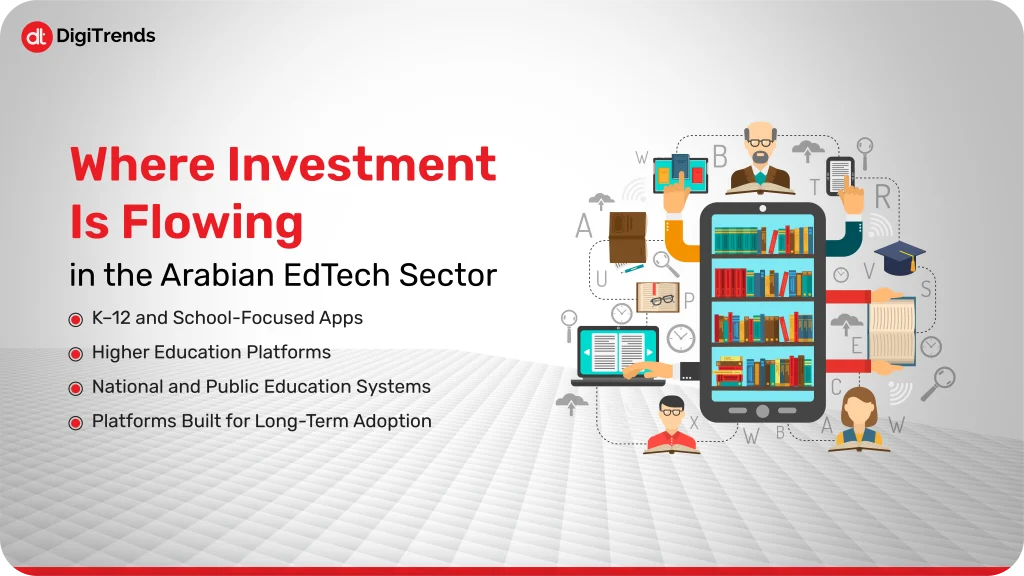
Where Investment Is Flowing in the Arabian EdTech Sector
Investment in Arabian Education App Development is becoming more targeted. The early phase was about digitization. Now, the focus has shifted to scale, specialization, and measurable impact within the Arabian education ecosystem.
Here’s where capital and strategic attention are going.
1. K–12 Digital Infrastructure
Schools across the region are upgrading their digital backbone. This includes student management systems, learning apps, parent communication portals, and assessment tools.
K–12 institutions require structured, easy-to-use education platforms that can handle attendance tracking, grading systems, homework management, and real-time communication. The demand for a scalable education app in this segment is particularly strong because solutions must support thousands of students across multiple campuses.
2. Higher Education and University Platforms
Universities are investing heavily in advanced education platforms that go beyond basic LMS functionality. They need systems that integrate admissions, course management, virtual classrooms, research collaboration, and alumni engagement.
Arabian education app development in higher education focuses on integration. Universities want unified systems, not fragmented tools. Scalability, security, and long-term performance are non-negotiable at this level.
3. Corporate and Vocational Learning
Another high-growth area within the Arabian education landscape is professional development and vocational training. Governments and enterprises are investing in workforce upskilling aligned with national economic goals.
This has opened space for specialized Arabian education app solutions tailored to certification programs, industry-specific training, and compliance-based learning models.
4. AI-Enabled Learning and Personalization
Smart features are attracting serious investment. Adaptive learning paths, performance analytics, predictive insights, and automated grading are no longer experimental.
Education platforms that integrate intelligent capabilities are gaining traction because they offer measurable academic improvement. Decision-makers are prioritizing solutions that combine engagement with outcomes.
5. Infrastructure-Ready, Long-Term Systems
Here’s what really stands out: investors and institutions are backing long-term systems, not quick builds.
Arabian Education App Development is moving toward enterprise-grade architecture. Institutions want platforms that evolve with curriculum changes, regulatory updates, and enrollment growth. A scalable education app must handle future expansion without rebuilding from scratch.
Investment patterns show one clear message. The Arabian education ecosystem is not looking for basic apps. It is looking for durable, adaptable education platforms designed for institutional growth.
Essential Requirements for Education Apps in Arabian Markets
Building for this region takes more than technical execution. Arabian Education App Development demands a strong grasp of regulatory frameworks, institutional scale, and user behavior within the broader Arabian education ecosystem.
Here are the core requirements that define successful education platforms in the region.
1. Cultural and Language Adaptation
Localization is not optional. It is foundational.
A successful Arabian education app must support Arabic and English seamlessly, often with right-to-left interface compatibility. Beyond language, content structure, design elements, and communication styles must reflect regional expectations.
Institutions want platforms that feel built for Arabia, not adapted as an afterthought.
2. Institutional-Grade Scalability
Schools and universities operate at scale. Multi-campus structures, thousands of active users, and centralized administrative systems require strong backend architecture.
A scalable education app must handle high traffic during exam periods, live sessions, and enrollment cycles without performance drops. Arabian education app development today prioritizes cloud infrastructure, load balancing, and modular architecture to ensure stability.
3. Data Visibility and Reporting
Decision-makers in the Arabian education ecosystem are increasingly data-focused. They need dashboards that provide real-time visibility into academic progress, attendance patterns, and institutional performance.
Modern education platforms must include robust analytics capabilities. Reporting is no longer just a feature. It is a decision-making tool at the leadership level.
4. Compliance and Data Protection
Regulatory compliance is a critical factor in Arabian education app development. Data privacy laws, government oversight, and institutional policies require secure data storage and strict access control.
Encryption, role-based permissions, secure authentication, and regional hosting options are often mandatory. Trust is central to adoption, especially when handling student information.
5. Integration With Existing Systems
Many institutions already operate legacy ERP systems, LMS platforms, or administrative software. A new Arabian education app cannot function in isolation.
Interoperability matters. APIs, system integrations, and smooth data migration are essential for long-term adoption within the Arabian education ecosystem.
What this really means is this: success in Arabian Education App Development depends on aligning technology with institutional realities. The platforms that win are not the most feature-heavy. They are the most stable, adaptable, and strategically designed.
Key Features That Matter in Arabian Education Apps
Features can make or break adoption. In Arabian Education App Development, institutions are not impressed by long feature lists. They want tools that solve real operational challenges inside the Arabian education ecosystem.
Here are the capabilities that consistently drive value:
Centralized Learning Management
At the core of every strong Arabian education app is a structured learning management system. Course uploads, content libraries, assignment submissions, grading, and feedback loops must be intuitive for both educators and students.
The goal is clarity. If a platform feels complicated, adoption drops quickly.
Real-Time Communication Tools
Communication gaps are a recurring challenge in education. Modern education platforms must support in-app messaging, push notifications, announcements, and parent portals.
Schools across the Arabian education landscape increasingly expect built-in communication features instead of relying on third-party apps.
Attendance and Performance Tracking
Automated attendance tracking, digital gradebooks, and progress reports are now standard expectations. Leadership teams rely on dashboards to monitor performance across classes, campuses, and departments.
A scalable education app should provide structured insights, not just raw data.
Secure Assessments and Examinations
Online quizzes, timed exams, plagiarism detection, and secure proctoring systems are critical, especially for hybrid learning models.
Arabian Education App Development in this area focuses on reliability and academic integrity. Institutions want secure environments that maintain credibility.
Multi-User Role Management
Education involves multiple stakeholders. Students, teachers, administrators, parents, and even regulators interact with the same system in different ways.
Education platforms must offer clear role-based access control. Each user type should see only what is relevant to them.
Content Flexibility and Multimedia Support
Interactive videos, downloadable materials, live classes, discussion forums, and collaborative tools enhance engagement. Within the Arabian education ecosystem, multimedia-driven learning is gaining strong traction.
However, performance must remain smooth even with high media usage. That is where strong backend architecture matters.
Arabian Education App Development is not about packing features into an app. It is about designing education platforms that improve efficiency, increase engagement, and scale alongside institutional growth.
Development Process for Education Apps in the Region
Execution is where many ideas fail. Arabian Education App Development requires a structured, strategy-first approach that aligns with institutional goals within the broader Arabian education ecosystem.
Here’s how high-performing education platforms are typically built.
1. Market and Institutional Research
Every successful Arabian education app starts with clarity.
This phase focuses on understanding the target segment. Is the platform built for K–12 schools, higher education institutions, vocational training centers, or government bodies? Each has different compliance needs, operational workflows, and scalability requirements.
Research also includes competitor analysis within the Arabian education landscape and identifying gaps that existing education platforms are not addressing.
A scalable education app is designed for long-term growth. That means modular architecture, expandable feature layers, and performance optimization are built into the foundation, not added later.
3. UI/UX Design With Regional Context
User experience can determine adoption speed. In Arabian Education App Development, design must support bilingual functionality, right-to-left compatibility, and simple navigation for diverse age groups.
Institutions prefer clean dashboards and intuitive workflows. Overcomplicated interfaces reduce engagement and increase training costs.
4. Agile Development and Iteration
Modern education platforms are rarely built in a single release cycle. Development teams follow agile methodologies, launching MVP versions and refining features through institutional feedback.
This phased approach reduces risk and ensures the final Arabian education app reflects real classroom and administrative use cases.
5. Testing, Security Validation, and Compliance Checks
Before deployment, rigorous testing is essential. Load testing ensures the platform handles peak usage periods. Security audits validate encryption and access controls.
Compliance checks confirm alignment with regional data protection requirements across the Arabian education ecosystem.
6. Deployment, Training, and Ongoing Optimization
Launch is only the beginning.
Institutions require onboarding support, faculty training sessions, and technical documentation. Post-launch analytics help refine performance, add features, and scale infrastructure as adoption grows.
How Emerging Technology Is Transforming the Arabian Education Ecosystem
Technology in education is no longer experimental in this region. Arabian Education App Development is increasingly defined by how intelligently emerging tools are integrated into real learning environments.
The focus is not on flashy features. It is a measurable improvement.
AI-Driven Personalization
AI-driven personalized learning is becoming a core expectation. Instead of one-size-fits-all instruction, modern education platforms analyze performance data to adjust learning paths.
An advanced Arabian education app can recommend content based on student progress, highlight weak areas, and suggest revision materials automatically. What this really means is better academic support without increasing teacher workload.
Intelligent Analytics for Institutional Leaders
Leadership teams across the Arabian education ecosystem want visibility.
AI-powered dashboards can predict dropout risks, flag attendance irregularities, and identify performance trends across campuses. These insights help institutions intervene early rather than react late.
Arabian Education App Development now frequently includes predictive analytics as a strategic feature, not an optional add-on.
Automation of Administrative Workflows
Admissions processing, fee management, grading, and reporting consume significant administrative time. Automation reduces manual errors and improves operational efficiency.
Education platforms built for the region increasingly integrate automated workflows to streamline daily operations. A scalable education app should simplify complexity, not add to it.
Virtual and Immersive Learning Tools
AR and VR technologies are gaining traction in specialized programs such as medical training, engineering simulations, and vocational education.
Within the Arabian education landscape, immersive learning is being explored as a way to enhance engagement and practical skill development. While not universal yet, it represents a clear growth area in Arabian education app development.
Cloud Infrastructure and Real-Time Collaboration
Cloud-based architecture supports real-time collaboration between students and faculty. Live sessions, shared documents, group projects, and recorded lectures are now standard components of advanced education platforms.
The shift to cloud-native systems ensures reliability, scalability, and accessibility across devices.
Emerging technology is not replacing traditional education. It is strengthening it. Arabian Education App Development today revolves around building intelligent, scalable systems that improve learning outcomes while supporting institutional growth.
Compliance, Data Privacy, and Building Institutional Trust
Trust is the backbone of Arabian Education App Development. Institutions are responsible for safeguarding student records, academic data, and financial information. Any education platform entering the Arabian education ecosystem must meet strict regulatory and security expectations.
Here’s what that involves.
Alignment With Regional Regulations
Countries across Arabia have strengthened data protection laws in recent years. Education providers are expected to comply with national cybersecurity frameworks and privacy regulations.
An Arabian education app must clearly define where data is stored, how it is processed, and who has access. In many cases, regional data hosting is preferred to ensure compliance and maintain government confidence.
Strong Security Architecture
Security cannot be layered on later. It must be built into the foundation.
Encryption protocols, multi-factor authentication, secure APIs, and role-based access controls are standard requirements in modern education platforms. A scalable education app must handle large user volumes without compromising data integrity.
Security audits and penetration testing are often expected before institutional rollout.
Role-Based Access and Controlled Visibility
Within the Arabian education ecosystem, multiple stakeholders interact with the same system. Students, parents, faculty, administrators, and regulators require different levels of access.
Clear permission hierarchies ensure that sensitive information remains protected while still allowing transparency where needed.
Transparency and Institutional Confidence
Beyond compliance, institutions want clarity. They want documented security policies, clear SLAs, and long-term maintenance commitments.
Arabian Education App Development is not just a technical engagement. It is a partnership built on reliability and accountability.
Education platforms that prioritize compliance and security from day one gain faster adoption and stronger long-term retention within the Arabian education landscape.
Major Challenges in Arabian Education App Development and How to Address Them
Growth brings complexity. While the Arabian education ecosystem offers strong opportunities, it also presents practical challenges that require careful planning.
Every institution believes its workflow is unique, but customization is often requested at every level.
The challenge in Arabian Education App Development is avoiding over-engineering. Excessive customization increases cost, slows deployment, and complicates maintenance.
The smarter approach is modular architecture. Core systems remain standardized, while configurable layers allow institutions to adapt workflows without altering the foundation.
Integrating With Legacy Systems
Many schools and universities in the Arabian education landscape operate older ERP or management systems. Replacing them entirely is rarely feasible.
Integration becomes the real hurdle.
Education platforms must support APIs and structured data migration strategies. Without proper integration planning, even the most advanced Arabian education app can struggle with adoption.
Ensuring User Adoption Across Stakeholders
Technology is only effective if people use it.
Faculty members may resist new systems due to training gaps. Parents may struggle with unfamiliar interfaces. Students may disengage if the experience feels clunky.
Arabian Education App Development must prioritize onboarding strategies, intuitive design, and continuous training support to ensure platform adoption across the ecosystem.
Managing Peak Usage and Performance Loads
Exam periods, admissions cycles, and live sessions create traffic spikes. A platform that performs well under normal conditions may fail under peak load.
This is why a scalable education app requires strong cloud infrastructure, load testing, and performance monitoring tools built into the backend.
Maintaining Long-Term Relevance
Curriculum standards evolve, regulatory frameworks change, and nstitutional priorities shift.
Education platforms in the Arabian education ecosystem must be built for evolution. Continuous updates, modular expansion, and ongoing optimization are essential to remain relevant.
The challenges are real, but they are manageable. Arabian Education App Development succeeds when strategy leads technology, not the other way around.
How DigiTrends Can Add Long-Term Value to Arabian Education App Development
In Arabian Education App Development, long-term success depends on more than technical delivery. It requires a partner who understands the Arabian education ecosystem, from regulatory frameworks and bilingual requirements to institutional workflows and national digital transformation goals. DigiTrends can approach every Arabian education app with this regional context in mind, ensuring alignment with both operational needs and future growth plans.
Strategy drives execution. DigiTrends focuses on scalable architecture, secure infrastructure, and seamless integration with existing education platforms. We can build scalable education app that handles institutional expansion, performance demands, and evolving academic models without constant restructuring.
Beyond deployment, DigiTrends ca support continuous optimization through analytics, upgrades, and compliance alignment. The goal is not just to launch a platform, but to build sustainable digital foundations that strengthen the Arabian education landscape over time.
Conclusion
Arabian Education App Development is no longer a forward-looking concept. It is an active transformation shaping the entire Arabian education ecosystem. Governments are investing, institutions are modernizing, and learners expect digital-first experiences that are intuitive, secure, and outcome-driven.
The real opportunity lies in building education platforms that go beyond basic functionality. A scalable education app must support institutional growth, ensure compliance, integrate seamlessly with existing systems, and deliver measurable academic value. Technology decisions made today will define how effectively institutions compete and evolve in the coming years.
As the Arabian education landscape continues to expand, the focus should remain clear: build strategically, scale intelligently, and prioritize long-term sustainability over short-term fixes. That is how meaningful impact is created in modern education.
Frequently Asked Questions
Arabian Education App Development is accelerating due to government-led digital transformation initiatives, increasing student populations, and the rising demand for modern education platforms. Institutions across the Arabian education ecosystem are investing in scalable, secure solutions to improve learning outcomes and operational efficiency.
A strong Arabian education app should include learning management tools, real-time communication, performance tracking, secure assessments, and role-based access control. Scalability, bilingual support, and compliance with regional data regulations are equally important.
Timelines vary depending on complexity, integrations, and compliance requirements. A basic version may take a few months, while a fully integrated, scalable education app for large institutions may require a phased development approach over several months.
Compliance plays a critical role in the Arabian education ecosystem. Education platforms must align with national data protection laws, cybersecurity frameworks, and institutional policies. Secure hosting, encryption, and controlled data access are standard requirements.
Yes. Modern Arabian Education App Development prioritizes API-based integration and structured data migration. A well-designed platform can connect with existing ERP systems, LMS tools, and administrative software without disrupting operations.
Submit Your Message
Author :Muhammad Ishaque
I’m a dedicated SEO specialist who propels brands to new heights of online visibility and growth through digital strategies and analytical insights.
Recent Blogs
February 17th, 2026
Customer Experience Automation in 2026: How AI is Transforming CX Strategy
Explore how customer experience automation is used to fulfill modern customer demands, how AI helps in transforming CX strategy, key CX automation tools, real-world examples, and more.











 11 February 2026
  1 month ago
  137 Views