Voice Recognition in Healthcare: Uses and Benefits
Published
03 February 2026
Time
7 months ago
Views
1028 Views
Muhammad Ishaque
As the SEO Manager at DigiTrends, Muhammad leads organic growth initiatives by developing and executing data-driven SEO strategies that improve search visibility, drive qualified traffic, and support business growth. With extensive experience in technical SEO, on-page optimization, content strategy, keyword research, and performance analysis, he focuses on delivering sustainable search results that align with business objectives. His ability to identify search opportunities, analyze market trends, and implement scalable SEO solutions helps businesses strengthen their digital presence and achieve long-term success.
Table Of content
Share This Article
Healthcare has no shortage of advanced systems, dashboards, and digital tools. Yet clinicians still spend a frustrating amount of time typing, clicking, and navigating screens instead of focusing on patients. Documentation overload, fragmented workflows, and administrative fatigue are now some of the biggest threats to both care quality and clinician wellbeing.
This is where voice recognition in healthcare is quietly changing the rules.
What started as basic speech-to-text dictation has evolved into intelligent systems that understand clinical context, automate documentation, assist decision-making, and interact with both patients and providers in real time. Today, speech recognition technology in healthcare is no longer a convenience feature. It is becoming a foundational layer of modern clinical operations.
At the same time, voice assistants in healthcare are reshaping how patients access care. From scheduling appointments and answering medication-related questions to supporting remote monitoring and chronic care management, these systems are making healthcare more accessible and responsive. A well-designed healthcare voice assistant can reduce friction for patients while easing the operational burden on care teams.
The impact goes beyond efficiency. Voice-enabled systems help restore something healthcare has been slowly losing: attention. When clinicians are freed from constant manual data entry, they can engage more fully with patients. When patients can interact with healthcare systems using natural speech instead of complex interfaces, the experience becomes more human.
Of course, adopting voice technology in healthcare is not as simple as plugging in a microphone. Accuracy, privacy, interoperability with electronic health records, and clinical safety all matter. The real value lies in how these systems are designed, trained, and integrated into existing workflows.
In this blog, we will take a deep dive into how voice recognition technology is being used across healthcare today. We will explore the role of voice assistants in clinical and patient-facing environments, and how speech recognition is improving documentation, diagnostics, and care coordination. We will also look at the challenges healthcare organizations must address to deploy these technologies responsibly and at scale.
How Voice Recognition Technology Works in Healthcare
To understand why voice recognition is gaining real traction in healthcare, you have to look under the hood. This is not just about converting spoken words into text. Modern voice recognition in healthcare is built to understand clinical language, intent, and context, often in high-pressure environments where accuracy matters.
At its core, voice recognition systems rely on automatic speech recognition, or ASR. ASR models are trained on large volumes of spoken language to identify phonetics, accents, pacing, and pronunciation patterns. In healthcare, this training goes several layers deeper. The system must recognize medical terminology, drug names, abbreviations, and specialty-specific language that would confuse general-purpose tools.
This is where speech recognition technology in healthcare separates itself from consumer-grade voice tools. Clinical systems are trained on medical datasets and continuously refined using specialty-specific vocabularies. A cardiologist dictating a discharge summary and a radiologist describing imaging findings use very different language, and the system needs to handle both without slowing anyone down.
Once speech is captured, the system does more than transcribe. Natural language processing, or NLP, analyzes sentence structure and meaning. It identifies entities such as symptoms, diagnoses, procedures, and medications. These data points can then be automatically mapped to structured fields within electronic health records. Instead of free-text notes that require manual cleanup later, clinicians get documentation that is immediately usable.
This process is what enables real-time clinical documentation. One of the most significant benefits of voice recognition technology in healthcare is the streamlining of clinical documentation. Once these voice-guided notes are captured, they sync seamlessly with modern healthcare systems through advanced patient portal app development. Physicians can speak naturally during or after a patient interaction, and the system generates progress notes, updates problem lists, and even suggests coding elements. Over time, the system learns individual speech patterns and preferences, improving accuracy and speed with continued use.
On top of this foundation sit voice assistants in healthcare. These assistants combine speech recognition with conversational AI to enable two-way interaction. Instead of passively recording speech, they respond to commands and questions. A clinician might ask for a patient’s latest lab results, medication history, or allergy information and receive an immediate spoken response. In clinical settings where hands-free access is critical, such as operating rooms or emergency departments, this capability is especially valuable.
For patients, a healthcare voice assistant works differently but relies on the same underlying technologies. It understands natural language queries like scheduling requests, prescription refills, or post-discharge instructions. When integrated with patient portals and care management systems, these assistants act as a first point of contact, guiding patients without forcing them through complex menus or long wait times.
Security and compliance are built into every layer. Healthcare voice recognition systems must operate within strict data protection frameworks. Audio data is encrypted, access is controlled, and processing often happens within secure environments rather than public cloud tools. This is not optional. Trust is a prerequisite for adoption in clinical environments.
What this really means is that voice recognition in healthcare is not a single tool. It is a stack of technologies working together: speech recognition, language understanding, clinical context modeling, and system integration. When implemented well, it becomes invisible. Clinicians stop thinking about the tool and simply speak. Patients interact naturally. The system handles the rest.
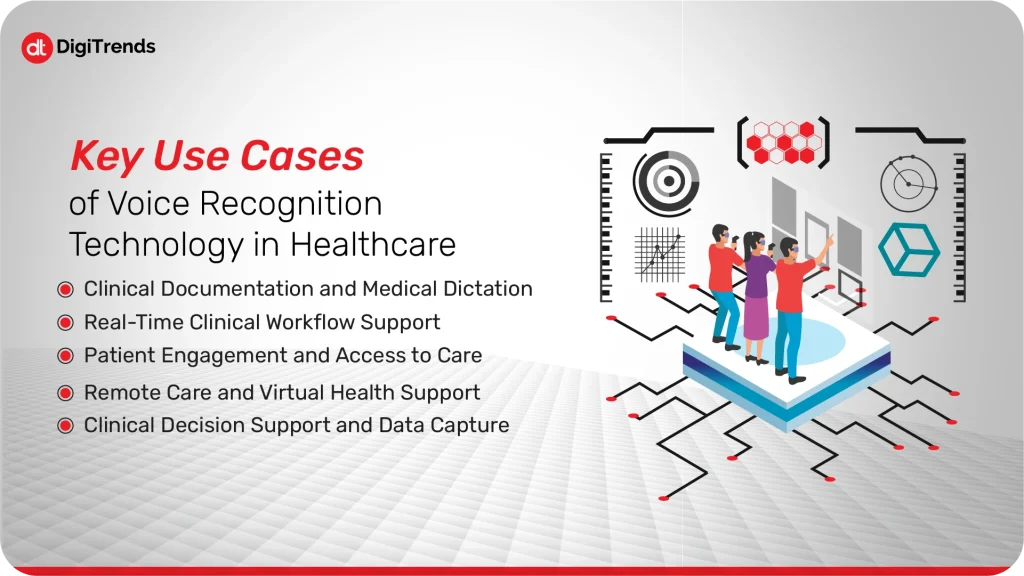
Key Use Cases of Voice Recognition Technology in Healthcare
Voice recognition earns its place in healthcare not because it is impressive, but because it solves very real, very expensive problems. The strongest adoption is happening in areas where time, accuracy, and cognitive load matter most.
Below are the most impactful use cases, with enough detail to show how this technology fits into day-to-day healthcare operations.
1. Clinical Documentation and Medical Dictation
This is where speech recognition technology in healthcare first proved its value and where it continues to evolve.
Clinicians can dictate progress notes, discharge summaries, operative reports, and referral letters directly into the EHR. Modern systems understand clinical structure, so the output is not just text but organized documentation aligned with medical standards.
Key advantages include:
Reduced time spent on manual typing and data entry
Faster turnaround for clinical notes and reports
Improved documentation completeness and consistency
Over time, voice recognition systems adapt to individual clinicians, learning their phrasing, pacing, and specialty-specific terminology. This personalization significantly improves accuracy and reduces the need for corrections.
2. Real-Time Clinical Workflow Support
Voice recognition becomes more powerful when it moves beyond documentation.
With voice assistants in healthcare, clinicians can access information hands-free while staying focused on patient care. Instead of navigating multiple screens, they can ask for lab results, imaging summaries, or medication histories in real time.
This is particularly valuable in:
Emergency departments, where speed is critical
Operating rooms, where hands-free interaction is essential
Inpatient wards with high patient turnover
By reducing interruptions and context switching, voice-enabled workflows help clinicians maintain focus and reduce cognitive fatigue.
3. Patient Engagement and Access to Care
On the patient side, voice technology removes friction.
A healthcare voice assistant allows patients to interact with healthcare systems using natural language. This is especially important for elderly patients, individuals with disabilities, or those who struggle with complex digital interfaces.
Post-discharge guidance and follow-up care information
Instead of navigating apps or waiting on hold, patients get immediate responses, improving satisfaction and adherence.
4. Remote Care and Virtual Health Support
Voice recognition plays a growing role in telehealth and remote patient monitoring.
During virtual consultations, clinicians can dictate notes in real time without breaking eye contact. For chronic care management, voice assistants can check in with patients, ask symptom-related questions, and log responses directly into care systems.
This supports:
Continuous monitoring outside clinical settings
Early detection of potential issues
Reduced administrative workload for care teams
When integrated with analytics platforms, spoken patient responses can even trigger alerts or care escalation when needed.
5. Clinical Decision Support and Data Capture
Advanced voice systems are starting to assist with decision support.
By analyzing spoken inputs during clinical encounters, these systems can identify relevant clinical signals and prompt next steps. For example, if certain symptoms or risk factors are mentioned, the system may suggest additional tests or flag guideline-based recommendations.
This does not replace clinical judgment. It supports it by ensuring critical details are not missed, especially in complex or fast-moving cases.
What this really shows is that voice recognition technology in healthcare is no longer confined to back-office tasks. It is embedded in clinical care, patient interaction, and remote health models. The value comes from how deeply it integrates into workflows, not from the novelty of voice itself.
Voice Assistants in Healthcare vs Traditional Speech Recognition
At first glance, voice assistants and speech recognition tools might seem like the same thing. Both listen, both understand speech, and both respond in some way. In healthcare, that distinction matters more than it appears.
Traditional speech recognition technology in healthcare is largely one-directional. The clinician speaks, and the system converts that speech into text. Its primary role is documentation. It focuses on accuracy, speed, and structured output, especially within electronic health records.
This approach works well for dictated notes, reports, and summaries. It reduces typing and accelerates documentation, but it does not actively participate in the workflow. Once the text is captured, the interaction ends.
Voice assistants in healthcare, on the other hand, are designed for two-way interaction.
They combine voice recognition with conversational AI and workflow logic. Instead of just listening, they respond. Instead of stopping at transcription, they take action. This difference changes how healthcare teams and patients engage with technology.
To make the contrast clearer, here are the core differences.
In clinical environments, this means a physician can ask a voice assistant for patient information, set reminders, or trigger workflows without touching a keyboard. The assistant retrieves data, confirms actions, and continues the interaction if needed.
For patients, the experience is even more distinct.
A healthcare voice assistant acts as a digital front door. Patients can ask questions about their care plan, request appointments, or get medication guidance using everyday language. The system does not just record the request. It interprets it and responds in a way that feels conversational and supportive.
This distinction also affects the implementation strategy.
Speech recognition tools are often deployed as standalone documentation solutions. They integrate deeply with EHRs but have limited interaction beyond note creation. Voice assistants require broader integration. They need access to scheduling systems, patient portals, clinical data repositories, and sometimes even IoT-enabled medical devices.
Accuracy expectations are also different. Documentation tools prioritize transcription precision. Voice assistants must balance accuracy with dialogue management, error handling, and user trust. A misheard word in a clinical note can be corrected. A misunderstood command that triggers the wrong action carries a higher risk.
What this really means is that healthcare organizations should not treat voice technology as a single purchase decision. The choice between speech recognition and voice assistants depends on goals.
If the primary challenge is documentation overload, traditional speech recognition may be enough. If the goal is to streamline workflows, improve patient engagement, and support real-time decision-making, voice assistants offer far greater value.
How Voice Recognition Technology Improves Patient Experience
Patient experience is often discussed in terms of bedside manner and facility quality, but a large part of it comes down to friction. How easy is it for a patient to get information, ask questions, or complete basic tasks without feeling lost or ignored? This is where voice recognition technology in healthcare creates meaningful change.
When voice is introduced thoughtfully, it removes layers of complexity that traditional digital interfaces add.
1. More Natural Patient Interactions
Most healthcare systems are designed around forms, portals, and menus. Patients are expected to adapt to the system. Voice flips that dynamic.
With voice assistants in healthcare, patients can interact using natural language. They can ask simple questions, clarify instructions, or request services without navigating screens or remembering login steps. This is especially impactful for elderly patients, visually impaired individuals, or those with limited digital literacy.
Instead of reading long instructions, patients can hear them. Instead of clicking through options, they can speak.
That alone changes how approachable healthcare feels.
2. Faster Access to Information and Support
Waiting is one of the biggest drivers of patient frustration.
A healthcare voice assistant can answer common questions instantly. Medication schedules, pre-visit instructions, post-procedure care, and appointment details can all be delivered through voice, without involving staff for routine queries.
This leads to:
Shorter wait times for non-urgent requests
Reduced call center overload
More consistent and accurate information delivery
Patients feel supported even outside clinic hours, which improves trust and continuity of care.
3. Better Communication During Clinical Encounters
Voice recognition also improves the in-person experience.
When clinicians use speech recognition technology in healthcare for real-time documentation, they spend less time looking at screens and more time engaging with patients. Eye contact improves. Conversations feel less rushed. Patients are more likely to feel heard.
This shift may seem subtle, but it has a real impact on satisfaction and perceived quality of care.
4. Improved Follow-Ups and Care Adherence
Many care plans fail not because patients are unwilling, but because instructions are misunderstood or forgotten.
Voice-enabled systems can deliver reminders, check in after visits, and reinforce care instructions in plain language. Patients can respond verbally, confirm completion, or ask follow-up questions without scheduling another appointment.
This supports:
Better medication adherence
Higher follow-up compliance
Early identification of post-discharge issues
For chronic conditions, these ongoing voice interactions can make care feel continuous rather than episodic.
5. More Inclusive and Accessible Healthcare
Accessibility is often treated as an afterthought. Voice makes it central.
By reducing reliance on screens and complex navigation, voice technology creates more inclusive healthcare experiences. Patients with motor impairments, cognitive challenges, or language barriers benefit from systems that listen and respond conversationally.
When paired with multilingual capabilities, voice recognition technology in healthcare can also bridge communication gaps and improve equity in care delivery.
What this really shows is that voice technology does not just optimize operations. It humanizes healthcare interactions. It meets patients where they are, using the most natural interface they have: their voice.
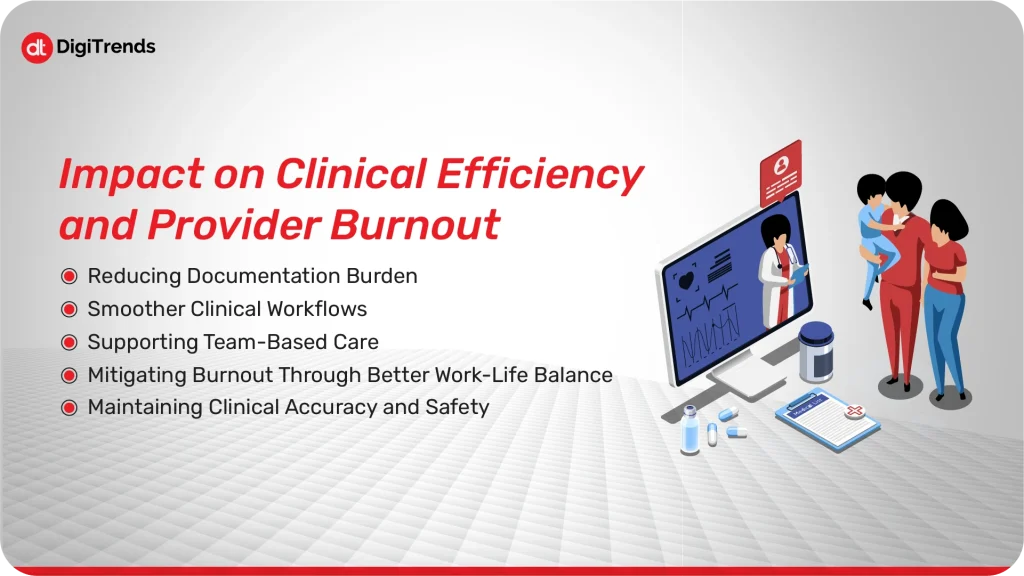
Impact on Clinical Efficiency and Provider Burnout
If there is one area where voice recognition technology in healthcare has moved from nice-to-have to necessary, it is clinician efficiency. Administrative overload is no longer a background issue. It is one of the primary drivers of burnout, turnover, and reduced quality of care.
Voice technology directly targets this problem.
1. Reducing Documentation Burden
Clinicians spend a significant portion of their day documenting care. Typing notes, updating records, and navigating EHR interfaces often take longer than the patient interaction itself.
With speech recognition technology in healthcare, documentation becomes faster and more natural. Clinicians can dictate notes in real time or immediately after an encounter, capturing details while they are still fresh. Structured data extraction ensures that the documentation is usable without extensive post-editing.
Reduced mental fatigue associated with repetitive data entry
Over time, the cumulative impact on workload is substantial.
2. Smoother Clinical Workflows
Efficiency is not just about speed. It is about flow.
Voice assistants in healthcare help clinicians move through tasks without constant interruptions. Instead of pausing to search for information, they can request it verbally and receive immediate responses. This reduces context switching, which is a major contributor to cognitive strain.
In fast-paced environments like emergency departments or intensive care units, this hands-free access can significantly improve both efficiency and safety.
3. Supporting Team-Based Care
Voice technology also supports collaboration.
Clinical notes dictated through voice recognition are often available faster to the entire care team. Nurses, specialists, and allied health professionals can access up-to-date information without delays. Voice assistants can also be used to assign tasks, set reminders, or trigger workflows across teams.
This improves coordination and reduces the risk of missed handoffs or incomplete communication.
4. Mitigating Burnout Through Better Work-Life Balance
By simplifying documentation and reducing administrative friction, voice technology gives clinicians back time and mental space. Many report spending less time charting after shifts and more time focusing on meaningful clinical work.
A healthcare voice assistant does not replace clinical expertise. It removes friction around it.
Modern voice recognition systems are designed to support accuracy through confirmation prompts, clinical context awareness, and structured validation. Clinicians retain full control over final documentation and decisions.
When implemented properly, voice technology enhances efficiency while maintaining the rigor required in clinical environments.
What this really means is that voice recognition addresses one of healthcare’s most persistent challenges at its root. It reduces unnecessary effort without compromising care quality.
Challenges and Considerations in Adopting Voice Recognition in Healthcare
For all its benefits, voice recognition technology in healthcare is not a plug-and-play solution. Healthcare environments are complex, regulated, and unforgiving of errors. Organizations that succeed with voice technology do so because they address the challenges head-on, not because they ignore them.
1. Accuracy in Clinical Environments
Clinical accuracy is non-negotiable.
Healthcare professionals use specialized terminology, abbreviations, and shorthand that vary by specialty and even by individual. Accents, background noise, and fast-paced conversations add further complexity.
While speech recognition technology in healthcare has improved dramatically, it still requires:
Without these safeguards, errors in transcription can undermine trust and adoption.
2. Data Privacy and Regulatory Compliance
Voice data is health data.
Any healthcare voice assistant must comply with strict privacy and security regulations. Audio recordings, transcriptions, and metadata all fall under protected health information and must be handled accordingly.
Key considerations include:
Secure data storage and encryption
Role-based access controls
Clear policies around audio retention and deletion
Healthcare organizations must also evaluate whether voice processing happens locally or in the cloud and how that aligns with regulatory requirements.
3. Integration With Existing Systems
Voice technology does not operate in isolation.
To deliver real value, it must integrate seamlessly with electronic health records, scheduling platforms, patient portals, and clinical decision support systems. Poor integration leads to fragmented workflows and frustration. This automated data flow is also a critical component in modern patient portal app development, ensuring patients can see their updated records instantly.
Successful deployments focus on:
Deep EHR integration rather than surface-level plugins
Interoperability across departments and systems
Minimal disruption to existing workflows
If clinicians have to change how they work just to accommodate voice tools, adoption will suffer.
4. Workflow Design and User Adoption
Technology alone does not change behavior.
Voice recognition tools must be aligned with how clinicians and patients actually work. This requires thoughtful workflow design, training, and ongoing support. Resistance often comes not from the technology itself, but from how it is introduced.
Clear onboarding, realistic expectations, and clinician involvement in design decisions make a measurable difference.
5. Managing Trust and Reliability
Trust takes time to build and seconds to lose.
A misinterpreted command or incorrect transcription can quickly erode confidence. Voice assistants in healthcare must be designed to confirm critical actions and allow easy correction.
Transparency matters. Users should understand what the system can and cannot do and when human oversight is required.
What this really means is that adopting voice recognition in healthcare is as much an organizational decision as it is a technical one. The technology works best when it is supported by strong governance, clear workflows, and a focus on user trust.
DigiTrends: Bringing Innovation to the Healthcare Industry
DigiTrends is exploring ways to make healthcare more connected and efficient through technology. By developing platforms that centralize patient data and streamline workflows, the team is helping healthcare providers access information faster and make more informed decisions.
The focus is on practical solutions, such as digital tools that support telemedicine, patient monitoring, and data analytics. These initiatives aim to reduce administrative overhead while improving patient engagement and care delivery.
While still evolving, DigiTrends’ approach emphasizes collaboration with healthcare professionals to address real challenges. The goal is to introduce technology thoughtfully, ensuring innovations support day-to-day operations without overcomplicating them.
Conclusion
Voice recognition technology is reshaping healthcare by reducing administrative burdens, improving patient engagement, and supporting more focused, efficient clinical care. When implemented thoughtfully, it enhances both the patient and provider experience without compromising safety or accuracy. As adoption grows, these tools have the potential to make healthcare more accessible, responsive, and human-centered.
Frequently Asked Questions
It’s a system that converts spoken language into text and understands clinical context, helping with documentation, workflow support, and patient interactions.
It reduces time spent on typing and navigating systems, supports hands-free access to patient information, and helps lower administrative burden and burnout.
Patients can interact naturally with healthcare systems to schedule appointments, get medication instructions, and receive follow-up guidance, making care more accessible and responsive.
Yes. Traditional tools mainly transcribe speech for documentation, while voice assistants interact two-way, execute commands, and integrate with multiple systems in real time.
Key considerations include accuracy with medical language, data privacy, integration with existing systems, workflow design, and building trust among users.
Submit Your Message
Author :Muhammad Ishaque
As the SEO Manager at DigiTrends, Muhammad leads organic growth initiatives by developing and executing data-driven SEO strategies that improve search visibility, drive qualified traffic, and support business growth. With extensive experience in technical SEO, on-page optimization, content strategy, keyword research, and performance analysis, he focuses on delivering sustainable search results that align with business objectives. His ability to identify search opportunities, analyze market trends, and implement scalable SEO solutions helps businesses strengthen their digital presence and achieve long-term success.
Recent Blogs
May 18th, 2026
How Predictive Analytics Helps Financial Services Stay Ahead of the Competition
Several technologies have been contributing to changes in how financial institutions operate and provide services to their customers. For a long time, AMCs, banks, and insurance companies have been changing their operations, moving towards digitalization and AI-powered solutions to enhance the customer experience and gain a competitive advantage in the finte...
Customer Experience Automation in 2026: How AI is Transforming CX Strategy
Explore how customer experience automation is used to fulfill modern customer demands, how AI helps in transforming CX strategy, key CX automation tools, real-world examples, and more.
Enabling First-Mover Advantage through Structured AI Adoption in KSA.
Driven by regional expertise and practical implementation experience, we help organisations in KSA move confidently from strategy to scalable AI execution with an approach aligned with Saudia’s Vision 2030 and SDAIA mandate.












 03 February 2026
  7 months ago
  1028 Views