AI and Data Security: Building Trust in the Digital Age
Published
08 December 2025
Time
10 months ago
Views
1012 Views
Muhammad Ishaque
As the SEO Manager at DigiTrends, Muhammad leads organic growth initiatives by developing and executing data-driven SEO strategies that improve search visibility, drive qualified traffic, and support business growth. With extensive experience in technical SEO, on-page optimization, content strategy, keyword research, and performance analysis, he focuses on delivering sustainable search results that align with business objectives. His ability to identify search opportunities, analyze market trends, and implement scalable SEO solutions helps businesses strengthen their digital presence and achieve long-term success.
Table Of content
Share This Article
We all know how quickly artificial intelligence has become a part of everyday operations and systems. It’s now being used to support better business decisions, automate complex workflows, strengthen compliance efforts, and provide better personal apps and websites to customers. It is present in almost every digital interaction we have nowadays.
As the use of AI grows, so does the amount of information these systems handle. And that leads to an important question:
How safe is our data when we use artificial intelligence tools?
Every day, people share a significant amount of information with AI systems. This can include private records, business operations, personal identities, and other sensitive material. From the perspective of AI, this data is useful because it helps the system improve over time.
But when we look at the risks involved in deploying AI inside a business, the concerns go beyond the technology itself. They extend to the data being used. If that information is ever exposed or mishandled, it can affect the company’s reputation, customer trust, and people’s confidence in relying on technology to make their work easier.
Think about it for a moment. We share so much information with AI systems, both personal and professional. Many businesses are now excited about automating their processes, improving accuracy, and meeting compliance requirements. But if they find out that the data used to train or operate these tools isn’t fully secure and protected, would they really feel comfortable integrating them into their operations?
Most wouldn’t want to risk it.
That’s why protecting the data that AI systems receive shouldn’t be treated as an option but a priority, because if an organization is depending on a technology, it needs to be confident that the system will keep its sensitive information safe.
Let’s explore why data security and AI matter, the challenges businesses face in securing AI-driven environments, and how to maintain a balance between protection and innovation.
AI and Data Security Market
The demand for cybersecurity and data protection has increased, and the growth is not slowing down either, especially now that AI has become a main part of the strategy that organizations are using to automate their systems. Organizations are not treating security as an option anymore, but rather they are using it as an essential part to make their processes smarter and also protect their sensitive information, especially nowadays when cyber threats are also becoming very risky as the technology evolves.
These numbers show growth, but the growth is not limited to security vendors only. It also shows that there is a huge shift as now many businesses in the world are investing more and more in AI-powered tools heavily to make sure their data is secure, their systems are protected, and their reputation can stay intact. This growth is not only good news for security vendors.
Wondering what the actual reason is behind this demand?
Traditional security is less reliable because nowadays cyberattackers are also using advanced tactics and automation. AI can easily spot patterns, any anomalies, and upcoming threats that humans can miss.
There is too much data that AI processes daily, be it personal, financial, or operational, that needs to be handled carefully, especially the data that comes through cloud systems, remote work, and global operations. This type of data is also now increasing in organizations as remote work is getting promoted.
The compliance requirements are increasing in all countries, which also increases the regulatory pressure on organizations; this makes strong data security very important. AI helps meet any strict regulatory requirements by automating real-time threat identification, access control, and monitoring.
Many companies are now using AI systems for their business operations, due to which securing the data and information that those systems use becomes very important. This market growth implies that businesses are increasingly using AI for better operations and compliance, but the need for security is also important to gain trust internally, as well as the trust of customers.
Where AI and Data Security Matter Most
Now that you know how so many businesses use artificial intelligence to secure their systems, let’s have a look at the areas where AI and data security matter the most.
Many industries frequently deal with sensitive information of users, companies, and others. They have to make difficult and risky decisions, and hence, these industries are installing AI into their systems and processes to help with those decisions, and that is exactly why strong data security matters a lot to them. When AI is used to analyze financial transactions, patient histories, or customer behavior, even a small data leak can cause the organization costly damage.
Many industries like finance, healthcare, retail, cybersecurity, and logistics are now relying on AI to make their work faster, predict outcomes, and automate tasks. But the catch here is that the data these systems use is often private, regulated, or business-critical. The organization must keep this data safe. If they fail to do so, the risk can go far beyond what you can imagine, and it also becomes a trust issue.
The real challenge in this situation is that AI is not only storing the data and information, but it is also learning from it. That learning is great for future predictions and results we get from AI, but it can also unintentionally expose patterns or insights if the system isn’t designed with the right safeguards. So, for the industries where the use of AI is so powerful, data security is important to create a foundation that will help in keeping everything stable.
To summarize it, we would say that wherever artificial intelligence is being used to handle sensitive data or information, strong protection is also required there, and it is not an option. It will allow you to go forward with your innovation with confidence that your data and reputation are being secured.
So, don’t treat data security like an option if you are using AI, because think about it, would you build a glass pyramid with a squeaky foundation?
How Businesses Can Ensure AI Data Security
As a business looking to install AI systems, you cannot approach protecting the data that is fed to the system casually. What this really means is that you can’t just install a new tool and forget about it. You must build an environment where every piece of information and data that is being handled by AI is guaranteed to be handled securely and with care.
And this protection is ensured long before the systems are installed. As a business, you will need a clear strategy to secure the data that helps your AI systems. This will also include having a clear understanding of how sensitive your data is, who can access it, how it is going to be stored, and how the data will move in the AI system. Strong access controls, encrypted storage, and responsible data-collection practices are the foundation for safe and trustworthy AI systems.
Another key factor is how the AI models themselves are designed. Systems should be built to minimize unnecessary exposure, limit the amount of identifiable data they rely on, and ensure that insights don’t unintentionally reveal private information. The better the design, the lower the risk of accidental data leakage.
Partnerships in creating and employing AI systems can also make a significant difference. Many organizations team up with experienced AI providers who understand both innovation and security. If you have an experienced partner with you, you can easily install AI systems that will also deliver value to your system while being highly secure.
If you are one of the companies that will think of data security as a part of the AI systems installation process and not think about it later after installing the systems, you will be able to reduce so many risks, have confidence and trust in your systems, and will also be able to build safe solutions that your customers will easily rely on.
Challenges in AI Data Security and Privacy
Artificial intelligence is a great opportunity for businesses to get more innovative and creative with their products, but the responsibility that comes with it is also not less.
AI is not like old systems, it doesn’t only store the information, but it also studies it, learn from it, and then later on uses the data to make future predictions. That learning process can create unexpected risks if the data that supports it isn’t properly protected.
One of the toughest challenges is controlling how much information the AI actually needs. The more data an AI system has access to, the better it performs, but that same access increases the chance of exposure. Striking a balance between performance and protection is harder than it looks.
Another challenge that comes with AI data security and privacy is the increasing rate of cyberattacks, which are also becoming smarter day by day. We all know how threats are nowadays due to the advanced and automated tools attackers use, and AI systems are very attractive to cyberattackers. So, if there is a single vulnerability spotted, there is a risk of volumes of sensitive data being exposed, and once that information is leaked, the damage is very difficult to undo.
And what about the internal challenges?
Well, there is one internal challenge, which is understanding how the AI itself handles data. If your system is not transparent, it will become hard for you to tell if the sensitive information is being used securely and responsibly or not. You should know the answers to questions like whether data can be anonymized without losing model accuracy or how outputs might unintentionally reveal user details.
One thing that becomes clear through these challenges is that the security of AI systems cannot be handled through traditional cybersecurity. These systems need a very proactive approach so that privacy and protection can be treated as a foundation for the design. When organizations understand these challenges early, they’re better prepared to build AI systems people can trust.
Navigating AI Data Security Challenges
Handling the risks that come with artificial intelligence systems can be a little overwhelming, right?
But it also depends on what steps you take. If you take the right steps, you can easily navigate the challenges and secure sensitive information while also getting the best out of the AI systems that you are looking to install in your business.
1. Identify and Classify Sensitive Data
The first step you can take to get through these challenges is to be clear about what kind of data is going to be accessible to your AI model. It is important to do this because every data type has a different level of sensitivity; for example, personal identities, financial records, and internal business details all hold different kinds of sensitivity. When you have a clear understanding of the type of data you are dealing with and its sensitivity, you will know how much protection your data needs.
2. Implement Strong Access Controls
AI systems should not have any entry points. AI systems ought to be closed off. Access should only be granted to those systems and individuals who actually require it. Limiting permissions reduces the possibility that data will be misused or made public during deployment, monitoring, or training.
3. Encrypt and Secure Data
Encryption is an important step because data is protected by encryption, even if someone can obtain it. Encrypted data is much more difficult to exploit, whether it is being stored or processed by the AI system.
4. Monitor AI Systems Continuously
AI models change over time. They engage with new datasets, pick up new patterns, and adapt to changing business requirements. Ongoing surveillance aids in identifying vulnerabilities before they become serious issues.
5. Partner with Experts
Specialized AI security partners bring experience that most in-house teams don’t have. They help organizations design systems that safeguard data at every stage, without slowing down AI development.
Navigating AI data security isn’t a one-time task. It’s an ongoing process that grows alongside the technology. With the right strategies, companies can protect confidential information, strengthen trust, and use AI with confidence.
Tips for Building Trust with Customers
Even the smartest AI system means nothing if people don’t feel safe sharing their information with it. Trust becomes the foundation. When customers know their data is protected, they’re far more willing to use AI-powered services.
1. Be Transparent About Data Usage
People want clarity. They want to know what data an AI system collects, how it’s used, and how it’s protected. Being straightforward reduces uncertainty and shows that data security is a core value, not an afterthought.
2. Offer Opt-In Choices
Giving customers control over what they share builds confidence. When users can choose what information enters the AI system, they feel respected and more comfortable engaging with the technology.
3. Highlight Security Measures
Tell customers what safeguards are in place. Encryption, access controls, anonymization, and monitoring these steps reassure them that their data isn’t floating around unprotected.
4. Respond Quickly to Concerns
Questions about data security should never be brushed aside. Fast, clear responses show responsibility and reinforce that protecting customer information is a priority.
5. Educate Customers About AI
Most people don’t fully understand how AI works. Simple explanations of how data is handled and secured help remove fear. When users understand the protection behind the scenes, trust grows naturally.
Building trust is not a one-time effort. It’s something businesses reinforce with every interaction, every update, and every decision. Strong data security inside AI systems creates confidence, and that confidence turns users into long-term advocates.
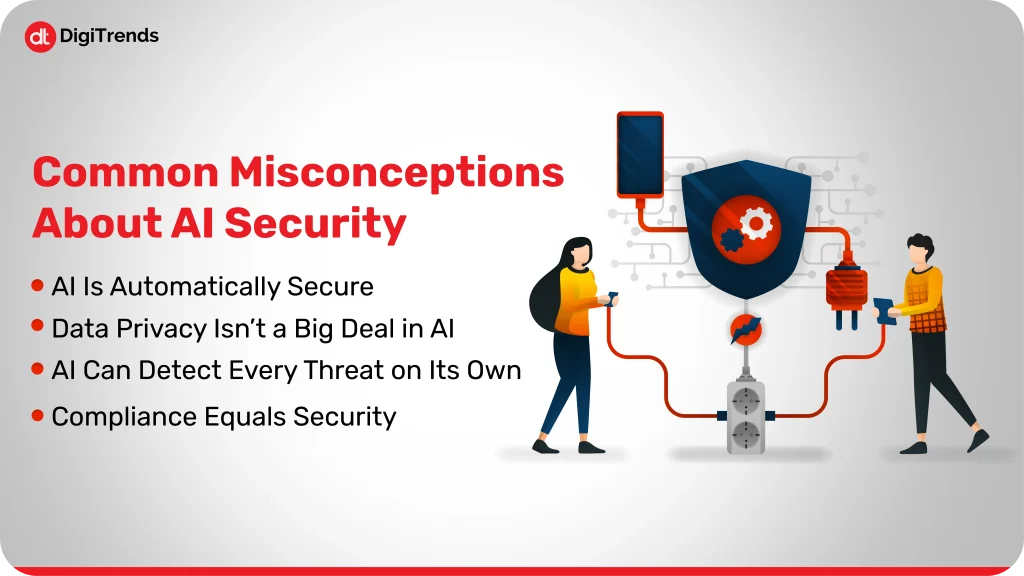
Common Misconceptions About AI Security
A lot of confusion still surrounds how AI handles data. These misconceptions can push businesses into risky decisions or give them a false sense of safety. Clearing them up makes it easier to protect sensitive information properly.
1. AI Is Automatically Secure
Many assume AI systems come with built-in protection. They don’t. AI is only as secure as the data practices around it. Without strong safeguards, even the smartest model can expose sensitive information.
2. Data Privacy Isn’t a Big Concern in AI
Some think removing names or basic identifiers is enough. It’s not. AI can detect patterns that unintentionally reveal identities, even from anonymized datasets. That’s why privacy needs to be baked into the entire AI pipeline.
3. AI Can Detect Every Threat on Its Own
AI helps identify risks, but it can’t catch everything. New attack methods appear constantly, and human oversight is still essential. Security comes from a mix of AI, monitoring, and thoughtful controls.
4. Compliance Equals Security
Meeting regulations like GDPR or HIPAA is important, but compliance alone doesn’t guarantee protection. True security depends on continuous monitoring, responsible data design, and strict control over how AI models use information.
Understanding these misconceptions helps businesses approach AI with a realistic mindset. When they recognize the gaps, they can put stronger protections in place and ensure that AI systems handle data safely and responsibly.
Real-World Examples of AI and Data Security
AI is transforming industries, but its true potential depends on how well businesses protect the data it uses. Seeing real-life examples makes it easier to understand why AI data security and privacy are so important. Here are some notable cases:
1. Cloud AI – Microsoft Azure
Microsoft uses AI through its Azure platform and Copilot tools to help businesses automate and analyze workflows. Strong security measures, including encryption at rest and in transit, ensure that sensitive company data stays protected while AI provides actionable insights.
2. Cloud AI – Google Cloud Vertex AI
Google Cloud’s Vertex AI enables companies to train and deploy AI models while keeping data isolated and encrypted. By default, customer data is separated from model training, ensuring that sensitive information remains secure even as AI delivers predictive analytics.
3. Enterprise AI – Salesforce Einstein
Salesforce Einstein uses AI to deliver insights across customer relationships and sales processes. Data stays within a company’s Salesforce environment, with role-based access, field-level permissions, and audit logs ensuring sensitive information never leaves the protected system.
4. On-Premise AI – IBM Watsonx
IBM Watsonx allows enterprises to run AI models in isolated, governed environments. This ensures strict control over datasets, keeping sensitive financial or healthcare information secure while still allowing AI to generate insights and predictions.
These examples show that organizations can harness AI power without compromising the security of critical data, maintaining trust while driving innovation.
The Future of AI and Data Security
As AI evolves, the importance of protecting the data it relies on will only grow. Tomorrow’s AI won’t just react to problems; it will be expected to handle sensitive information responsibly from the start.
Imagine AI systems that can anticipate vulnerabilities before they’re exploited, automatically enforce data protection, or process information without exposing personal or business details. That future is only possible if organizations treat data security as a core part of AI design and deployment.
But technology alone isn’t enough. Trust is built at every interaction. Companies that commit to secure data handling, clear communication, and transparent AI practices will lead the way. Customers expect accountability, privacy, and protection, and AI systems must deliver on all three.
Collaboration with experienced AI service providers will remain key. Businesses that integrate security-focused AI solutions today will be better prepared for tomorrow’s challenges, adopting best practices that protect sensitive information while still enabling innovation.
In short, AI is only as reliable as the trust people place in it. Prioritizing data security when using AI isn’t optional; it’s the foundation that will allow organizations to unlock AI’s full potential safely.
How DigiTrends Can Help
Whether it’s financial services, healthcare, retail, or any sector that relies on AI, DigiTrends helps companies build systems that are both powerful and trustworthy. By prioritizing data security in AI deployment, businesses can protect sensitive information, strengthen customer trust, and maintain a competitive advantage in the digital landscape.
Conclusion
AI is transforming how businesses operate across finance and healthcare, retail, and cybersecurity. But with this transformation comes a clear responsibility: protecting the data that fuels AI is no longer optional. Strong data security and privacy practices are essential to maintaining trust, meeting regulatory requirements, and unlocking the full potential of AI.
By understanding the challenges, implementing best practices, and learning from real-world examples, organizations can build AI systems that are both innovative and secure. Trust is earned through transparency, careful data handling, and robust security measures.
Partnering with experts like DigiTrends makes this process easier. With tailored solutions that prioritize data protection, businesses can deploy AI safely, safeguard sensitive information, and focus on growth with confidence. In today’s digital world, combining AI innovation with strong data security isn’t just a strategy; it’s the key to long-term success.
Frequently Asked Questions
AI systems process large amounts of sensitive information, from personal details to business insights. Ensuring AI data security and privacy protects confidential data, builds trust with customers, and reduces the risk of breaches.
Industries like finance, healthcare, retail, cybersecurity, and logistics rely heavily on AI while handling sensitive data. Implementing confidential data and secure AI practices helps these sectors innovate safely.
While AI is powerful for detecting threats, it isn’t foolproof. Combining AI with human oversight, monitoring, and strong data privacy and security in AI measures is essential to minimize risks.
Transparency, giving customers control over their data, highlighting security measures, and educating users about AI practices all help foster confidence. These steps reinforce secure AI solutions and responsible handling of confidential data.
DigiTrends provides tailored guidance and solutions to help businesses implement AI data security and privacy practices. From risk assessment to deploying secure AI solutions, they help organizations protect sensitive data while innovating confidently.
Submit Your Message
Author :Muhammad Ishaque
As the SEO Manager at DigiTrends, Muhammad leads organic growth initiatives by developing and executing data-driven SEO strategies that improve search visibility, drive qualified traffic, and support business growth. With extensive experience in technical SEO, on-page optimization, content strategy, keyword research, and performance analysis, he focuses on delivering sustainable search results that align with business objectives. His ability to identify search opportunities, analyze market trends, and implement scalable SEO solutions helps businesses strengthen their digital presence and achieve long-term success.
Recent Blogs
June 22nd, 2026
AI Agent Development Cost: What You’ll Actually Pay in 2026
On average, custom AI agent development costs between $25,000 to $100,000 for basic to mid-level task agents, while advanced enterprise multi-agent systems can exceed $250,000 to $400,000+. Key cost drivers include data processing, model selection (open-source vs. APIs), and ongoing monthly maintenance. Many people are still stuck on questions like if busine...
How Predictive Analytics Helps Financial Services Stay Ahead of the Competition
Several technologies have been contributing to changes in how financial institutions operate and provide services to their customers. For a long time, AMCs, banks, and insurance companies have been changing their operations, moving towards digitalization and AI-powered solutions to enhance the customer experience and gain a competitive advantage in the finte...
DigiTrends Launches AI CoE to Redefine the Future of Enterprise Transformation
Recognized as a leading innovator of transformative digital solutions for clients around the world, DigiTrends is further solidifying its commitment to forward-thinking digital transformation with the launch of its AI Center of Excellence (AI CoE)
Customer Experience Automation in 2026: How AI is Transforming CX Strategy
Explore how customer experience automation is used to fulfill modern customer demands, how AI helps in transforming CX strategy, key CX automation tools, real-world examples, and more.
Enabling First-Mover Advantage through Structured AI Adoption in KSA.
Driven by regional expertise and practical implementation experience, we help organisations in KSA move confidently from strategy to scalable AI execution with an approach aligned with Saudia’s Vision 2030 and SDAIA mandate.











 08 December 2025
  10 months ago
  1012 Views