


 10 February 2026
  2 months ago
  158 Views
Benefits of Having a Mobile App for an E-Commerce Business
Explore why investing in mobile e-commerce solutions pays off, what key e-commerce mobile app features make a real difference.
Continue Reading
We build AI-powered software solutions designed to transform your vision into powerful, results-driven applications.


Providing Avant-Garde Mobile App Solutions.
Powerful apps made for the Apple ecosystem
Scalable apps built for android
Single codebase apps that work across platforms
Efficient apps built using React Native
High-performance apps made using Flutter
Providing Bespoke Mobile Game Development Services.
Delivering Innovative And Avant- Garde AR Solutions.
Our VR Development Services Allow Interaction With Simulated Surroundings.
Customised mobile apps for your Shopify shopfront.
Web Development Services With A Stellar Record Of Excellence.
Providing Web Design Services For All Industries.
Offering Custom And Robust PWA Solutions.
Bespoke E-Commerce Solutions For All Industries.
An Exceptional Success Record In CMS Development Services.
Customised software solutions to match corporate requirements.
Providing Business With Bespoke MVP Development Solutions.
DigiTrends Produces Essential Custom Software Solutions.
Transforming Brands With Innovative Digital Marketing.
AI-Powered Solutions. Wide-Ranging Industries. From finance to healthcare, our intelligent technologies drive innovation across every sector.


Revolutionizing Financial Services with Innovative Technology Solutions
Developing digital software to upgrade healthcare
Innovating learning experience with technology
Helping you step up your advertisement game
Reshaping automotive business experiences with tech
Transforming Real Estate with digital solutions
Digitalizing hospitality management with e-solution
Transforming the retail industry for with digital transformation
Transforming data into intelligent insights that drive innovation across multiple industries.

Delivering exceptional services across different cities, innovating here; and thriving everywhere!

Seek exceptional mobile app development in Delaware.
Where creativity and tech unite for innovation.
Seek advanced mobile app development in LA.
Unleash your business with our innovative mobile apps
Step into Austin’s mobile innovation hub.
Each business is unique; tailored approaches for all.
Leaders of mobile app development in Saudi Arabia
Meet the best app developers in Dubai
Meet the Nordik mobile development experts



Online shopping has evolved a lot over the past few years, from functionalities like AR to personalized recommendations. But what we frequently miss is that not all online shopping is the same. E-commerce and m-commerce have a difference, and before you think, you might not have experienced it, let me tell you that whenever you ditch your laptop to continue shopping from your phone, that’s exactly where you shifted from e-commerce to m-commerce.
Many companies treat e-commerce and mobile commerce as interchangeable. That misunderstanding is expensive. Brands invest heavily in traditional online stores, only to lose customers when the mobile experience feels slow, cramped, or frustrating. The result is abandoned carts, lost conversions, and users who never come back.
At its core, e-commerce is the broader concept. It covers all online buying and selling, typically through websites accessed on desktops and laptops. M-commerce, or mobile commerce, is more specific. It focuses on transactions made through smartphones and tablets, often via apps or mobile-optimized platforms. The difference between e-commerce and m-commerce is not just about screen size. It directly affects checkout flows, payment methods, user experience, and how customers engage with your brand in real time.
Understanding ecommerce vs mobile commerce is no longer optional. It shapes how you design your store, how quickly customers can pay, and how effectively you capture impulse purchases. Businesses that treat mobile as an afterthought struggle. Those that adopt a mobile-first mindset build stronger loyalty and unlock new revenue streams.
In this guide, we’ll break down what e-commerce is and what m-commerce is, explore how they differ, examine modern e-commerce and m-commerce business models, and look at the trends shaping their future. More importantly, you’ll learn how e-commerce and m-commerce for businesses can work together to create smoother, faster, and more profitable shopping experiences.
E-commerce refers to the buying and selling of products or services over the internet, primarily through websites accessed on desktops and laptops. It’s the foundation of online retail and the model most businesses start with when they move their operations online.
In a traditional e-commerce setup, customers browse products on a website, compare options, add items to a cart, and complete the purchase through an online checkout process. Payments are usually made via credit or debit cards, bank transfers, or digital payment gateways. The experience is designed for larger screens, making it easier to display detailed product descriptions, multiple images, and side-by-side comparisons.
What makes e-commerce powerful is its reach. A single online store can serve customers across cities, countries, and continents without the limitations of physical locations. This global accessibility is why e-commerce has become a core revenue channel for brands of all sizes, from small online retailers to enterprise marketplaces.
That said, e-commerce is no longer limited to simple “browse and buy” interactions. Modern platforms now use data, automation, and personalization to improve the shopping experience. Features like AI-powered product recommendations, dynamic pricing, advanced search filters, and customer reviews all play a role in guiding purchase decisions. For many users, the desktop environment still feels ideal for research-heavy purchases that require time and comparison.
Some of the most recognizable names in online retail operate primarily as e-commerce platforms. Marketplaces like Amazon and eBay allow millions of sellers to list products and reach a global audience through web-based storefronts. Platforms such as Shopify and WooCommerce enable businesses to build their own e-commerce websites, manage inventory, and process payments from a centralized dashboard.
From electronics and fashion to groceries and digital services, e-commerce supports nearly every industry. It remains the backbone of online selling, especially for businesses that rely on detailed product presentation and longer buying cycles.
Pros of E-commerce
While e-commerce continues to evolve, its desktop-first nature also introduces limitations, especially as consumer behavior shifts toward mobile. That’s where the next model comes in.
M-commerce, short for mobile commerce, refers to buying and selling products or services through smartphones and tablets. While it sits under the larger umbrella of e-commerce, it deserves its own spotlight because the behavior, expectations, and experience on mobile are fundamentally different.
In an m-commerce environment, users shop through mobile-optimized websites or dedicated apps. The experience is built around speed, simplicity, and convenience. Instead of long browsing sessions, mobile shoppers tend to act fast. They scroll, tap, and purchase in moments that fit into daily life like commuting, waiting in line, or relaxing on the couch.
This shift matters. Mobile commerce removes friction by design. Checkout flows are shorter. Payments rely on mobile wallets like Apple Pay or Google Pay. Authentication happens through fingerprints or facial recognition instead of passwords. The goal is to reduce effort to almost zero.
What really sets m-commerce apart is context. Mobile devices are personal and always on. They know where users are, what they’ve searched for, and how they interact with apps. That allows businesses to deliver location-based offers, personalized recommendations, and timely push notifications that desktop-based e-commerce simply can’t match.
M-commerce relies on mobile-first infrastructure. This includes responsive design, lightweight interfaces, fast-loading pages, and touch-friendly navigation. Many brands go a step further by launching dedicated mobile apps that store user preferences, payment details, and order history to speed up repeat purchases.
Behind the scenes, m-commerce platforms integrate with mobile payment systems, GPS services, camera functionality, and push notification services. These capabilities turn a phone into more than a shopping device. It becomes a discovery, engagement, and conversion tool all in one.
Every day, apps offer clear examples of mobile commerce in action. The Amazon mobile app lets users search, scan products, track deliveries, and reorder in seconds. Food delivery platforms like Uber Eats and DoorDash are built entirely around mobile behavior. Payment apps such as PayPal and Venmo enable instant transactions without typing card details.
Social platforms have also become major m-commerce channels. Instagram, TikTok, and Facebook now allow users to discover and purchase products without leaving the app, blurring the line between browsing and buying.
Pros of M-commerce
As mobile usage continues to dominate online activity, m-commerce has shifted from a nice-to-have to a core business requirement. Understanding this model is essential before comparing it directly with traditional e-commerce, which is exactly what we’ll do next.
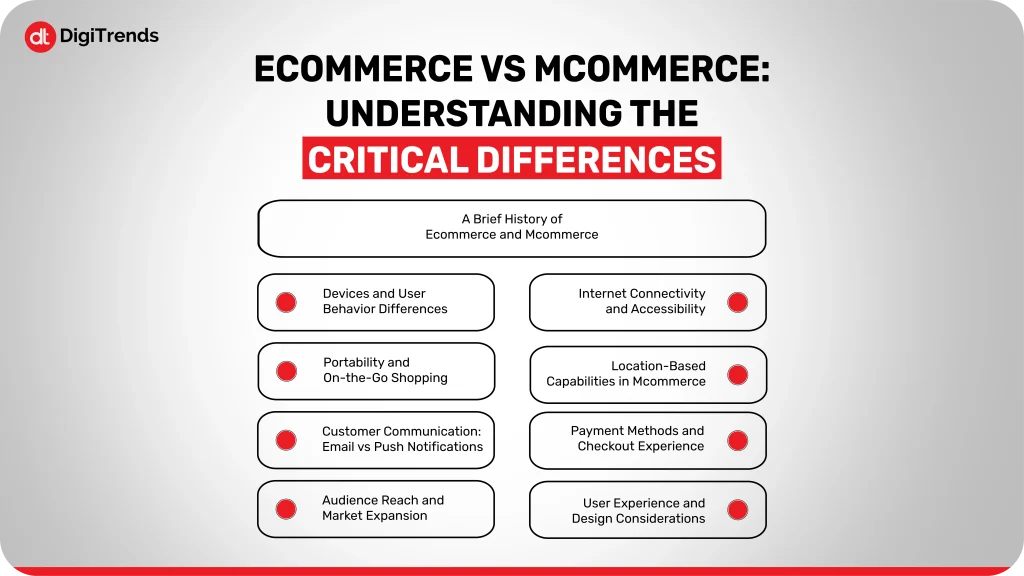
The difference between e-commerce and m-commerce goes far beyond the device you use to shop. It affects how customers discover products, how quickly they make decisions, and how smoothly they move from interest to purchase. If you’re building or scaling an online business, understanding these differences is critical.
E-commerce came first. Its roots go back to the early days of the internet, when online transactions were limited, slow, and mostly desktop-based. The real boom happened in the 1990s with the rise of web browsers and platforms like Amazon and eBay. Shopping online meant sitting at a desk, researching products, and completing purchases through a website.
M-commerce arrived later. Early mobile transactions existed in the late 1990s, but adoption remained limited until smartphones became mainstream. The launch of the iPhone and the rapid growth of mobile apps transformed phones into powerful commerce tools. What was once an extension of e-commerce became its own dominant channel.
E-commerce is typically accessed through desktops and laptops. These devices support longer sessions, detailed research, and complex workflows. Users are more likely to compare multiple products, read reviews, and take time before making a purchase.
M-commerce is built around immediacy. Mobile users shop in short bursts. Decisions happen faster, often driven by convenience or impulse. This shift in behavior explains why simplified navigation and one-tap checkout are so effective on mobile.
Traditional e-commerce relies heavily on stable internet connections. If connectivity drops, the shopping experience usually stops.
M-commerce is more flexible. Many mobile apps allow users to browse products, save items, or build carts even with weak or intermittent connections. Actions sync automatically once the device reconnects, making mobile commerce more forgiving in real-world conditions.
Desktops and laptops limit where and when e-commerce can happen. Shopping typically requires a fixed setup and dedicated time.
M-commerce removes that limitation. Smartphones turn idle moments into shopping opportunities. Whether it’s during a commute or while waiting in line, mobile commerce fits naturally into everyday life. This constant accessibility is one of the biggest drivers behind its rapid growth.
E-commerce platforms have limited access to location data, usually based on IP addresses. This provides only a rough estimate of where a user is.
M-commerce leverages GPS, Wi-Fi, and cellular data to deliver precise location-based experiences. Businesses can show nearby stores, local inventory, personalized promotions, or time-sensitive offers based on where a customer is at that moment.
E-commerce communication depends heavily on email. While effective, email often lacks immediacy and relies on users choosing to open messages later.
M-commerce enables real-time communication through push notifications. Businesses can alert users about abandoned carts, flash sales, order updates, or personalized offers instantly. This direct line to customers drives higher engagement and faster action.
E-commerce checkout processes often involve manually entering card details, billing addresses, and passwords. On the desktop, this feels manageable.
M-commerce simplifies payments through mobile wallets and biometric authentication. Fingerprints, face recognition, and stored payment details reduce checkout time to seconds. Fewer steps mean fewer abandoned carts.
E-commerce primarily serves users with access to computers and reliable home internet. While this audience is valuable, it has natural limits.
M-commerce reaches a broader audience, especially in regions where smartphones are more common than personal computers. For many users, mobile devices are their primary gateway to the internet, making mobile commerce essential for global growth.
E-commerce experiences are designed for large screens. They support detailed visuals, long descriptions, and complex navigation.
M-commerce demands simplicity. Small screens force businesses to prioritize clarity, speed, and ease of use. Successful mobile experiences focus on minimal steps, fast load times, and intuitive gestures.
Understanding these differences helps businesses make smarter decisions about where to invest and how to design their digital storefronts. The next step is choosing the right business model to support both channels effectively.
The business model you choose defines how you sell, how you scale, and how customers interact with your brand. While e-commerce and m-commerce often overlap, the way these models perform can change significantly depending on the platform and user behavior.
This is the most common e-commerce model. Businesses sell products or services directly to individual consumers through online stores or marketplaces. Examples include global retailers like Amazon or brand-owned websites selling fashion, electronics, or household items.
In a traditional e-commerce setup, B2C thrives on detailed product pages, strong visuals, reviews, and comparison tools. Many customers still prefer desktops for high-consideration purchases, where research and evaluation matter before checkout.
B2B ecommerce involves businesses selling to other businesses, such as wholesalers, manufacturers, or service providers. These transactions often include bulk pricing, custom quotes, repeat orders, and account-based pricing.
While B2B ecommerce started as a desktop-heavy experience, mobile access is now becoming essential. Sales teams and buyers use mobile devices to place orders, check inventory, and manage accounts on the go, blending e-commerce and m-commerce functionality.
C2C platforms allow individuals to sell products or services directly to other individuals. Marketplaces like eBay and Facebook Marketplace are classic examples.
E-commerce platforms provide the structure, while mobile access drives participation. Sellers can list items, communicate with buyers, and complete transactions quickly, especially when mobile features are involved.
D2C brands sell directly to customers without relying on third-party retailers. This model gives businesses full control over pricing, branding, and customer relationships.
E-commerce websites form the foundation of D2C, but m-commerce strengthens the connection. Mobile apps, loyalty programs, and personalized offers help brands stay visible and relevant in customers’ daily lives.
App-based commerce focuses on transactions through dedicated mobile applications rather than mobile browsers. Brand apps like Starbucks, Sephora, or Target are designed to make repeat purchases fast and effortless.
Apps store user preferences, payment details, and purchase history. This reduces friction and encourages loyalty, making app-based m-commerce one of the most effective mobile selling models.
Social commerce allows users to discover and purchase products directly within social media platforms. Instagram, TikTok, Facebook, and Pinterest now offer built-in shopping features.
This model works especially well on mobile, where social browsing already dominates screen time. The transition from content to checkout feels natural and immediate.
QR codes and NFC technology enable quick, contactless transactions. Users scan a code or tap their phone to access product details, menus, or payment options.
This model blends online and offline experiences and is particularly effective for mobile-first audiences looking for speed and simplicity.
Mobile marketplaces are designed specifically for smartphone users. Apps like Amazon, eBay, and food delivery platforms prioritize thumb-friendly navigation, fast search, and one-tap checkout.
These platforms combine the reach of e-commerce with the convenience of m-commerce, making them central to modern digital shopping habits.
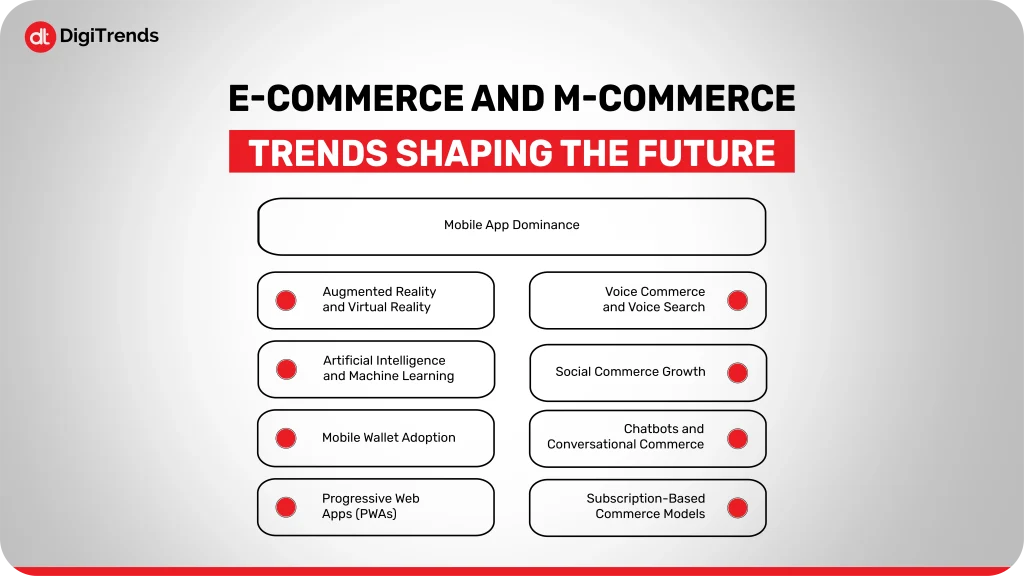
The digital commerce landscape is evolving rapidly. Understanding the latest e-commerce and m-commerce trends is essential for businesses that want to stay competitive, capture mobile audiences, and deliver seamless shopping experiences.
Mobile applications continue to dominate consumer behavior. Apps are faster, more intuitive, and more capable than mobile websites. They allow push notifications, store user preferences, and simplify repeat purchases. Research shows app users engage up to three times more than mobile web visitors, making apps a critical driver of m-commerce sales.
AR and VR are transforming both e-commerce and m-commerce by enabling interactive, immersive experiences. Furniture brands let users visualize products in their homes via mobile cameras, while beauty brands offer virtual try-ons. For desktop users, VR showrooms recreate in-store experiences. These technologies reduce uncertainty, increase confidence, and improve conversion rates.
Voice assistants like Alexa, Siri, and Google Assistant are changing how people shop. Consumers can search, reorder, or place new orders without touching a screen. Voice commerce integrates seamlessly with both desktop and mobile experiences, especially when paired with mobile devices for on-the-go convenience.
AI powers personalization across e-commerce and m-commerce platforms. From product recommendations and chatbots to predictive inventory and dynamic pricing, AI ensures that shopping feels tailored. For mobile users, this means smarter notifications, faster searches, and context-aware suggestions that drive engagement.
Social media is increasingly becoming a direct sales channel. Platforms like Instagram, TikTok, and Facebook now support in-app purchases, making shopping a part of social engagement. Since most social browsing happens on mobile, this trend represents a major m-commerce growth opportunity.
Mobile wallets like Apple Pay, Google Pay, and Samsung Pay simplify payments and reduce checkout friction. They are secure, fast, and help lower cart abandonment rates. By 2028, mobile wallet transactions are expected to surpass $16 trillion globally, highlighting their critical role in the future of m-commerce.
Chatbots provide instant support across platforms. They guide users, answer questions, and help with checkout processes. For mobile shoppers, chatbots are particularly useful because they deliver quick assistance without navigating away from the app.
PWAs combine the best of websites and mobile apps. They load quickly, work offline, send push notifications, and feel like native apps without requiring downloads. PWAs are ideal for businesses seeking mobile-first experiences without building separate apps for iOS and Android.
Subscription models extend beyond streaming services to products like meal kits, personal care, or curated boxes. Both e-commerce and m-commerce platforms support subscriptions, allowing businesses to build recurring revenue and maintain continuous engagement. Mobile apps simplify management, reordering, and notifications, making subscriptions more convenient for customers.
Modern online businesses don’t have to choose between e-commerce and m-commerce. The most successful brands deliver seamless experiences across both desktop and mobile. If your business hasn’t fully embraced mobile yet, here’s how to integrate m-commerce effectively into your existing e-commerce strategy.
Start by assessing whether your existing platform supports mobile commerce functionality. Not all e-commerce systems are optimized for mobile. Older platforms may lack responsive design, mobile-friendly checkout, or app integration.
If your platform is limiting growth, consider migrating to a solution that provides true flexibility. Modern ecommerce platforms should support:
When in doubt, working with an e-commerce development company can help ensure your systems are ready for mobile-first commerce.
Mobile optimization is more than shrinking content for smaller screens. It requires:
A smooth mobile experience keeps users engaged and reduces cart abandonment.
Not every business needs a dedicated app, but apps can significantly improve engagement. They offer:
You can either convert your website into an app using app-building platforms or develop a custom app to meet unique customer needs.
Simplifying checkout is critical for mobile shoppers. Integrate mobile wallets such as:
These payment methods reduce friction with biometric authentication and one-tap purchases, increasing conversions and reducing abandoned carts.
Mobile devices make it possible to engage customers based on location. You can:
Location-based marketing creates highly relevant experiences that drive immediate action.
Mobile commerce isn’t a one-time project. Track metrics such as:
Use this data to refine navigation, checkout flows, and promotional strategies. Staying updated with technology trends ensures your mobile strategy remains competitive.
Navigating the shift from e-commerce to m-commerce isn’t just about technology; it’s about strategy, execution, and understanding how your customers interact with your brand. That’s where DigiTrends comes in. We help businesses build seamless, mobile-first experiences that drive engagement, loyalty, and revenue.
End-to-End Ecommerce Solutions
From designing robust, user-friendly websites to integrating payment gateways and CRM systems, DigiTrends ensures your e-commerce platform works flawlessly on both desktop and mobile. Our team focuses on creating scalable solutions that grow with your business while delivering the performance and security your customers expect.
Mobile-First Commerce Expertise
Mobile is no longer optional; it’s essential. DigiTrends specializes in mobile commerce solutions, including:
Data-Driven Insights and Optimization
We don’t just build platforms, we optimize them. DigiTrends leverages analytics to track user behavior, conversion rates, and engagement patterns across devices. This allows continuous refinement of both e-commerce websites and m-commerce apps, ensuring you’re always a step ahead of competitors.
By combining technical expertise with strategic insight, DigiTrends helps businesses:
Whether you’re launching a new online store, upgrading your mobile experience, or seeking a complete digital commerce overhaul, DigiTrends provides the tools, expertise, and guidance to turn visitors into loyal customers.

E-commerce and m-commerce are no longer separate paths; they are two sides of the same digital commerce strategy. E-commerce gives your business reach, detailed product displays, and robust infrastructure, while m-commerce delivers convenience, speed, and personalized mobile experiences that meet customers wherever they are.
The key is integration. Businesses that treat mobile as an afterthought risk losing conversions, abandoned carts, and disengaged customers. Those that adopt a mobile-first approach, supported by a well-designed e-commerce platform, unlock new revenue streams, higher customer loyalty, and long-term growth.

Explore why investing in mobile e-commerce solutions pays off, what key e-commerce mobile app features make a real difference.
Continue Reading
Social commerce in KSA and UAE is becoming a preference for shoppers. Understand its trends, challenges and why it is important for businesses.
Continue Reading
Explore the ways to adopt digital transformation in e-commerce and be one of the e-commerce businesses that hold the power of evolving with time.
Continue Reading
Fashion retail app for is highly important to keep up with the fashion industry. What’s the cost of custom fashion app development?
Continue Reading

DigiTrends, a digital transformation company, has been named a top 100 eCommerce development company in the US for 2025 by Techreviewer.co.
Continue Reading
Learn why partnering with an e-commerce web development company is key to your online success
Continue Reading