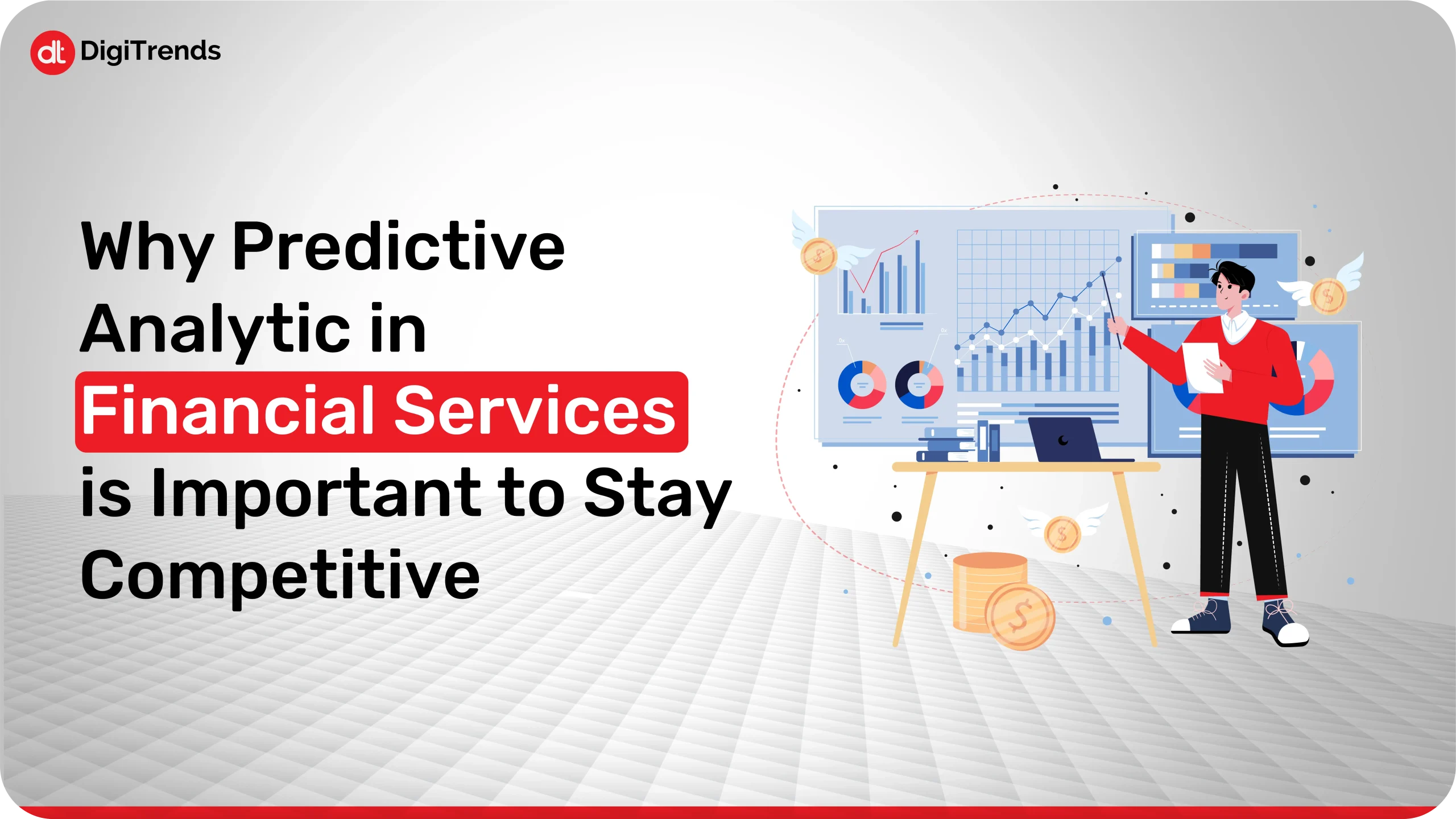
How Predictive Analytics Helps Financial Services Stay Ahead of the Competition
Published
18 May 2026
Time
4 months ago
Views
662 Views
Muhammad Ishaque
As the SEO Manager at DigiTrends, Muhammad leads organic growth initiatives by developing and executing data-driven SEO strategies that improve search visibility, drive qualified traffic, and support business growth. With extensive experience in technical SEO, on-page optimization, content strategy, keyword research, and performance analysis, he focuses on delivering sustainable search results that align with business objectives. His ability to identify search opportunities, analyze market trends, and implement scalable SEO solutions helps businesses strengthen their digital presence and achieve long-term success.
Table Of content
Share This Article
Several technologies have been contributing to changes in how financial institutions operate and provide services to their customers. For a long time, AMCs, banks, and insurance companies have been changing their operations, moving towards digitalization and AI-powered solutions to enhance the customer experience and gain a competitive advantage in the fintech market.
One of the technologies that is gaining traction by becoming the backbone of market decision-making in the finance industry is predictive analytics. As financial institutions are sitting on an enormous amount of data, every action, including transactions, loan applications, customer interaction, investment, and digital clicks, is important and valuable for the firm. We are not implying that storing this data is a challenge; that problem was solved a long time ago. The real problem lies in where firms fail to understand what to do with the information and data before the opportunity is lost or risks become costly.
This is the exact problem that predictive analytics in financial services solves, which is why it has become a major priority for banks, investment firms, and financial organizations worldwide.
What is Predictive Analytics in Financial Services?
Imagine if, instead of reacting to your problems after they happen, you could predict upcoming challenges and solve them long before you have to face them.
Now let’s think about it in financial terms. Detecting fraudulent transactions, predicting customer behavior, and identifying loan default risks long before a challenge or risk occurs. Predictive models allow organizations to move from reactive operations to proactive decision-making.
According to McKinsey & Company, banks that effectively implement AI and advanced analytics can increase productivity by 30 percent.
This explains why financial institutions are interested in exploring predictive analytics banking industry solutions over the last couple of years across the globe.
Understanding Predictive Analytics in Financial Services
Predictive analytics in financial services operates by using historical data, artificial intelligence, machine learning, and statistical models to predict future outcomes.
For example, a bank can use predictive models to identify customers who may be considering switching banks, detect unusual transaction activity before fraud occurs, or forecast which products a customer is most likely to purchase next.
The true power of predictive analytics in financial services is that it can aid in better and faster business decisions. Rather than making decisions based on assumption or stale reports, financial leaders can do this with real-time intelligence.
Why the Banking Sector Is Investing Heavily in Predictive Technologies
As a professional in the marketing sector, or even someone who’s following the industry must know the kind of pressure the financial industry is from multiple directions including customer end, and regulatory end. Since customers are now demanding personalized digital experiences, cyber threats are becoming more advanced, and economic uncertainty is continuing to impact lending and investment decisions.
That is exactly why the use of predictive analytics in the banking industry is the talk of the town now.
The real of value of predictive analytics for banks is in it’s ability to make sense of huge amounts of customer and operational data in real time.
It stands at a level where traditional reporting systems can’t as these outdated systems can’t explain what predictive analytics helps institutions to understand including what is likely to happen tomorrow. yesterday.
Fraud Detection Is Becoming Smarter
Fraud is one of the most concerning factors for financial institutions worldwide. The main problem is that the traditional fraud systems can only identify suspicious activity after the transaction has already taken place. That delay can lead to financial losses, reputational damage, and customer dissatisfaction.
This is where predictive analytics for banking & financial services is creating a measurable impact.
Advanced predictive solutions are designed to consider multiple factors in transactions, spending patterns, geography, device activity, and historical fraud indicators, all at once. If odd behavior is noted, the system can immediately flag or block suspicious transactions before damage is done.
One of the major drivers of the rapid evolution of predictive analytics in banking industry environments is the proactive approach.
Financial institutions are no longer only using manual monitoring. Today, AI-driven predictive models are assisting banks in their quick response, fraud loss reduction, and enhancing customer confidence.
Smarter Lending and Credit Decisions
The process of lending is now more complicated due to new technologies, due to which the traditional credit scoring model is not always able to account for customer behavior in real-time or for evolving financial situations.
A bank can use predictive analytics to consider all of these and more.
Improve credit scoring accuracy
Reduce loan default risks
Accelerate approvals
Expand financial inclusion
Improve portfolio management
The ability to predict financial behavior more accurately is one of the biggest advantages of predictive analytics in financial services today.
Banks can now identify high-risk borrowers earlier while also discovering opportunities to serve reliable customers who may have been overlooked by traditional systems.
Personalized Banking Experiences Are Now Expected
Customers no longer compare banks only with other banks. They compare their digital experience with companies like Netflix, Amazon, and Uber without understanding the complexity of the industry. They expect personalization, convenience, and intelligent recommendations.
This is another area where predictive analytics in the banking industry capabilities are making a major difference.
For example, if predictive models identify that a customer may soon require a mortgage, investment plan, or savings product, the bank can proactively provide personalized recommendations.
This level of intelligence is why predictive analytics for banking & financial services is becoming important if a financial institution wishes to improve its customer experience strategy.
Operational Efficiency Is Becoming a Competitive Advantage
Financial institutions face issues like rising operational costs, increasing compliance requirements, and customer expectations reaching new levels everyday. These are the reasons thatare forcing banks to improve their internal processes and gain operational efficiency before all these problems become bigger with time.
Using predictive analytics in banking industry environments, organizations can forecast operational bottlenecks, automate workflows, and improve resource planning.
Some institutions are already using predictive systems for:
The result is lower operational costs and faster decision-making.
This is why many institutions now see predictive analytics for banks not just as a technology investment, but as a long-term business strategy.
Compliance and Risk Management Are Becoming More Intelligent
Finance is one of the most regulated industries in the world, and there’s no doubt about it; let’s just say compliance teams of financial institutions are running on strong caffeine. They constantly monitor transactions, detect suspicious activity, and ensure adherence to changing regulations.
Wondering how predictive analytics in financial services is making the lives of compliance managers easier?
Traditional compliance processes are often slow and resource-intensive. However, predictive analytics can help organizations automate and strengthen compliance monitoring by dentifying unusual transaction patterns, detecting anti-money laundering risks, and flagging high-risk activities before they turn into major issues.
This makes predictive analytics for banking & financial services highly valuable for risk management and governance teams because teams now don’t have to rely only on historical audits; institutions can now identify potential risks in real time and take preventive action earlier.
The Future of Predictive Analytics in Banking
The concept of predictive analytics in the banking industry is fancy enough right now, but as rapidly as artificial intelligence is moving forward, with almost a better version, a better model is being released every month. The upgrade that predictive analytics can reach is also not limited.
This is why the future of banking is highly intelligent, automated, and completely AI-powered. Financial institutions must step into the realm of predictive analytics before they struggle to compete in a rapidly digital financial landscape.
As technologies continue to evolve, predictive analytics banking industry solutions will become even more advanced and accessible.
In the coming years, we can expect predictive systems to power:
Hyper-personalized banking
Real-time fraud prevention
AI-driven wealth management
Intelligent customer service
Predictive compliance monitoring
Automated financial operations
The role of predictive analytics in financial services will continue to expand as institutions look for smarter ways to improve efficiency, reduce risks, and enhance customer experiences.
How DigiTrends Supports Financial Institutions
DigiTrends has been an experienced digital partner for financial institutions for a decade now, helping organizations maximize the potential of data and unlock its value with AI-powered digital transformation solutions.
We bring with us expertise in predictive analytics for banks and intelligent financial technologies that help organizations to make faster, smarter, and more strategic decisions.
Through advanced technology and deep industry understanding, DigiTrends helps organizations modernize operations while building future-ready financial ecosystems.
Conclusion
The financial industry is moving toward a future where decisions will increasingly be powered by data and predictive intelligence. Institutions that embrace predictive analytics in banking industry environments today will be better positioned to adapt, compete, and grow tomorrow.
From fraud prevention and smarter lending to customer personalization and operational optimization, predictive analytics is transforming how financial institutions operate at every level.
As competition intensifies and customer expectations continue to evolve, investing in predictive analytics for banking & financial services is no longer optional; it is becoming essential for long-term success.
Submit Your Message
Author :Muhammad Ishaque
As the SEO Manager at DigiTrends, Muhammad leads organic growth initiatives by developing and executing data-driven SEO strategies that improve search visibility, drive qualified traffic, and support business growth. With extensive experience in technical SEO, on-page optimization, content strategy, keyword research, and performance analysis, he focuses on delivering sustainable search results that align with business objectives. His ability to identify search opportunities, analyze market trends, and implement scalable SEO solutions helps businesses strengthen their digital presence and achieve long-term success.
Recent Blogs
June 22nd, 2026
AI Agent Development Cost: What You’ll Actually Pay in 2026
On average, custom AI agent development costs between $25,000 to $100,000 for basic to mid-level task agents, while advanced enterprise multi-agent systems can exceed $250,000 to $400,000+. Key cost drivers include data processing, model selection (open-source vs. APIs), and ongoing monthly maintenance. Many people are still stuck on questions like if busine...
DigiTrends Launches AI CoE to Redefine the Future of Enterprise Transformation
Recognized as a leading innovator of transformative digital solutions for clients around the world, DigiTrends is further solidifying its commitment to forward-thinking digital transformation with the launch of its AI Center of Excellence (AI CoE)
Customer Experience Automation in 2026: How AI is Transforming CX Strategy
Explore how customer experience automation is used to fulfill modern customer demands, how AI helps in transforming CX strategy, key CX automation tools, real-world examples, and more.
Enabling First-Mover Advantage through Structured AI Adoption in KSA.
Driven by regional expertise and practical implementation experience, we help organisations in KSA move confidently from strategy to scalable AI execution with an approach aligned with Saudia’s Vision 2030 and SDAIA mandate.












 18 May 2026
  4 months ago
  662 Views