


Mastering Custom Application Development: A Playbook for Business Leaders
Explore an effective roadmap for custom application development that leaders need to understand, plan, and implement.
Continue Reading
We build AI-powered software solutions designed to transform your vision into powerful, results-driven applications.


Providing Avant-Garde Mobile App Solutions.
Powerful apps made for the Apple ecosystem
Scalable apps built for android
Single codebase apps that work across platforms
Efficient apps built using React Native
High-performance apps made using Flutter
Providing Bespoke Mobile Game Development Services.
Delivering Innovative And Avant- Garde AR Solutions.
Our VR Development Services Allow Interaction With Simulated Surroundings.
Customised mobile apps for your Shopify shopfront.
Web Development Services With A Stellar Record Of Excellence.
Providing Web Design Services For All Industries.
Offering Custom And Robust PWA Solutions.
Bespoke E-Commerce Solutions For All Industries.
An Exceptional Success Record In CMS Development Services.
Customised software solutions to match corporate requirements.
Providing Business With Bespoke MVP Development Solutions.
DigiTrends Produces Essential Custom Software Solutions.
Transforming Brands With Innovative Digital Marketing.
AI-Powered Solutions. Wide-Ranging Industries. From finance to healthcare, our intelligent technologies drive innovation across every sector.


Revolutionizing Financial Services with Innovative Technology Solutions
Developing digital software to upgrade healthcare
Innovating learning experience with technology
Helping you step up your advertisement game
Reshaping automotive business experiences with tech
Transforming Real Estate with digital solutions
Digitalizing hospitality management with e-solution
Transforming the retail industry for with digital transformation
Transforming data into intelligent insights that drive innovation across multiple industries.


Delivering exceptional services across different cities, innovating here; and thriving everywhere!


Seek exceptional mobile app development in Delaware.
Where creativity and tech unite for innovation.
Seek advanced mobile app development in LA.
Unleash your business with our innovative mobile apps
Step into Austin’s mobile innovation hub.
Each business is unique; tailored approaches for all.
Leaders of mobile app development in Saudi Arabia
Meet the best app developers in Dubai
Meet the Nordik mobile development experts

 06 January 2026
 3 months ago
 143 Views


Did you know that doctors attend to at least 20 – 30 patients per day in the United States?
They also simultaneously take care of other tasks such as electronic health records maintenance, administrative tasks, and their personal activities. In this case self learning becomes a file they cannot include in their daily workflow pile.
HCP portals were built to overcome this issue and provide doctors with the latest industry news, studies, and findings of the field so they can easily concentrate more on the most important thing, that is, their patients.
The HCP portal is no less than a specially curated mission-critical platform. We say this because this platform connects physicians, providers, and pharma teams with the necessary content, tools, and services. Healthcare providers get access to new medication releases, upcoming conferences, learning materials, and webinars.
Management of telehealth sessions, medical webinars, product access, medical data, you name it, and HCP portals have it, whatever it takes to make the lives of medical professionals easy.
DigiTrends possesses hands-on experience in building an HCP portal that provides a seamless experience while being secure without any compromise on the features and their quality.
Explore how DigiTrends was successful in building an HCP portal with features like webinars, telemedicine, online CMEs, and more. This behind-the-scenes look offers practical insights and lessons from a real-world portal by DigiTrends.
The core use of HCP portals is to make healthcare workflows simple and to centralize the resources for healthcare professionals, but many struggle with their development when it comes to security.
Whatever happens on this portal, whether it is a telemedicine session, a webinar, or a healthcare professional accessing product information, everything hits the wall of security and compliance. So, if any of the data and information is mishandled, it can create serious legal, operational, and reputational risks for the healthcare organization.
If you are looking to develop a secure HCP portal, then you must consider overcoming issues like inconsistent access controls, fragmented modules, and insufficient monitoring because these small mistakes will pull you back from a truly secure HCP portal. Even portals that provide multiple features like video libraries, telemedicine, and event management can fall short if the architecture doesn’t support secure auditing at every level.
This is where DigiTrends’s approach stands out. We make sure that every feature of the portal, including webinars, telemedicine sessions, product access, news feeds, and more, is secure without compromising usability or performance of the platform.
For a future-ready HCP portal development, the architecture is supposed to be designed around various factors, including access control and data security from the beginning of the project.
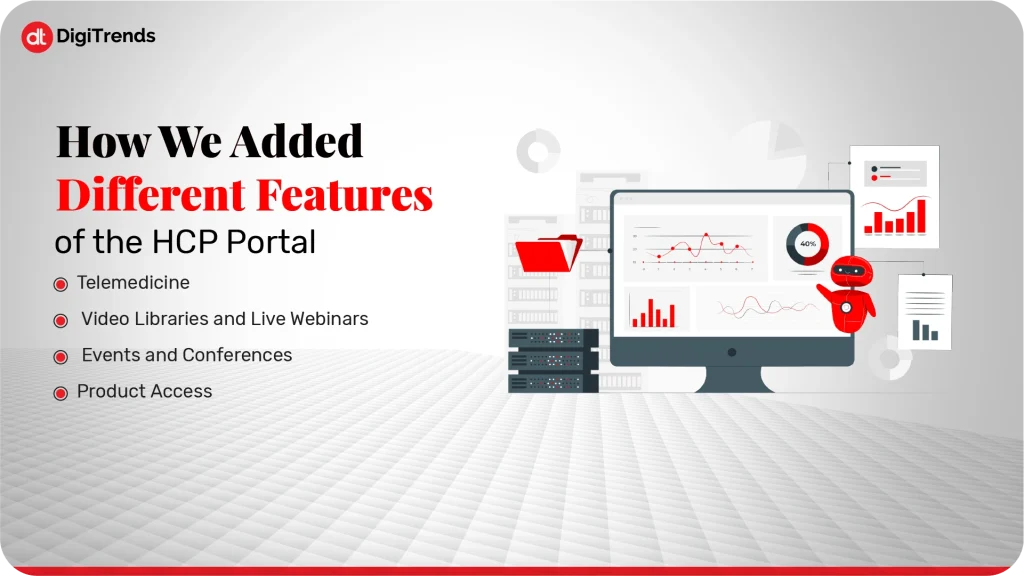
The platform that DigiTrends built had multiple high-risk features, including video libraries, live webinars, telemedicine, events, and product access. Each feature comes with its own security and privacy requirements; therefore, we adopted a unified approach to ensure security, as treating every feature as a separate module could have increased risks and complexities.
We have designed a centralized, secure architecture where all features are built on the same security foundation. Identity management, role-based access, encryption, and audit logging were implemented as core services rather than feature-specific add-ons. This approach ensures that whatever step the HCP is taking, whether it is accessing telemedicine tools, joining live webinars, or accessing product details, every feature is being used with the same compliance standards across the entire platform.
DigiTrends has built a scalable healthcare platform that supports growth without weakening security.
We used secure session handling, encrypted communication, and stringent role-based access. Sessions can only be started or joined by authorized users, and all communications are completely secure. This protects patient privacy and frees up medical staff to concentrate on patient care rather than technology.
HCP engagement requires live webinars and video content, but one thing that is the most important aspects in integrating these modules is careful access control.
Our HCP portal has been designed such that the content visibility of these features is governed by user role, consent status, and compliance rules, which prevents any unauthorized access and ensures that educational and clinical material is delivered to the medical professionals securely within the broader healthcare platform.
Event calendars, conference registrations, and galleries may appear low-risk at first, but they often involve user data and engagement tracking. We secured these features with controlled registration flows, encrypted data handling, and audit logging.
By doing so, the portal maintains consistent HCP portal security across both high-risk and low-risk interactions.
Product sections and ordering tools require a careful balance between usability and compliance. We designed these modules to ensure that sensitive data is protected, access is role-based, and activity is traceable without adding friction to the user experience.
By tailoring security controls to each feature, DigiTrends transformed a complex set of tools into a cohesive healthcare platform. This feature-first security mindset ensures that, as the portal evolves, compliance remains intact without slowing innovation.

Security is a complex task that needs to be considered carefully when designing, building, and maintaining an HCP portal. Compliance should be considered at every step because even if one area is overlooked by fault, you can put the entire platform at risk.
Let’s have a look at the core security requirements that every HCP portal must address, regardless of its size or feature set.
Security requires that only authorized individuals can access protected health information. For an HCP portal, this means strict role-based access control.
Physicians, administrators, pharma teams, and support staff should all see different levels of information based on their role. Strong authentication methods, session timeouts, and permission management are essential for maintaining HCP portal security and preventing unauthorized access.
Any healthcare platform must encrypt sensitive data, whether it’s being stored or transmitted.
This includes patient-related data shared during telemedicine sessions, files uploaded to the portal, webinar interactions, and backend databases. Encryption ensures that even if data is intercepted or accessed improperly, it remains unreadable and protected.
Secure portal requires full visibility into who accessed data, when it was accessed, and what actions were taken.
A secure HCP portal development strategy must include detailed audit logs across all features. Whether an HCP joins a webinar, accesses product content, or conducts a telemedicine session, every interaction should be traceable. These logs are critical for compliance audits, incident investigations, and ongoing risk management.
Telemedicine features introduce some of the highest compliance risks. Live video, messaging, file sharing, and real-time collaboration all involve sensitive data.
To meet secure telemedicine portal requirements, platforms must support encrypted communication, secure session handling, and strict participant verification. Recording policies, data storage rules, and session access controls must also align with security standards.
HCP portals should only display or share data that is directly relevant to the user’s role and task. Overexposure of information, even internally, increases compliance risk and weakens the overall security posture of the platform.
Behind every healthcare platform is a secure infrastructure.
This includes compliant cloud hosting, secure APIs, network monitoring, intrusion detection, and regular security updates. Infrastructure decisions directly impact compliance, which is why security must be planned from day one, not layered on later.
An HCP portal must support continuous monitoring, vulnerability assessments, and regular security reviews. This ensures the platform remains compliant as it scales and adapts to new business or clinical requirements.
By addressing these core security requirements at both the architectural and feature level, healthcare organizations can build HCP portals that are not just compliant on paper, but secure, scalable, and trusted in real-world use.
Here’s what this all comes down to. A successful HCP portal isn’t defined by how many features it offers. It’s defined by how safely, reliably, and confidently those features can be used in a regulated healthcare environment.
This is where many platforms fall short. They focus on speed and functionality first, then try to retrofit security later. DigiTrends took the opposite path. By designing a secure platform from day one, every part of the portal, from telemedicine and webinars to events and product access, was built on a shared foundation of security, compliance, and scalability.
The result is a secure HCP portal that supports real healthcare workflows without slowing them down. Security is embedded, not bolted on. Compliance scales with the platform instead of restricting it. And healthcare professionals get a seamless experience they can trust with sensitive data.
That’s how DigiTrends builds HCP portals that don’t just meet security standards, but are ready for the future of digital healthcare.

Explore an effective roadmap for custom application development that leaders need to understand, plan, and implement.
Continue Reading
Explore how to choose a software development company that will not just provide what you ask for but also align perfectly with your goals.
Continue Reading
Explore how customer experience automation is used to fulfill modern customer demands, how AI helps in transforming CX strategy, key CX automation tools, real-world examples, and more.
Continue Reading

Success in Arabian education app development requires more than coding an app. Explore the education framework and regulatory environment.
Continue Reading
Explore how voice recognition technology is being used across healthcare and the role of voice assistants in clinical environments.
Continue Reading
Explore how Unreal Engine 5 for enterprise applications is used and how organizations are using it in the real world.
Continue Reading