


Top 11 Healthcare App Developers in the USA: A 2026 Guide
Have a look at the top 11 healthcare app developers in the USA in 2026 and what makes them stand out.
Continue Reading
We build AI-powered software solutions designed to transform your vision into powerful, results-driven applications.
Providing Avant-Garde Mobile App Solutions.
Powerful apps made for the Apple ecosystem
Scalable apps built for android
Single codebase apps that work across platforms
Efficient apps built using React Native
High-performance apps made using Flutter
Providing Bespoke Mobile Game Development Services.
Delivering Innovative And Avant- Garde AR Solutions.
Our VR Development Services Allow Interaction With Simulated Surroundings.
Customised mobile apps for your Shopify shopfront.
Web Development Services With A Stellar Record Of Excellence.
Providing Web Design Services For All Industries.
Offering Custom And Robust PWA Solutions.
Bespoke E-Commerce Solutions For All Industries.
An Exceptional Success Record In CMS Development Services.
Customised software solutions to match corporate requirements.
Providing Business With Bespoke MVP Development Solutions.
DigiTrends Produces Essential Custom Software Solutions.
Transforming Brands With Innovative Digital Marketing.
AI-Powered Solutions. Wide-Ranging Industries. From finance to healthcare, our intelligent technologies drive innovation across every sector.
Revolutionizing Financial Services with Innovative Technology Solutions
Developing digital software to upgrade healthcare
Innovating learning experience with technology
Helping you step up your advertisement game
Reshaping automotive business experiences with tech
Transforming Real Estate with digital solutions
Digitalizing hospitality management with e-solution
Transforming the retail industry for with digital transformation
Transforming data into intelligent insights that drive innovation across multiple industries.


Delivering exceptional services across different cities, innovating here; and thriving everywhere!

Seek exceptional mobile app development in Delaware.
Where creativity and tech unite for innovation.
Seek advanced mobile app development in LA.
Unleash your business with our innovative mobile apps
Step into Austin’s mobile innovation hub.
Each business is unique; tailored approaches for all.
Leaders of mobile app development in Saudi Arabia
Meet the best app developers in Dubai
Meet the Nordik mobile development experts

 04 December 2025
 3 months ago
 66 Views


If you think that the only massive breakthrough in healthcare can be a new drug, device, or treatment invention, continue reading this blog to discover just how wrong you could be.
The healthcare industry now has many new tools in its arsenal that have opened up new possibilities. Particularly when it comes to cutting costs.
All of this has become possible thanks to the promise of AI.
And while it may have sounded futuristic or made-up once upon a time, that is no longer the case. These AI tools are already being used to work towards reducing waste, preventing errors, predicting risk, and saving up millions for healthcare organizations that are using them to their full potential.
The use of this technology is important nowadays because many healthcare organizations, from clinics to hospitals, face the same type of operational challenges, such as too many manual steps, too many processes that their systems can’t handle. These inefficiencies are reflected in the price paid in dealing with problems such as slow diagnoses, billing errors, claims sent somewhere else, redundant tests, readmissions, and compliance overload.
These are all the things that play a major role in increasing the costs of healthcare organizations that can’t be controlled easily. These costs only look controllable when they are viewed through the lens of AI; further proving that reducing healthcare costs can be easy by making workflows and other processes smarter. In fact, we now have real numbers from real healthcare organizations that show how costs can be reduced with the help of AI.
Let’s have a look at what McKinsey’s report says.
These numbers are no theory; these imply that hospitals and startups now have a great opportunity to save up money and also improve patient care at the same time. This was once an idea that people said would be possible in the future, so let us tell you that the future is here now, and this is happening.
What this shows is that AI in healthcare is not only about improving the way patients are treated, but it is also a useful tool for healthcare organizations and all the stakeholders.
Artificial intelligence really just said, “Hold on, don’t work harder, work smarter”.
Healthcare organizations are always under heavy pressure to enhance their patient care services while also keeping the budget in check. They deal with this pressure while also dealing with challenges like a large amount of data coming in every day from various sources, and staff having to do paperwork that never ends.
If you are a healthcare organization, you must know that ineffectiveness in patient care and healthcare processes can not only be frustrating but also heavy on the pocket for organizations. The issues that might sound like small problems sometimes become hard to handle and also cost organizations millions of dollars annually.
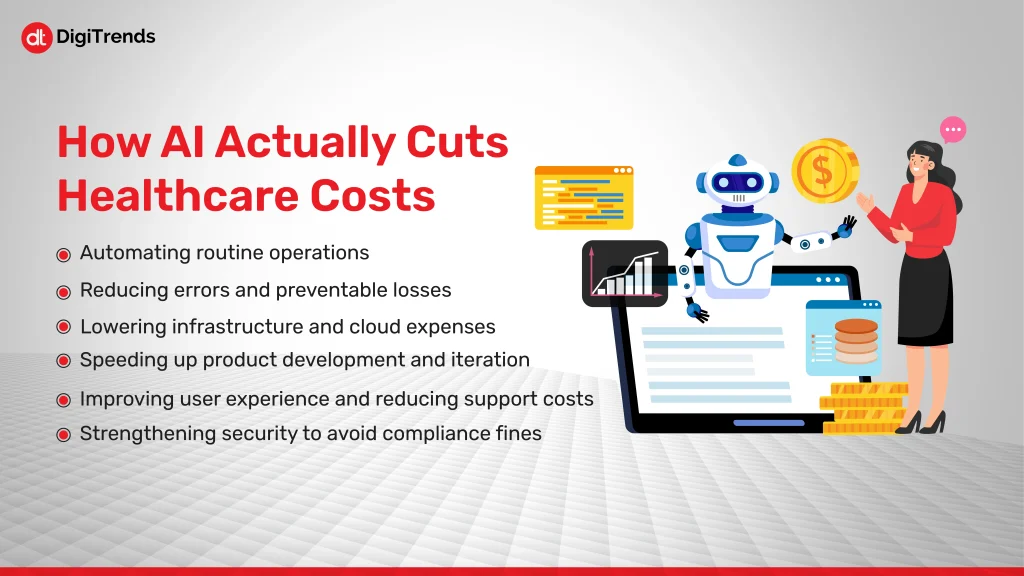
AI reducing healthcare costs might sound like magic, but it is not.
It is a complete combination of different tools that are gathered together to target only the areas where improvement is needed, such as operations, diagnostics, patient management, and infrastructure. Let’s take a look at how AI can help cut costs in all of these areas:
The healthcare industry involves many tasks that are repetitive, such as scheduling appointments and processing insurance claims. When these tasks are done manually, the chances of mistakes and fatigue are also higher, but AI systems can handle these tasks without fatigue or mistakes. When the system helps in automating routine operations, it not only helps in giving the staff time for other important work but also helps in reducing labor costs that healthcare departments might otherwise waste in hiring more staff for manual work.
There is no doubt in the fact human errors are possible in all processes, right?
The healthcare sector also faces multiple minor mistakes that can be anything, such as wrong billing, but these minor mistakes can cost healthcare organizations millions every year.
So, how can AI help in that?
AI is transforming this totally by introducing algorithms that can easily identify trends in patient information, detect any deviations, and offer viable assistance to teams whenever it comes to making decisions with confidence. This helps healthcare organizations in reducing minor mistakes that can cost a lot later, improving the quality of patient care, and preventing organizations from huge financial losses that can occur from wrong diagnoses or unnecessary treatments.
The most interesting things about AI-powered platforms are that they can be easily scaled. What this really means is that hospitals and startups will only pay for the computing power they will need and use. The cloud-based AI tools can adjust in real-time according to the needs of the organization, which helps in keeping the costs of the infrastructure in control without any compromise on performance.
Healthcare organizations are no longer just providing patient care; they are also building software, devices, and digital tools. All this requires a lot of time and cost for research and iteration, which are the most important steps of product development. Organizations can use AI tools to analyze user feedback, simulate their product features, and predict outcomes faster than any traditional methods can. This way, healthcare organizations can speed up the process of R&D, reduce the costs wasted in development, and also launch their product in less time.
Increasing volume of patient and staff inquiries is also a major issue surrounding the healthcare sector. AI chatbots and virtual assistants can easily handle this volume of queries; they will anticipate common problems, provide instant guidance to the users, this way hospitals won’t need too many people in their support teams. This means no need to keep hiring more staff for customer support, and also provides your customers with a better experience.
Data breaches and fines from the government are costly. AI keeps an eye out for anything unusual, spots any suspicious activity, and makes sure that healthcare standards are being followed. Stopping just one big breach can save millions of dollars in fines and costs to fix the problem.
Till now, we have only talked about theories. Now, let’s have a look at AI reducing healthcare costs in reality. These seven startups are proving that AI healthcare cost savings aren’t just projections; they’re measurable and significant.
Stage: Series A
Location: Stockholm, Sweden
Founded: 2018
Founders: Hjalmar Nilsonne, Daniel Ek
Funding: $65M
Website: nekohealth.com
Neko Health is a healthcare platform that uses AI and advanced sensors to offer non-intrusive full-body scans, which help in capturing millions of health data points per patient. The captured data is high-resolution, which allows early detection of issues and reduces unnecessary testing. AI also helps in cutting their administrative burden by automating compliance and reporting. Neko’s Body Scan service employs over 70 sensors to capture a wide array of health data, analyzing more than 50 million data points from each individual.
Impact: This is the perfect example of AI reducing healthcare costs by streamlining diagnostics and compliance.
Stage: Series A
Location: California, United States
Founded: 2018
Founders: Doktor Gurson, Jeff Chang
Funding: $33M
Website: radai.com
RadAI’s mission is to help physicians save their time by reducing burnout and improving patient care. These tools help reduce dictation times by up to 50% and words dictated by up to 90%. AI enables faster and more accurate diagnoses, which means there are fewer unnecessary procedures, and hospital stays are also shorter.
Impact: RadAI’s technology contributes to over $10 million in annual savings, combining lower treatment costs and preventive interventions.
Stage: Series C
Location: California, United States
Founded: 2018
Founder: Daphne Koller
Funding: $743M
Website: insitro.com
Insitro is a healthcare company focused on drug discovery, combining genetic, clinical, and phenotypic data to model diseases. AI helps them accelerate their research by reviewing, analyzing the large amounts of data faster than traditional methods can.
Impact: By automating repetitive analysis, Insitro saves labor, resources, and development expenses, which enables teams to focus on high-value innovation in drug development.
Stage: Unknown
Location: Pennsylvania, United States
Founded: 2014
Founders: David Robins, Landy Toth, Rob Schwartz, Robert Van Tassel
Funding: $3.2M
Website: lifelenstech.com
LifeLens uses AI for diagnostic testing, improving the accuracy and automating the processes. This way, the need for repeated tests is decreased, and the result is a significant cost cut.
Impact: The use of AI at Lifelens helps in reducing the diagnostic costs by 30%, which further helps in converting that into $5 million annual savings while making tests more accessible.
Stage: Private Equity
Location: Dallas, United States
Founded: 2008
Founder: Jason Wersland
Funding: $165M
Website: therabody.com
TheraMind uses AI to customize therapy for the patients, looking at their medical history, genetics, environment, and real-time patient responses. More effective, shorter treatments mean lower cumulative healthcare costs.
Impact: AI-driven personalized therapy reduces prolonged treatment expenses, yielding $6 million in yearly savings.
Stage: Seed
Location: HaMerkaz, Israel
Founded: 2016
Founders: Dr. Guy Steuer, Eugene Dicker, Gennadi Schechtmann, Prof. Arieh Ingber
Funding: $5.3M
Website: dermadetect.com
DermDetect applies AI-powered image scanning to detect subtle skin irregularities that human eyes might miss. Early detection prevents unnecessary treatments and misdiagnoses.
Impact: AI-enabled diagnostics save the healthcare sector approximately $4 million annually.
Stage: Unknown
Location: United States
Focus: Cardiac health
Founded:
Website: heartbeatai.com
HeartBeat AI predicts cardiac events early, enabling timely interventions that prevent costly hospitalizations and emergency care.
Impact: Annual savings reach around $10 million, illustrating how AI in predictive care can relieve financial pressure on health systems.
These startups are proof of the potential that the concept of AI reducing healthcare costs holds. No matter what it is, from diagnostics to therapy to prevention, AI is proving it can both improve patient outcomes and deliver measurable financial results at the same time.

Let’s have a look at the bigger picture of AI reducing healthcare costs.
It might sound like only healthcare AI startups are benefiting from the tools and technology, but the larger picture tells that it is also playing a major role in transforming the economics of healthcare.
The idea behind it is very simple: when factors like early detection, smart diagnostics, automated operations, and personalized therapy are combined, it creates a chain reaction, more like a ripple effect.
When there are fewer hospital readmissions, fewer unnecessary procedures being done, faster interventions, and the administrative overhead is also reduced, the organizations end up saving millions annually, which in one way or the other leads to a better economics of healthcare.
What this really signals is simple: healthcare doesn’t have to be a slow, expensive, error-prone system anymore. AI in healthcare comes with efficiency and accuracy that completely changes this idea of the industry.
Healthcare cost reduction with AI today isn’t just about cutting expenses; it’s about building a foundation for a smarter, more sustainable healthcare system where patients, providers, and payers all benefit.
AI has the potential to reduce healthcare costs, but turning that potential into real savings requires expertise, strategy, and the right technology. That’s where DigiTrends comes in.
With many years of experience in healthcare technology, DigiTrends helps organizations identify areas where AI can deliver maximum impact. From streamlining workflows to personalized patient care, we help healthcare providers and startups in implementing solutions that are both practical and scalable.
What this really means is that your organization doesn’t have to figure it all out alone. With the right approach, AI can:
Partnering with DigiTrends ensures that AI reducing healthcare costs is not just theoretical; it becomes measurable results that improve both operations and patient outcomes.

AI reducing healthcare costs is no longer a vision of the future; it’s happening right now. The examples of Neko Health, RadAI, Insitro, LifeLens, TheraMind, DermDetect, and HeartBeat AI show that intelligent automation, predictive analytics, and AI-driven decision-making translate directly into real dollars saved.
Healthcare systems that embrace AI don’t just reduce expenses; they improve patient care, streamline operations, and position themselves for sustainable growth. The numbers aren’t abstract; they’re proof that smarter processes and predictive insights create measurable impact.
If there’s one thing to take away, it’s this: AI in healthcare isn’t optional anymore. It’s a strategic advantage, and the earlier organizations adopt it, the faster they realize both financial and operational gains.
Have a look at the top 11 healthcare app developers in the USA in 2026 and what makes them stand out.
Continue Reading
Explore how customer experience automation is used to fulfill modern customer demands, how AI helps in transforming CX strategy, key CX automation tools, real-world examples, and more.
Continue Reading

Explore what smart home automation really is, how AI upgrades it, and the key use cases shaping modern homes today.
Continue Reading
Explore how voice recognition technology is being used across healthcare and the role of voice assistants in clinical environments.
Continue Reading

Explore more about multimodal AI applications in different industry sectors, their benefits, real-world applications and more.
Continue Reading
Explore healthcare software development costs in the Middle East and how businesses can plan smarter in 2026 without compromising quality.
Continue Reading